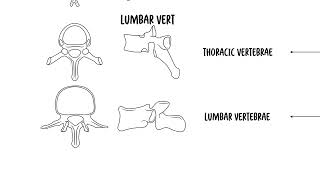
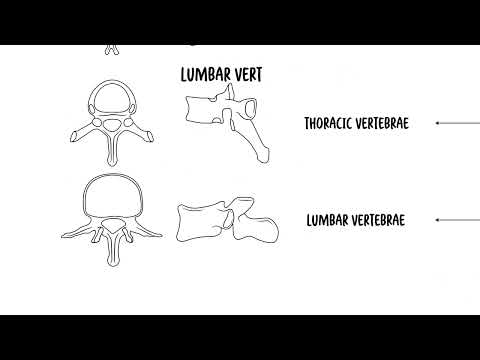
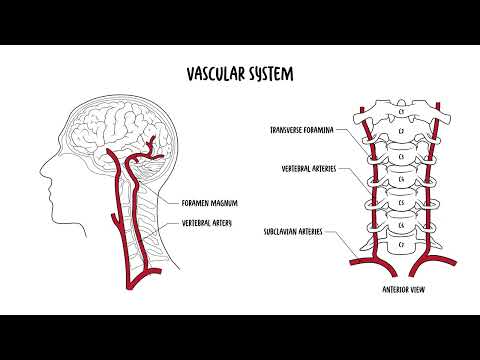
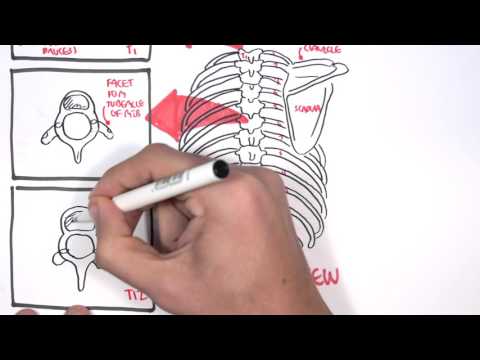
0:00 The vertebral column, also known as the spine or backbone, is made up of 0:15 individual vertebrae. 0:17 It consists of 33 individual vertebrae in total, categorized into 5 region. 0:23 Another vehicle, which is made up of 7 vertebrae, located in the neck, thoracic 0:28 , 12, associated 0:30 with the ribcage, the lumbar, which is 5 vertebrae, found in the lower back, 0:34 sacral 5-fuse vertebrae, 0:35 forming the sacrum, and the coccigial 4-fuse vertebrae, forming the coccyx or 0:40 tailbone. 0:41 Each vertebrae is uniquely adapted to its position and function within the 0:46 column. 0:47 And they all share a common structural design. 0:52 But no two vertebrae are identical. 0:55 The following basic structures of a vertebrae include a vertebral body, which 1:00 is the anterior 1:01 portion of the vertebrae, the vertebral arch, the structure located posterior 1:07 to the body. 1:09 It consists of two peduncles and two laminae. 1:13 Essentially they facilitate the passage of spinal nerves from the spinal cord. 1:20 So here you can also find what's called the vertebral foramen, the large 1:24 central opening 1:25 formed by the vertebral body and arch. 1:29 You have the vertebral canal. 1:31 It's the space throughout the spinal column that is enclosed by the vertebral 1:36 foramen. 1:36 It protects the spinal cord and associated structures. 1:41 Then you have the vertebral processes. 1:43 The vertebral arch gives rise to several of these processes, including the spin 1:47 ous process, 1:49 which is a projection posteriorly. 1:53 It provides attachment for muscles and ligaments. 1:56 You have the transverse process, the two lateral projections extending from the 2:01 junction 2:02 of the pedicles and laminae. 2:04 It serves, again, for muscle attachment and articulation with the ribs in the 2:08 thoracic 2:08 region. 2:09 And then you have the articular processes, which are paired superior and 2:13 inferior projections 2:14 that form the facet joints which facilitate and limit movement between adjacent 2:25 vertebrae. 2:27 So let's talk about the regional variations in the vertebrae. 2:31 Although the vertebrae share common structural features, which we just talked 2:35 about, their 2:35 anatomy varies to accommodate different functions across the regions of the 2:40 vertebral column. 2:42 Let's take a look at the key differences between the five regions of the verte 2:46 bral column beginning 2:48 with the cervical vertebrae. 2:53 So the cervical vertebrae, there are seven of these in the human body. 2:58 They have three main distinguishing features. 3:02 First of all, they have a bifid spinous process. 3:08 In most of them, except the last, the C7 typically, presence of transverse for 3:15 amina, which transmits 3:17 the vertebral arteries. 3:19 They have small bodies typically and a large triangular vertebral foramina. 3:29 For movement, the cervical spine has greatest range of motion, allowing for 3:34 flexion, bending 3:35 the head forward extension, bending the head backwards, lateral flexion and 3:45 rotation. 3:47 There are some specialized vertebrae within the cervical vertebrae. 3:50 These are your atlas and axis. 3:53 So C1 is your atlas. 3:55 It lacks a body and spinous process. 3:58 It supports the skull and allows nodding motion. 4:02 The C2 is the axis. 4:04 It features the dens, a dontonoid process, enabling rotational movement of the 4:11 head. 4:11 It sort of inserts into the atlas, as shown. 4:22 Next is the thoracic region. 4:26 You have 12 thoracic vertebrae. 4:29 These are medium sized and increase in size from superior to inferior. 4:33 They specialize function is to articulate with ribs, producing the bony thorax. 4:38 So some unique features of the thoracic vertebrae. 4:42 First of all, you get larger bodies compared to the cervical. 4:45 You get these things called "costal facets" on the transverse processes and 4:49 vertebral 4:50 bodies for articulation with the ribs. 4:52 The "costal facets" in the vertebral bodies are also known as the demi facets. 4:56 The ribs only articulate with thoracic vertebrae and not the cervical or lumbar 5:03 vertebrae. 5:04 The thoracic vertebrae are typically long, downward sloping spinous processes. 5:14 For movement, the thoracic spine has less flexibility compared to the cervical 5:18 and lumbar 5:18 regions. 5:20 Those are primarily limited to rotation, turning the torso, and there's some 5:25 lateral flexion. 5:34 Then you have the lumbar vertebrae. 5:37 These are five of the largest vertebrae in the body. 5:43 They are structurally specialized to support the weight of the torso. 5:48 Bending features, again, they're the largest and heaviest bodies to bear the 5:52 weight of 5:52 the upper body. 5:53 They're typically short, thick pedicles and laminate. 5:56 They have a robust spinous process and oriented, typically, horizontally. 6:06 For movement, the lumbar spine has significant flexibility, interestingly, and 6:11 is crucial 6:12 for bending and lifting movements, such as flexion, bending forward, extension, 6:17 bending 6:18 backwards, lateral flexion, bending to the side. 6:27 Then you have the sacral vertebrae. 6:30 There are five sacral vertebrae that are fused to form the sacrum. 6:36 The sacrum is a triangular bone that articulates with the eyeliac bones of the 6:41 pelvis to form 6:42 the sacral egg joints. 6:44 As the sacrum is fused, it does not allow independent movement like the other 6:49 regions. 6:50 It typically provides strength and stability to the pelvis. 6:54 The sacrophiramen, the holes, these are where the nerves and the blood vessels 6:59 pass through. 7:01 Then you have the coccygal vertebrae that forms a coccyx or tailbone through 7:06 fusion. 7:07 It acts as a point of attachment for ligaments and pelvic floor muscles. 7:18 We can't talk about the vertebrae without talking about the intravatiable discs 7:22 . 7:22 The intravatiable discs are fibrocartilaginous structures. 7:26 They're cartilage, situated between adjacent vertebral bodies. 7:30 They provide shock absorption, distributing loads during movement and weight- 7:35 bearing flexibility, 7:37 allowing the vertebral carbon to bend and twist. 7:41 Each disc contains two main parts, the annulus fibrosis and nucleus poposis. 7:46 The annulus fibrosis is the tough outer layer of concentric fibrous rings and 7:51 the nucleus 7:51 poposis is the soft gel-like core that absorbs compressive forces. 8:04 Then you have the ligaments of the vertebra. 8:06 There are several ligaments that stabilize the vertebral column and limit 8:10 excessive movement. 8:11 You have the anterior longitudinal ligament that runs along the anterior 8:16 surface of the 8:17 vertebral bodies, preventing hyper-extension. 8:21 You have the posterior longitudinal ligament located within the vertebral canal 8:26 along the 8:27 posterior surface of the vertebral bodies, resisting hyper-flection. 8:31 You have the ligamentum flavon, which connects the laminar of adjacent vertebra 8:36 e providing 8:37 elasticity. 8:38 You have the interspinus and supraspinus ligaments, which connects the spinus 8:44 processes aiding 8:45 instability, and then you have the intratransis ligaments, which connects 8:49 adjacent transverse 8:50 processes. 8:51 There are a lot of ligaments for support in the vertebral column. 9:02 Let's talk about some clinical anatomy. 9:04 Despite itself can develop abnormal morphology. 9:09 There are several clinical syndromes resulting from an abnormal curvature of 9:13 the spine. 9:14 There is something called kyphosis, excessive thoracic curvature causing a h 9:19 unchback deformity. 9:21 You have lordosis, excessive lumba curvature causing a swayback deformity, scol 9:28 iosis, lateral 9:30 curvature of the spine, usually of unknown cause. 9:35 Then you have cervical spondylosis. 9:38 To be fair you can have spondylosis anywhere, not only in the cervical vertebra 9:42 , thoracic 9:43 or lumba. 9:44 But in the cervical spondylosis there is decreasing the size of the interval 9:49 foramenar, usually 9:50 due to degeneration of the joints of the spine. 9:53 The smallest size of the interval foramenar puts pressure on the exiting nerves 9:56 causing 9:57 pain. 9:58 So a lot of people get a lot of neck pain, which is very common. 10:06 So in summary there are 33 individual vertebrae in total that are divided into 10:11 5 regions, 10:12 cervical, thoracic, lumba, sacral and coccyx. 10:15 They all share similar structures as in they all have a body, most of them have 10:21 a spinous 10:22 process as well as a vertebral foramen. 10:26 But each region shares a unique characteristic and unique anatomy. 10:32 Thank you for watching. 10:36 [BLANK_AUDIO]