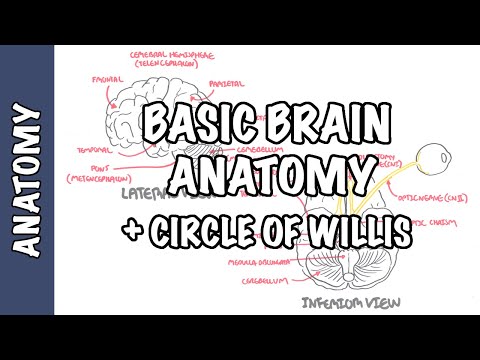
0:00 Today, we will be discussing the cerebral cortex of the brain, which refers to 0:10 the outer layer 0:12 of gray matter that covers the two cerebral hemispheres. 0:16 The cerebral cortex contains nerve cell bodies, and is approximately 2 to 4 0:21 millimeters thick. 0:23 This layer has many folds, the elevation called gyri, and the grooves are 0:30 called sulci. 0:31 The cerebral cortex is distinct from the cerebrum, the forebrain. 0:36 The cerebrum describes the two cerebral hemispheres, the right and the left. 0:42 The cerebral cortex, the outer part, has a wide range of functions, such as 0:48 perception 0:49 and awareness of sensory information, and planning and initiation of motor 0:55 activity. 0:55 It also has a role in decision making, motivation, learning, memory, attention, 1:02 problem solving, 1:03 and conceptual thinking. 1:08 The cerebral cortex is organized into six lobes, the frontal lobe, the parietal 1:13 lobe, the 1:14 temporal lobe, the occipital lobe, the insular lobe, and the limbic lobe. 1:20 Let us talk about each of these lobes separately, and look at some clinical 1:28 anatomy. 1:30 As the name suggests, the frontal lobe lies underneath the frontal bone, and is 1:35 the most 1:35 anterior region of the cerebrum. 1:38 It is the largest lobe of the cortex and contains the prefrontal cortex, pre-m 1:45 otor cortex, primary 1:46 motor cortex, and brokers area. 1:50 This lobe is responsible for controlling voluntary movement, and its associated 1:57 areas are involved 1:58 in personality, mood, higher intellectual function, social conduct, and 2:05 language. 2:06 Injury to the frontal lobe. 2:09 When there is damage to the frontal lobe, it can be due to trauma, stroke, 2:15 infection, 2:15 brain tumours, dementia, and other degenerative brain diseases. 2:21 Injury to this lobe has many presentations, common clinical signs and symptoms 2:26 are changes 2:27 in personality and behavior, and an inability to problem solve. 2:32 Injury to the motor cortex presents with contralateral weakness. 2:36 These personality changes were beautifully documented in a case that affected 2:40 Phoenix 2:41 Cage, an American railroad construction foreman. 2:45 Gauge suffered a severe brain injury from an iron rod penetrating his skull 2:50 through 2:50 his frontal lobe, of which he miraculously survived. 2:55 After the accident, Gauge's personality completely changed. 3:00 There once he was a competent, forearmed, and reasonable person, he lost his 3:05 inhibitions 3:06 and became impulsive, inappropriate, violent, indulging, and displayed poor 3:14 problem solving. 3:16 The frontal lobe is located underneath the frontal bone, between the frontal 3:20 lobe anteriorly 3:21 and the occipital lobe posteriorly. 3:24 The frontal lobe is important in integrating sensory stimuli. 3:28 The cortical association areas regulate control of language, calculation, and 3:33 visual spatial 3:34 functions. 3:36 Some clinical anatomy. 3:39 Injury to the frontal lobe often occurs due to trauma, such as a macar accident 3:43 or fall, 3:43 but it can also occur from a stroke. 3:46 Injury often presents with attention deficits, such as contralateral hemisp 3:51 atial neglect syndrome, 3:54 where the patient does not pay attention to one side of their body, contral 3:59 ateral to 3:59 the side of injury. 4:01 So here, a right-sided parietal lobe injury results in left-sided neglect, left 4:09 -side being 4:10 contralateral to the right-sided injury. 4:14 Damage along the optic tract within the parietal lobe results in contralateral 4:19 homonymous hemionopia. 4:23 Here, injury to the right-priotal lobe causes left-homonymous hemionopia. 4:29 You lose the left-visual field. 4:34 Gurdsman syndrome can occur when there is also injury to the left-priotal lobe 4:39 in the 4:39 dominant hemisphere. 4:41 This presentation includes right-to-left confusion, agraphia, which is 4:47 difficulty with writing, 4:49 a calculus, which is difficulty with mathematics, aphasia, disorders of 4:56 language, and agnausea, 4:57 inability to perceive objects normally. 5:03 The temporal lobe lies underneath the temporal bone, inferior to the frontal 5:07 and prior to 5:08 lobes. 5:09 This lobe contains the primary auditory cortex and Wernicchi's area. 5:14 The cortical association areas of the temporal lobe are responsible for 5:18 retention of visual 5:20 memory and language comprehension. 5:26 Injury to the temporal lobe. 5:27 The most common cause of temporal lobe injury is cerebrovascular events, such 5:33 as a stroke. 5:34 A patient who has injury to the temporal lobe presents with agnosias, which are 5:41 recognition 5:42 deficits. 5:45 Agnosia comes from the Greek word agnosia, meaning ignorance. 5:49 Examples include auditory agnosia, where the patient is unable to recognize 5:54 basic sounds, 5:55 and prosopagnosia, which is a failure to recognize faces. 6:00 Injury to Wernicchi's area presents with receptive aphasia. 6:04 Aphasia comes from the Greek A, meaning not, or absent, andphasia meaning to 6:09 speak, so 6:10 basically translates to unable to speak properly. 6:14 People with Wernicchi's aphasia are able to speak fluently normally, but their 6:21 speech 6:22 lacks meaning. 6:24 This is because their language comprehension is impaired. 6:28 They don't understand the information they're receiving, hence the term 6:34 receptive aphasia. 6:36 Whereas injury to Broca's area, which is in the frontal lobe, this causes 6:42 expressive 6:42 aphasia. 6:44 Patients here are able to comprehend and process what is being said to them, 6:49 but they're unable 6:50 to express themselves properly, and so it presents with halting and effortful 6:56 speech. 6:56 They look very frustrated because they're unable to say what they want. 7:04 The occipital lobe is located below the occipital bone. 7:08 It is the most posterior part of the cerebrum. 7:11 The occipital lobe contains the primary visual cortex, meaning that its 7:16 cortical association 7:17 area is responsible for vision. 7:24 Injury to the occipital lobe, so common causes of injury to this lobe are 7:28 trauma, neoplastic 7:29 lesions, infections, and stroke. 7:32 As the occipital lobe contains the primary visual cortex, injury presents with 7:38 visual 7:38 defects, such as contralateral homonymous heminopia, sparing the macula 7:46 specifically. 7:47 Quadrantinopia can also occur, which is the loss of vision in one of the 7:54 quarters of the 7:56 visual field. 7:57 Here is someone with right-sided occipital injury resulting in left quadrantin 8:05 opia, and 8:06 then again, injury here results in left homonymous heminopia, sparing the mac 8:13 ula. 8:14 Visual field of someone with right homonymous heminopia with the macula being 8:21 impaired occurs 8:22 in injury to the left prior to lobe. 8:30 The insular lobe is found deep to the lateral sulcus. 8:34 This lobe plays a role in the receiving, processing, and integration of many 8:38 types of 8:39 information, such as language, visual, vestibular, integration, taste, and pain 8:46 sensation. 8:47 Injury to the insular lobe can result in difficulties with sensory perception, 8:50 such as touch, taste, 8:52 sound, smell, perception of pain, language, and emotion, in particular the 8:58 emotions of 8:58 disgust and anger. 9:01 Interestingly, chronic pain can alter the function and anatomical structure of 9:05 the insular lobe, 9:06 resulting in thinking disruption and changes in emotional state. 9:15 The last lobe is the limbic lobe, it's located on the medial part of each 9:19 hemisphere and 9:20 surrounds the corpus cholosum. 9:22 It is a component of the large limbic system, meaning it is involved with 9:26 emotional and 9:26 behavioral expression. 9:28 In particular, the limbic lobe contains areas concerned with the modulation of 9:33 emotions, 9:34 visceral and autonomic functions, learning and memory. 9:38 Injury to the limbic lobe can result in epilepsy, dementia, changes in mood, 9:43 personality, or 9:44 impulse control, psychiatric disorders, and disorders of the endocrine system. 9:49 Injury can also lead to aphasia. 9:54 So in summary, in this video we talked about the cerebral cortex, the outer 9:58 layer of gray 9:59 matter that covers the two cerebral hemispheres. 10:02 As well as discussing the anatomy, we talked about the lobes of the cerebral 10:06 cortex, the 10:07 frontal, the parietal, the temporal, the occipital, the insular, and the limbic 10:12 lobes. 10:13 We also discussed the function of each of these lobes and how injury to these 10:18 lobes would 10:19 present clinically. 10:21 Thank you for watching.