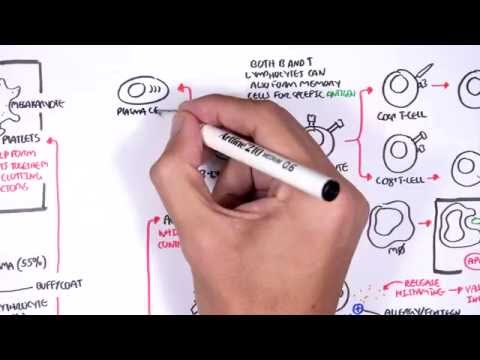
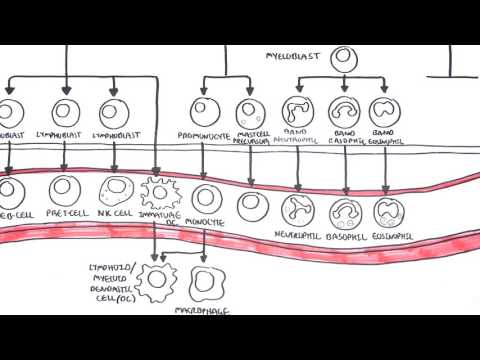
0:00 Hemophagocytic lympho-histeocytosis, heme refers to the blood, the red blood 0:14 cells. 0:15 Phagocytic refers to engulfing or eating. 0:18 So literally hemophagocytic means eating of red blood cells. 0:24 Hemophagocytic lymph refers to the lymphoid cells, the B and T cells, and histi 0:25 ocytosis 0:30 refers to accumulation and infiltration of cells such as the monocytes, macroph 0:35 ages and 0:36 dendritic cells. 0:38 So lympho-histiocytosis actually means more of an accumulation, activation of T 0:44 cells, 0:45 and the macrophages and the monocytes, which actually end up eating red blood 0:51 cells. 0:53 Hemophagocytic lympho-histeocytosis is a syndrome of excessive inflammation and 1:00 tissue destruction 1:01 due to abnormal immune activation. 1:04 The abnormal immune activation leads to a hyper-inflammatory immune state. 1:10 Now there are a number of key players in the pathophysiology, the macrophages, 1:14 the phagocytes, 1:16 and then you have the cytotoxic T lymphocytes, which are your lymphoid cells, 1:21 as well as your natural killer cells. 1:25 Macrophages are professional antigen-presenting cells derived from circulating 1:30 monocytes. 1:32 Macrophages are phagocytes. 1:34 They engulf, process, and normally present foreign antigens to the lymphocytes 1:41 to initiate 1:42 a specific immune response towards that antigen. 1:47 Cytotoxic T lymphocytes become activated and proliferate. 1:52 The purpose of the cytotoxic T lymphocytes and natural killer cells are to 1:57 recognize 1:58 these foreign antigens and essentially eliminate it. 2:02 Natural killer cells and cytotoxic T lymphocytes are very different, 2:07 but for the purpose of this video their actions are similar. 2:11 So these guys roam around areas of inflammation and scout for these foreign ant 2:18 igens, 2:19 which may be expressed on infected cells. 2:22 When they find them they kill the infected cells by forming a perforan channel 2:27 and releasing grandzymes or proteases into the cell. 2:32 The infected cells will die after receiving the proteases released by the cytot 2:37 oxic 2:38 T lymphocytes and natural killer cells. 2:41 During this process cytokines are released by the cytotoxic T lymphocytes 2:47 and the natural killer cells because it's mounting an immune response. 2:51 It's promoting the inflammatory response to essentially ask other cells to help 2:56 out, 2:57 to contain and fix the issue. 3:01 Macrophages get attracted to these sites of inflammation and become activated 3:07 by the pro-inflammatory cytokines causing them to release more cytokines to 3:12 help out 3:13 and to recruit more inflammatory cells. 3:19 Oftentimes macrophages can be overactive and release too many cytokines, 3:23 even after the culprit or the problem has been resolved. 3:29 In this scenario cells such as the natural killer cells and cytotoxic T lymph 3:33 ocytes 3:34 will actually eliminate the stressed macrophage 3:37 again via the perforan channel and the grandzymes. 3:42 This is a normal example of what should happen. 3:46 The immune system is under control and regulated. 3:52 In hemophagocytic lymphohistocytosis we have a hyperactive immune state. 4:00 There is loss of control. 4:02 The hyperinflammatory dysregulated immune state is thought to be caused by the 4:07 absence 4:07 of normal down regulation of the macrophages and the lymphocytes. 4:12 Hemophagocytic lymphohistocytosis can be classified as primary or secondary. 4:19 Primary hemophagocytic lymphohistocytosis is hereditary and caused by defects 4:25 in perforan 4:27 or grandzymes be mediated toxicity. 4:31 In this diagram for primary hemophagocytic lymphohistocytosis 4:37 you have defect and you have impaired perforan and grandzymes mediated cytot 4:43 oxicity. 4:45 These cells will still release a lot of cytokines because they need help 4:50 which will activate more macrophages and also increase cytokine production 4:58 by the macrophages. 5:00 Also note that when macrophages are hyperactive the cytotoxic T cells 5:07 and natural killer cells are unable to control these hyperactive macrophages 5:12 because of defects in perforan and grandzymes be. 5:18 Secondary causes of hemophagocytic lymphohistocytosis include infections 5:24 particularly Epstein-Barr virus, malignancies as well as autoimmune diseases. 5:31 In Epstein-Barr virus infections these guys normally reside in B cells 5:37 and can hide within them staying dormant. 5:42 Now cytotoxic T lymphocytes will screen and destroy infective cells 5:48 such as the B cells if they can identify the foreign Epstein-Barr virus. 5:53 With Epstein-Barr virus infection some people have impaired cytotoxic pathways 5:59 against the Epstein-Barr virus and are unable to control the Epstein-Barr virus 6:05 infection. 6:06 Thus again resulting in cytokine release by the cytotoxic T lymphocytes 6:11 resulting in severe infectious mononucleosis 6:14 which will can eventually lead to hemophagocytic lymphohistocytosis. 6:20 I think the key principle to know about the different causes of hemophagocytic 6:25 lymphohistocytosis 6:27 is that you have activation of cytotoxic T lymphocytes 6:32 as well as hyperactive macrophages. 6:35 Uncontrolled activated macrophages can lead to something called macrophage 6:41 activation syndrome. 6:43 But forget about that syndrome for now. 6:48 In hemophagocytic lymphohistocytosis macrophages become activated 6:55 and secrete excessive amount of cytokines ultimately causing severe tissue 7:00 damage 7:01 that can lead to organ failure. 7:04 Natural kilocells and/or cytotoxic T lymphocytes fail to eliminate the 7:09 activated macrophages 7:11 either because of defects in peripheral information on the macrophage 7:17 or release and function of the protease's grandzyme B. 7:22 Unregulated and uncontrolled macrophages will secrete many different cytokines 7:27 activating one another resulting in agrocell, which can start eating up 7:32 anything really around it. 7:34 Macrophages can even eat red blood cells when overactivated, hence hemophagocyt 7:40 osis. 7:42 But also the macrophages can begin eating platelets resulting in thrombocytopen 7:46 ia 7:47 and leukocytes, the white blood cells causing leukopenia, low white cell count. 7:54 Overactivation of the macrophages as well as the cytotoxic T lymphocytes 7:59 can lead to release of so many cytokines resulting in a cytokine storm. 8:05 Cytokines produced include interferon gamma, which is an important one to 8:10 remember in this condition, 8:11 as well as TNF alpha, interleukin-6, interleukin-10, interleukin-12, 8:18 all of which will subsequently cause multi-organ failure. 8:24 Clinical features of hemophagocytic lymphohistocytosis, as you can expect, 8:31 include fever, splenomegaly, 8:35 ranged bloods, including anemia, thrombocytopenia, leukopenia, or leukocytosis, 8:42 so either low or elevated white cell count, organ failure can involve the liver 8:49 , 8:49 causing liver hepatitis. 8:51 And when you get liver hepatitis, you get elevated triglycerides, hyper 8:55 triglyceridemia. 8:57 You can have quagulopathy, as well as hypofibrenogenemia, 9:02 which is low-fibrenogen levels in the blood. 9:06 In this disease, you get elevated ferritin, and this is from the activated mac 9:11 rophages. 9:13 Multi-organ failure in this condition include respiratory failure, as well as 9:18 renal failure. 9:20 Investigations for anyone suspected of hemophagocytic lymphohistocytosis 9:28 include blood tests of full blood count, coagulation profile, 9:32 including d-dimer and fibrenogen, liver function tests, serum triglyceride, 9:39 serum ferritin, 9:40 which will both be high. 9:42 There is a soluble interleukin II receptor A alpha. 9:47 Important to identify the possible causes, as well as the complications 9:51 associated with the lymphohistocytosis. 9:55 So, essentially, as infection can be the cause, you culture everything. 10:00 The blood, bone marrow, the urine, as well as order viral PCR. 10:07 A bone marrow aspect can reveal features of hemophagocytosis. 10:14 CT chest abdopelvis can look for malignancies, as well as potential infection, 10:20 which, again, is a cause of this condition. 10:23 Lumbar puncture, as well as MRI, can also find potential cause, as well as 10:27 complications. 10:29 Molecular testing, including immunologic profile and genetic testing, 10:34 can look for hereditary causes of hemophagocytic lymphohistocytosis. 10:41 Treatment involves urgent referral to a hematologist and oromcologist, 10:47 immunosuppression using steroids, because, remember, it's a hyperactive immune 10:51 state, 10:52 cytokine release, and so using steroids can dampen the immune response. 10:58 Transfuse if you have low red blood cells, due to hemophagocytosis, or low 11:04 platelets. 11:06 Correct quagulopathy associated with this condition. 11:09 You have low fibrinogen, so you can use fresh frozen plasma, thawed platelets, 11:15 as well as cryoprecipitate. 11:19 Identify the cause and treat the underlying cause. 11:23 An allogenic hemopoietic stem cell transplantation is the final treatment 11:29 option. 11:30 Prognosis is quite important. 11:32 Untreated people only have months to live, and usually because it is very 11:36 difficult to diagnose, 11:38 or they're undiagnosed. 11:41 Of those treated, 50% of people survive. 11:46 Thanks for watching. I hope you enjoyed this video on hemophagocytic lymphohist 11:51 ocytosis. 11:51 In summary, it is a condition where you have hyperactivation of the immune 11:56 response, 11:57 involving macrophages, as well as cytotoxic T lymphocytes. 12:01 This will result in a cytokine storm, which will cause multi-organ failure, 12:05 but also, the activated macrophage can start engulfing other things in your 12:09 body, 12:10 such as your red blood cells, hence hemophagocytosis. 12:16 [BLANK_AUDIO]