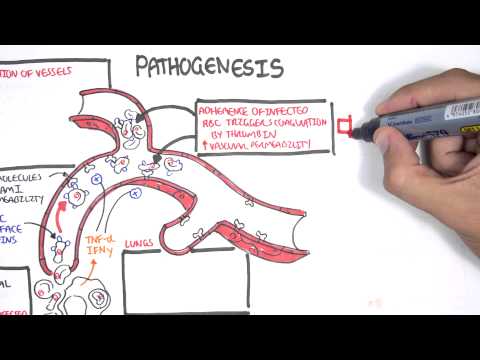
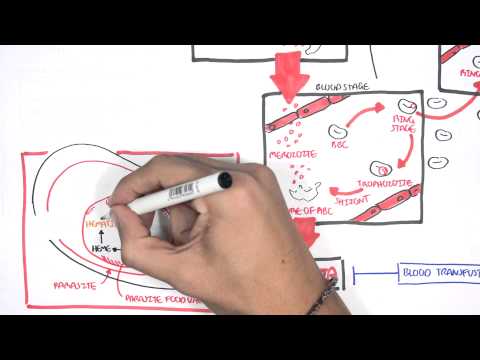
0:00 In this video, we will talk about malaria. 0:16 When we think of malaria, we think of mosquito, but malaria is not caused by a 0:20 mosquito, rather 0:21 malaria is caused by a parasite that the mosquito carries. 0:27 Malaria is caused by the protozoan genus Plasmodium. 0:30 So the mosquito in this case is specifically called anopheles, and they carry 0:38 the parasite 0:39 plasmodium. 0:42 Malaria is a problem, especially in developing and tropical countries. 0:46 There are 300-500 cases of malaria each year, and 2-3 million deaths annually, 0:56 and this 0:56 occurs mainly in children. 0:59 So Plasmodium is a parasitic genus that causes malaria. 1:04 There are actually few types of plasmodiums that infect man. 1:08 These are the Plasmodium vivax, Plasmodium falciparum, Plasmodium malaria, and 1:14 Plasmodium 1:15 overlay. 1:16 Now, as the name suggests, you would probably think Plasmodium malaria is the 1:20 main agent, 1:21 like causative agent. 1:22 But it's actually not, Plasmodium vivax, and Plasmodium falciparum are the main 1:27 agents 1:27 of malaria. 1:30 Let's have a look at how the Plasmodium infects humans, and what happens, by 1:38 looking at its 1:39 life cycle from the time it enters a human body. 1:43 So here I'm doing a child, and he comes from a tropical area, because this is 1:50 where malaria 1:51 is epidemic. 1:52 And as well, I'm enjoying a liver here, because liver has a main role in the 1:58 malarial infection. 2:00 Now here I am enjoying a female and not Feliz mosquito, which is carrying the 2:05 Plasmodium 2:06 parasite. 2:07 It's a female, because female mosquitoes are the one that bites and sucks blood 2:13 from humans 2:14 and infects humans. 2:16 So first what happens during the life cycle is that a mosquito injects a spor 2:23 ozoite when 2:24 it bites the human. 2:26 A sporozoite is just a technical term for an immature form of Plasmodium 2:31 parasite. 2:31 I'll be using some other terms, but whatever I use, they refer to the parasite 2:38 itself. 2:39 So the sporozoite gets injected into the bloodstream. 2:43 The sporozoite travels to the liver via the blood and will take up residence in 2:49 the hepatocytes, 2:51 which are the liver cells. 2:53 So here the sporozoite will take up residence in the hepatocyte. 2:57 The sporozoite will begin multiplying asexually to form many merozoites. 3:06 If there are many merozoites, this is collectively known as a schizant. 3:12 All these merozoites are then released by the hepatocytes back into the 3:18 bloodstream 3:19 by rupturing the hepatocyte itself. 3:22 So let's just recap what happened. 3:24 In the liver, the sporozoites will multiply asexually and become heaps of mero 3:30 zoites. 3:31 The liver cells will then burst, releasing these merozoites into the 3:35 bloodstream. 3:36 And this occurs about 7-10 days later. 3:41 So here in the blood, we have this merozoite. 3:44 Now in the blood, all these merozoites will begin invading erythrocytes, the 3:49 red blood 3:50 cells, and multiply again within the red blood cells to form many more merozo 3:56 ites until 3:57 the red blood cells bursts, releasing them into the bloodstream. 4:01 So here the merozoite will invade this particular red blood cell. 4:07 The merozoite within the red blood cell will form into a ring-like structure 4:11 and then a 4:11 trophozoite. 4:14 And from this trophozoite stage, it will multiply asexually to form many, many 4:19 more 4:20 merozoites. 4:22 With many, many more merozoites, the red blood cell will just burst, releasing 4:26 all these 4:26 merozoites again back into the bloodstream. 4:30 So what will happen with all these merozoites? 4:33 Well, the cycle will just repeat itself. 4:37 The merozoites will invade more red blood cells, they will multiply, and they 4:41 will burst out. 4:43 Each time this happens, this will cause chills, fever, and sweating. 4:48 The chills, fever, and sweating are typical symptoms of malaria. 4:54 So with each time these red blood cell bursts, releasing more merozoites, the 5:00 person will 5:01 keep having chills, fever, and sweating. 5:04 And this cycle just continues and this may eventually lead to death because of 5:07 depletion 5:08 of red blood cells, for example, and high temperature. 5:14 So these merozoites will keep invading red blood cells and multiply. 5:19 Now after several asexual cycles, the merozoites can infect or in blood cell, 5:25 and instead of 5:26 replicating or multiplying, they can develop into sexual forms of the plasmod 5:32 ium parasite. 5:34 Which are the plasmodium gametosites. 5:38 Now there has to be two types, a female and a male gametosite. 5:43 So here we have a merozoite invading a red blood cell, and forms gametosites, a 5:50 female 5:50 and a male gametosites, both still in the red blood cell. 5:58 So what do these gametosites do? 6:00 Well, they can't really do much in the human body, they require a nophilus 6:05 mosquito in 6:05 order to become a sporozoite, an infected form of the plasmodium species again. 6:12 So therefore, if another uninfected nophilus mosquito comes along, a female, 6:18 and bites 6:19 this particular infected human being, it will suck up these gametosites, the 6:25 male and the 6:25 female. 6:30 So writing this up, the mosquito will bite this infected human, it will digest 6:33 the male 6:34 and female gametosites, which will allow the gametosites to develop into mature 6:39 sex cells 6:40 called gametes. 6:42 So here this nophilus mosquito will suck up this male and female gametosite, 6:47 and then 6:47 let's just zoom into this back of this nophilus mosquito to see what happens 6:53 with these gametosites 6:54 now gametes. 6:56 The gametes will fuse together to form a zygote, which will form an oocyte 7:02 where we have sporozoites 7:04 begin to develop. 7:07 These sporozoites will multiply and then will cause the oocyte to rupture, 7:11 releasing 7:12 the sporozoites. 7:13 The sporozoites will move into the salivary glands of the mosquito, ready to be 7:18 injected 7:19 into another human being or anything else. 7:24 So the male and female, so again the male and female gametes enter the spor 7:29 ogenic cycle, 7:30 producing more pathogenic sporozoites. 7:34 The mosquito in this case of female can then bite another human and infect it, 7:38 causing malaria. 7:44 And this cycle will continue. 7:46 The infected nophilus mosquito can then inject the parasite sporozoite into 7:51 another human 7:52 being, causing malaria. 7:54 So how would you treat malaria? 7:56 Well, you treat it with a group of drugs known as quinines. 8:00 The complications that can arise with malaria include spleenomegli, enlasmid sp 8:05 leen, hepatomagli, 8:06 enlasmid of the liver, pulmonary edema, renal failure, jaundice, as well as 8:12 high fema. 8:13 Thank you for watching, thank you.