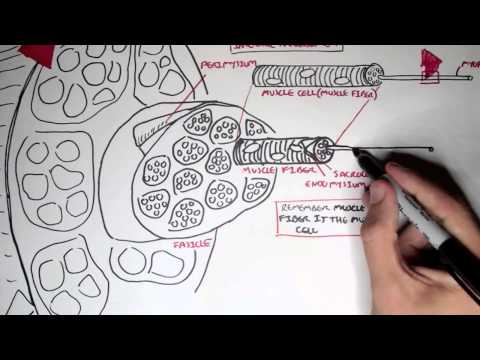
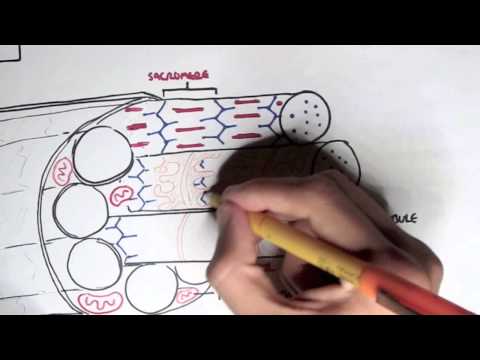
0:00 Adamanda considering on biology and medicine videos, please make sure to 0:04 subscribe, join 0:05 the four main group for the latest videos, please visit Facebook, Adamanda, and 0:09 here 0:09 you can also like, please ask questions, answer some questions, and post some 0:13 interesting 0:13 things including artworks. 0:14 You can be fairly appreciated, and you can also change the quality settings to 0:18 the highest 0:18 one for better graphics. 0:19 In this video, we're going to look at an introduction to the musculosystem. 0:23 Our musculosystem, obviously, is our muscles, and muscles are important in 0:30 keeping the 0:31 homostatic conditions of our body. 0:34 It's particularly important for us when we breathe, and also for movement, such 0:41 as lifting weights, 0:42 for example, or lifting anything, and it's also important because it gives us 0:47 heat and 0:47 provides us with balance and also stabilizing our joints. 0:51 Now, there are three types of muscles. 0:54 There is the skeletal muscle, cardiac muscle, and smooth muscle. 0:59 We'll begin with looking at skeletal muscle just briefly, and a skeletal muscle 1:03 is essentially 1:04 the muscle which we require when we move and when we lift things up. 1:09 A skeletal muscle differs to the other type of muscles because they usually 1:12 connect to 1:13 the ends of bones, such as the thigh bone, for example, and they're voluntary 1:16 and also 1:17 striated. 1:18 They're voluntary because when we move our arms, we are voluntarily moving them 1:23 . 1:23 For example, skeletal muscles are the muscles, such as our bicep muscles, our 1:27 pictorialist 1:28 major, and our quadri steps, for example. 1:32 If we zoom into this particular skeletal muscle, a skeletal muscle cell is cyl 1:36 indrical shape. 1:38 As I mentioned, they're also striated. 1:40 Another important feature of a skeletal muscle is that it is multi-nucleated, 1:44 which means 1:44 that it consists of multiple nucleuses, and this is what differs skeletal 1:49 muscle to, 1:50 for example, cardiac muscle and the other one, the smooth muscle. 1:54 The second type of muscle I would like to look at is the cardiac muscle, and 1:57 the cardiac 1:57 muscle essentially implies the heart because cardiac implies heart, and so we 2:02 're looking 2:03 at the heart muscles, such as this area here. 2:06 Cardiac muscles are amazing because they keep contracting until the day we die 2:10 to pump blood 2:10 around our body. 2:12 Cardiac muscles are involuntary, meaning that we have no conscious over it, and 2:16 so that 2:16 is what we have no conscious over our beating heart. 2:20 Cardiac muscles are also actually striated, like skeletal muscles, so if we 2:24 zoom into the 2:24 cardiac muscles in this heart, for example, we can see a few cardiac muscle 2:29 cells here. 2:30 Cardiac muscle cells are either uninucleated or bineucleated, in that they have 2:35 one or 2:35 two nucleuses per cell, and each muscle cell are separated by what's called 2:40 interclated 2:41 discs, which help combine each cardiac muscle cell, as well as assisting in 2:46 transmitting 2:46 nerve impulses throughout the heart during contraction. 2:52 The last type of muscle we're going to look at is the smooth muscles, and 2:55 smooth muscles 2:55 are found in the stomach and in the intestines, essentially the 2:59 gastrointestinal tract or 3:00 GIT, and they usually wrap around each of these organs to assist in the 3:04 movement of food 3:06 down the gastrointestinal tract from our mouth to our anus, essentially, and 3:13 this movement 3:14 of food down this gastrointestinal snake is known as peristalsis, and this is 3:18 assisted 3:18 by the smooth muscle cells, and so as expected, smooth muscle cells are 3:21 involuntary in that 3:22 we have no conscious control over it, and what differs smooth muscle cells to 3:26 cardiac 3:27 and skeletal muscle is that they are unstrated, they contain no striations 3:31 whatsoever, and 3:32 so if we zoom into this part of the stomach duodenum part of the small intest 3:37 ines, we 3:38 can look at the smooth muscles, and you can see that they're unstrated, they 3:43 contain 3:43 no striations, and each cell is also unineuclated, in that it contains only one 3:50 nucleus, 3:50 and so for example, this group of smooth muscle cells, they are in a relaxed 3:55 position, and 3:56 when they contract, what essentially happens is that they squeeze together, and 4:00 when they 4:00 squeeze together, this is what allows the movement of food down our 4:03 gastrointestinal tract, and 4:06 so that was a brief overview about three types of muscles and the muscular 4:10 system, please 4:11 click on the skeletal muscle link or the smooth muscle link to learn more about 4:16 these muscles, 4:16 the cardiac muscle link will not be available because we will learn about the 4:20 cardiac muscle 4:20 in the cardiovascular system because the cardiac muscle has an important role 4:23 in pumping blood 4:24 all throughout our body, hope you enjoyed this video, please like, comment and 4:28 subscribe 4:28 and Joel.