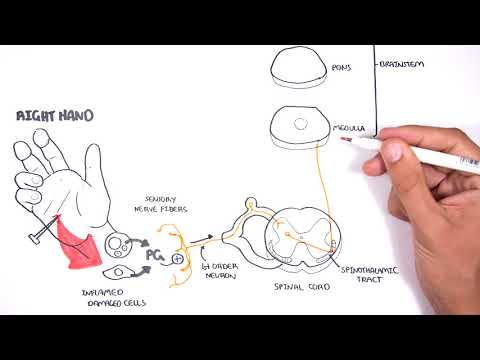
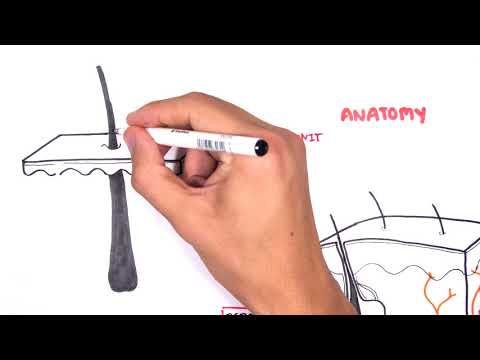
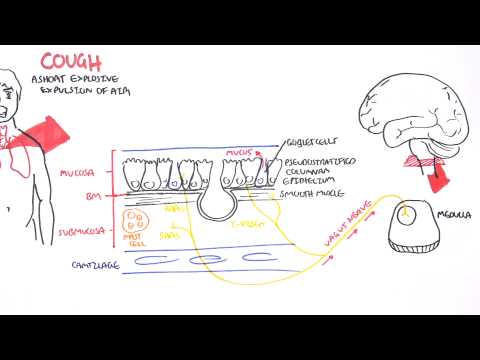
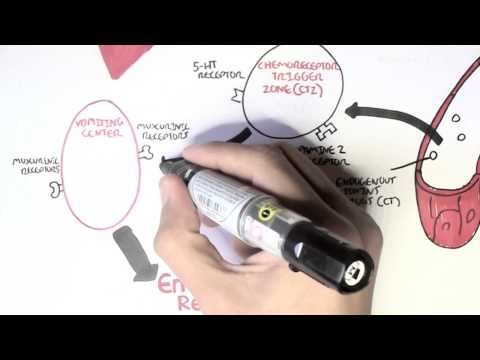
0:00 Armando has said, in biology and medicine videos, please make sure to subscribe 0:03 to the 0:03 former group. 0:04 For the latest videos, please leave a comment on Instagram, please like, and 0:06 you can also 0:07 ask questions, answer questions, and post some interesting things, including 0:09 your hours. 0:09 You can also change the quality settings to the highest one for better graphics 0:13 . 0:13 In this video, we're going to talk about pain. 0:16 Now pain is pretty important for us, in that it's a sort of defense mechanism, 0:20 telling 0:21 our body something is wrong. 0:23 But pain can persist, and this is when it might cause some problems. 0:29 So how do we feel pain, such as a joint injury from a sport, or a punch in the 0:34 face? 0:34 Well, there are special nerve cell endings that initiate the sensation of pain 0:39 all around 0:40 our body. 0:42 These nerve cells are known as no ciceptos. 0:46 Right now, here, I am drawing the central nervous system, the brain, the spinal 0:50 cord, 0:51 and the brainstem, because these are important in pain registration as well, 0:57 and feeling pain. 1:01 To understand more about how we feel pain, we must first review the spinal cord 1:06 as well, 1:07 and its general anatomy. 1:10 Because the spinal cord is like a relay station where the information about 1:15 pain, temperature, 1:16 and pressure from the periphery, meaning the skin, the joint, and the muscles, 1:21 can travel 1:21 up to the brain. 1:24 So here is a structure of the spinal cord. 1:34 The barriers of the spinal cord, as well as the brain, from the inside, is the 1:39 PMatter, 1:40 Arachnoid, and Duramatter. 1:44 All these are collectively known as the meninges. 1:49 Now if you have a cross section of the spinal cord, like on the top here, there 1:54 is usually 1:55 a butterfly shaped grey matter, with the white matter around it. 2:01 The white matter contains the axons of the nerve cells, while the grey matter 2:06 contains 2:07 the cell bodies of the nerve cells itself. 2:11 Now the funny thing is, the brain actually has the white matter in the center, 2:15 and then 2:15 the grey matter around, so it's the opposite to the spinal cord. 2:22 And then in the center here, this round thing, we have this central canal, 2:25 which actually 2:26 contains cerebrospinal fluid, which is important fluid for nourishing the 2:31 central nervous system, 2:32 that is the spinal cord and the brain. 2:36 So these red tracks I'm drawing right now are nerve fibers. 2:39 These tracks are coming out from the front of the spinal cord, the front. 2:46 When they are in the front, they are called motor fibers, meaning that these 2:53 fibers carry 2:54 information out of the spinal cord, not into the spinal cord. 2:59 So information is leaving out as indicated by this black arrow here. 3:06 Then we have fibers connecting at the dorsal aspect of the spinal cord, the 3:14 back. 3:15 And these are the sensory fibers. 3:18 These fibers transmit information into the spinal cord, so towards the spinal 3:25 cord, which 3:26 then can go to the brain. 3:29 The main thing to take out of this diagram is the sensory fibers and how it 3:34 brings in information 3:36 to the back of the spinal cord, the dorsal side of the spinal cord, and then 3:40 this information 3:41 can then travel up towards the brain from the spinal cord. 3:46 Now that we know about these sensory fibers, a bit about it, let's see how pain 3:51 , how we 3:52 sense pain, how sensation of pain begins. 3:58 Let's just say a big nail has penetrated the skin in the trunk area of this 4:03 human here. 4:04 What would happen from here? 4:06 Well, underneath our skins, in the periphery, which also includes the joints 4:11 and the muscles, 4:12 we have these cells known as noceceptors. 4:16 These are the pain-sensing nerve cells. 4:19 When anxious stimuli occurs, such as the big nail penetrating our body, there 4:24 will be chemicals 4:25 released by immune cells and all of these other factors, which essentially 4:28 stimulate 4:28 these noceceptors. 4:31 When the noceceptors are stimulated, they'll propagate this information about 4:36 this pain 4:37 to the spinal cord nearby. 4:40 So let's just take a cross-section of the spinal cord here. 4:43 The noceceptors will bring this pain information into the spinal cord from the 4:48 dorsal horn, which 4:49 is the back of the spinal cord, because remember, the sensory fibers are at the 4:54 dorsal side of 4:55 the spinal cord as we learned just before. 4:58 They bring information from the back to the back of the spinal cord. 5:03 The noceceptors will then release chemicals here, pain neurotransmitters, such 5:09 as substance 5:10 P. Then a second neuron called the second-order neuron will receive this 5:17 information and then 5:18 go and then cross over inside the spinal cord, so to the opposite side of the 5:24 spinal cord, 5:25 and then bring this information towards the brain. 5:31 Now before continuing on with this second-order neuron, we must understand that 5:35 there are actually 5:36 two types of noceceptors. 5:39 The first is the alpha-delta fibers. 5:42 These are very small, myelinated nerve cells that produce fast, well-localized 5:48 sharp pain. 5:49 Then you have the C fibers, which are smaller and are unmyelinated and produce 5:55 slow, poorly 5:56 localized pain. 5:58 The C fibers are the fibers that produce the burning type, throbbing pain that 6:03 some people 6:04 have experienced. 6:07 The noceceptors can also be referred to as the afferent nerve fibers because it 6:13 is bringing 6:13 information into the spinal cord to the second-order neuron. 6:19 Anyways, if that makes sense, continuing on. 6:23 So the second-order neuron will bring this pain information through the spinal 6:28 cord towards 6:28 the brain. 6:29 It will travel to the brain via the spinal thalamic tract or pathway. 6:37 The name thalamic implies the thalamus, which is an area of the brain, so this 6:42 tract will 6:43 go towards the thalamus in the brain, basically. 6:47 But why is it called the spinal thalamic tract? 6:50 Well, because the spinal cord, they have areas that bring the nerves straight 6:57 to the thalamus. 6:59 These areas are collectively known as the spinal thalamic tract here. 7:06 So the second-order neuron will bring this pain information through a via the 7:11 spinal 7:12 thalamic tract in the spinal cord to the thalamus of the brain. 7:19 Looking at it at a big picture, the second-order neuron is traveling up the 7:23 spinal cord towards 7:24 the thalamus of the brain via the spinal thalamic tract. 7:29 Here I am drawing a cross-section of the brain. 7:33 This red area is the thalamus. 7:36 The thalamus is also known as the relay station as well. 7:40 If you know your brain, there are areas in the cortex of the brain, the outer 7:44 part of 7:45 the brain that are associated with sensation. 7:49 So touch, feeling of touch. 7:53 This area is called the somatosensory cortex. 7:57 Now along the somatosensory cortex are specific areas related to specific parts 8:04 of the body. 8:05 So for example, here I am drawing a simple diagram of body parts that correlate 8:11 with that 8:12 area of the somatosensory cortex. 8:16 So here are the somatosensory cortex where areas where we feel the trunk, our 8:22 body, the 8:23 trunk, our head, hand, thumb, and face. 8:28 The body parts, as you can see, look quite disproportion. 8:33 As you can see, the face sensation area covers a massive part of the somatosens 8:39 ory cortex 8:40 compared to the hand, for example. 8:43 So you can say that our face is more sensitive. 8:46 We can feel more sensations in our face than in our hands. 8:51 So if we make an actual human figure out of this, we would call it a homunculus 8:57 . 8:58 Thus, this whole diagram I am drawing can therefore be called a homunculus of 9:04 primary 9:04 somatosensory cortex. 9:08 Now to make things even more difficult, this is the left side of the brain and 9:12 here is 9:13 the right. 9:15 We would of course also have a somatosensory cortex on the right side of the 9:19 brain because 9:19 it is symmetrical. 9:21 So here we have again the trunk, the hands, blah, blah, blah. 9:26 Now you might ask yourself why are we talking about the homunculus, the primary 9:30 somatosensory 9:31 cortex, this diagram? 9:33 Well, it is because the location of where the pain has occurred correlates to 9:41 the area 9:42 of the somatosensory cortex, one of these areas. 9:47 So what happens is this second order neuron which is on the left side of the 9:54 brain will 9:55 pass on the pain information to another neuron by releasing neurotransmitters. 10:00 The second order neuron will pass it on to a third order neuron in the thalamus 10:06 . 10:06 And this is where the location and discrimination of pain then occurs. 10:11 In this case, the third order neuron is locating the pain to be within the 10:16 trunk area which 10:17 is true because if you remember the nail penetrating the trunk area of the body 10:25 . 10:26 As shown by the picture here, the location and discrimination of pain is on the 10:30 left 10:30 side of the brain. 10:32 The question I ask is why is it not on the right side of the brain? 10:36 Well, it is because if we look back to where the nociceptor and the second 10:41 order neuron 10:42 is synapsed, the second order neuron which was on the right side crossed over 10:49 to the left 10:50 side and then ascended to the left side of the brain. 10:59 So we can say that pain on the right side of the body is processed on the left 11:02 side of 11:03 the brain and vice versa. 11:06 If pain is coming from the left side of the body, it will be processed on the 11:10 right side 11:10 of the brain. 11:12 Finally, everything that we just saw from when the nocice stimulates the nocice 11:20 ptors 11:21 to where the location and discrimination of pain occurred in the brain, this is 11:26 all called 11:26 the ascending pathway because it is going up. 11:31 Now, there is also a descending pathway. 11:36 There are other nerves that actually regulate and modulate the ascending 11:41 pathway of pain 11:42 here. 11:44 These are the inhibitory descending pathway which goes down and this is 11:48 directly linked 11:49 to the gate theory of pain area which is located in the spinal cord. 11:54 But we won't talk about that in this video. 11:57 This video was just an overview of how we feel pain. 12:01 It's important to know that there are regulatory neurons and stuff that 12:06 regulate the pain pathway 12:08 up to the brain. 12:09 Hopefully, the next video will go more into depth of pain and look at the 12:13 modulation regulation 12:14 of other stuff which is interesting.