
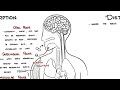
0:00 This video is a follow on from pharmacokinetics overview, going into a bit more 0:10 detail into 0:11 pharmacokinetics. 0:12 This is going to be a two-part video. 0:15 In this part, we're going to talk about how drugs enter and move around the 0:21 body. 0:22 So pharmacokinetics describes what the body does to a drug. 0:26 When a medication is given, it does not immediately and magically act at its 0:31 target. 0:31 It must enter. 0:33 The body reached the bloodstream, traveled to the tissues, sometimes enter 0:37 specific organs, 0:39 and then eventually be changed and removed. 0:42 In simple terms, pharmacokinetics is the study of the journey of a drug through 0:47 the body. 0:47 The four major stages are commonly remembered as ADME, absorption, how the drug 0:54 enters 0:55 the bloodstream distribution, how the drug moves around the body, metabolism, 1:00 how the 1:01 body chemically modifies the drug and excretion, how the drug leaves the body. 1:07 So we're going to talk about absorption and distribution. 1:16 Absorption is the movement of a drug from its side of administration into the 1:22 bloodstream. 1:23 For example, when the patient swallows a tablet, the drug must dissolve in the 1:28 gastrointestinal 1:29 tract, pass across the gut wall, and then into the blood. 1:35 This process takes time, which is why oral medication usually do not act 1:40 immediately. 1:41 The importance of absorption is that it determines how much drug reaches the 1:47 circulation and 1:48 how quickly it gets there. 1:50 Some routes of administration include oral, so these are your tablets, capsules 1:55 , and liquids, 1:57 intravenous directly into the bloodstream, sublingual under the tongue, subcut 2:02 aneous 2:03 into the fat tissue, intramuscular into muscle, and transdermal through the 2:08 skin. 2:09 The oral route is the most common because it's convenient, it's cheap and safe 2:14 relatively. 2:15 Examples include paracetamol tablets, ibuprofen, metformin, and many 2:20 antibiotics. 2:20 However, oral drugs have disadvantages, they may be absorbed slowly, they are 2:25 affected 2:25 by food, destroyed by stomach acids, or metabolized by the liver before 2:31 reaching the systemic 2:32 circulation. 2:34 The intravenous route bypasses absorption because the drug is placed directly 2:39 into the 2:40 blood. 2:41 This gives rapid onset and 100% bioavailability, which I'll talk about in a 2:47 second. 2:47 It is useful in emergencies such as IV antibiotics and sepsis, IV morphine for 2:53 severe pain. 2:54 The disadvantage is that IV drugs require venous access and can cause rapid 2:59 toxicity 2:59 if wrong doses are given. 3:02 The sublingual route is useful when rapid absorption is needed and when first- 3:07 pass metabolism 3:09 should be avoided. 3:10 The classic example is glycerol trinitrate for angina. 3:15 Stacing it under the tongue allows it to enter the bloodstream quickly. 3:20 The first concept of absorption, aside from the route of administration, is the 3:26 term bioavailability. 3:30 Bioavailability is the proportion of an administered drug dose that reaches 3:35 systemic circulation 3:36 unchanged. 3:38 Intravenous drugs, for example, they have 100% bioavailability because the full 3:43 dose enters 3:44 the blood directly. 3:47 Oral drugs usually have lower bioavailability because some of the drugs may be 3:52 lost before 3:53 it reaches a systemic circulation and there are reasons for reduced oral bio 3:58 availability. 3:59 These include poor absorption from the gut of the drug, breakdown of the drug 4:05 by the 4:06 stomach acid. 4:08 The drug might be metabolized by gut wall enzymes or metabolized by the liver 4:13 before reaching 4:15 systemic circulation. 4:17 For bioavailability, think about this example. 4:21 If a patient takes 100 milligram tablet of a drug and only 50 milligram reaches 4:28 the bloodstream 4:29 unchanged, the bioavailability is there for 50%. 4:35 This concept is important clinically because a drug may require different doses 4:40 depending 4:41 on the route and oral dose may need to be higher than an IV dose because not 4:46 all of 4:46 it reaches the circulation. 4:50 The next concept of absorption is first-past metabolism. 4:55 First-past metabolism occurs when an oral drug is absorbed from the 5:00 gastrointestinal 5:02 tract and travels through the portal vein to the liver before reaching the 5:08 systemic circulation. 5:10 The liver may metabolize part of the drug during this first-past, reducing the 5:17 amount 5:18 of active drug that reaches the rest of the body. 5:22 The sequence is, you swallow a drug, the drug is absorbed from the intestine, 5:28 the drug enters 5:29 the portal circulation and then has to travel to the liver. 5:35 The liver metabolizes some of the drug and so the remaining drug then enters 5:39 the systemic 5:40 circulation. 5:42 This is clinically important because some drugs are extensively metabolized by 5:48 the liver 5:49 and therefore have poor oral effectiveness. 5:52 A classic example is glyceral trinitrate. 5:57 If swallowed much of it is metabolized before it can even act, the liver will 6:03 metabolize 6:04 it. 6:05 So for acute angina, so chest pain it is therefore often given sublingually 6:11 allowing rapid absorption 6:13 directly into the bloodstream. 6:17 Finally, the final concept of absorption, you've got to think about factors 6:21 that actually 6:22 affect the absorption of a drug. 6:25 Evolution is not the same in every patient or every situation. 6:28 Several factors can change how quickly and how completely a drug is absorbed. 6:33 So drug formulation is important. 6:35 A liquid formulation may be absorbed faster than a tablet. 6:39 Modified release tablets are designed to release the drug slowly over time 6:43 while immediate 6:45 release tablets are designed to act more quickly. 6:48 Food can also affect absorption. 6:51 Some drugs are better tolerated with food because food reduces stomach 6:56 irritation. 6:56 Other drugs are less well absorbed with food and should be taken on an empty 7:01 stomach. 7:02 Gastric emptying also matters. 7:04 If the stomach empties slowly, the drug may take longer to reach the small 7:09 intestine where 7:11 most absorption occurs. 7:13 Opioids, severe illness and some gastrointestinal disorders can slow gastric 7:19 emptying. 7:20 Important factors affecting absorption include the root of administration, the 7:27 drug formulation, 7:29 the food intake, gastric emptying as we've all discussed, the gut pH, vomiting 7:34 diarrhea 7:35 obviously will affect absorption, certain gastrointestinal disease especially 7:40 the ones 7:41 affecting the gut of the intestine will obviously affect absorption, drug 7:46 interaction within 7:46 the gut. 7:48 For example, a patient with severe vomiting may not absorb oral medications 7:53 reliably. 7:53 In this case, an IV root may be more appropriate. 8:03 The second big part of pharmacokinetics is distribution. 8:09 Distribution is the movement of a drug from the bloodstream into body tissues. 8:15 So once the drug enters the blood, once it's absorbed enters the blood, it may 8:21 stay in 8:21 the plasma, move into organs and to fat, cross into the brain or just pass into 8:27 breast milk 8:28 or the placenta. 8:30 Distribution determines where the drug goes after it enters the blood. 8:34 Drugs may distribute into the brain, the heart, the liver, kidneys, muscle, fat 8:44 , bone, placenta 8:45 breast milk anywhere. 8:48 Distribution depends on blood flow, it depends on lipid solubility, protein 8:54 binding and the 8:55 ability of the drug to cross biological barriers. 9:00 Organs with high blood flow receive drugs quickly. 9:04 And these include the brain, heart, liver and kidneys. 9:10 And this explains why IV anesthetic drugs act rapidly on the brain. 9:16 Tissues with lower blood flows such as the fat and bone receive drugs more 9:22 slowly. 9:23 The first concept of distribution is lipid solubility and the blood brain 9:29 barrier. 9:30 So lipid soluble drugs cross cell membranes more easily than water soluble 9:37 drugs. 9:38 And this is important because cell membranes are made largely of lipids. 9:44 So lipid soluble drugs can enter the cell much easier. 9:49 Lipid soluble drugs are more likely to enter the brain, fat tissue, placenta 9:55 breast milk. 9:56 The blood brain barrier, another important area is essentially a barrier that 10:02 protects 10:03 the brain from many substances in the blood. 10:07 To enter the central nervous system, the brain, a drug often needs to be lipid 10:14 soluble or have 10:15 a specific transport mechanism. 10:17 For example, many sedatives and anesthetic drugs are lipid soluble, allowing 10:22 them to 10:22 enter the brain and produce central nervous system effects such as making you 10:27 sleep or 10:28 feel drowsy. 10:30 Another concept of distribution is protein binding. 10:33 Many drugs bind to plasma proteins, especially albumin. 10:36 When a drug is bound to protein, it usually cannot leave the bloodstream. 10:42 Bind to receptors or be metabolized or be excreted easily. 10:46 The free unbound drug is usually the pharmacologically active part. 10:52 This means that protein binding can affect drug activity. 10:56 There are two forms of drug in the blood. 10:58 There is the bound drug, which is when it's attached to a plasma protein. 11:04 This means a drug is usually inactive. 11:08 A free drug is the unbound version. 11:11 It is active. 11:12 It is able to move into tissues and produce effects. 11:16 Warfarin is a classic example of a highly bound protein drug. 11:21 If another medication displaces warfarin from albumin, the free amount of war 11:26 farin may 11:26 increase and this can cause increased risk of bleeding. 11:32 So a really important teaching point is that a free drug concentration usually 11:38 matters 11:39 most clinically because this tells you what's active. 11:42 Finally, the last part or concept of distribution is volume of distribution. 11:51 This thing called volume of distribution, or VD, is a theoretical value that 11:55 describes 11:56 how widely a drug distributes into tissues compared with plasma. 12:01 It is not a real anatomical volume. 12:04 Instead, it helps us understand whether a drug mostly stays in the blood or 12:09 moves widely 12:09 into tissues. 12:12 A drug with low volume of distribution mainly stays in the bloodstream. 12:17 This may occur if the drug is large, water soluble or highly protein bound 12:23 because remember 12:25 if they're protein bound, they stay in the blood, they don't really move. 12:29 Liver soluble, they probably cannot move into cells easily because they're not 12:33 lipid soluble. 12:34 So low volume of distribution mainly stays in the blood. 12:39 A drug with high volume of distribution leaves the bloodstream and distributes 12:44 extensively 12:44 into tissues. 12:45 This is more likely if a drug is lipid soluble or binds strongly to tissue. 12:52 A simple comparison, a low volume of distribution, drug mainly stays in blood, 12:59 high volume of 13:00 distribution drug moves widely into tissues. 13:03 For example, heparin has a low volume of distribution because it largely 13:08 remains within the vascular 13:09 compartment. 13:10 Dejoxone has a high volume of distribution because it distributes widely into 13:16 tissues. 13:17 So that is part one of pharmacokinetics. 13:21 In part two, we will talk about metabolism and excretion of a drug.