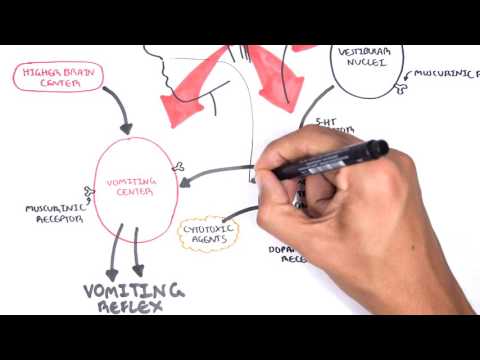
0:00 In this video we're going to talk about the physiology of vomiting. 0:16 Vomiting refers to forceful expulsion of contents from stomach and intestines. 0:23 It can act as a sort of defense mechanism to get rid of bad content or 0:28 substances from the body such as drinking excess amount of alcohol can cause us 0:33 to vomit. 0:35 Vomiting is also related to many other things such as motion sickness, morning 0:39 sickness, taking certain medications, suffering certain medical conditions as 0:43 well as receiving chemotherapy. 0:46 Emesis is another word that means to vomit and so, emesis is sort of a medical 0:53 terminology for vomiting. 0:56 But how do we vomit? Like what physiological mechanism causes us to vomit? 1:01 Well, all the centers or areas related to initiating the act of vomiting comes 1:08 from the central nervous system, particularly the brain step, the area I am z 1:14 ooming into here. 1:15 There is a center or area known as the vomiting center here that initiates, 1:24 regulates and controls the act of vomiting. 1:28 The vomiting center is located in a reticular formation of the medulla oblong 1:32 ata. 1:33 The vomiting center have predominantly muscarinic type receptors. 1:38 And so, activation of these receptors will activate the vomiting center to send 1:43 signals to the muscles that carry out the physical act of vomiting. 1:47 The emetic reflux, that is. 1:51 Note, emetic comes from emesis and emesis is a medical term to mean vomiting, 1:57 so essentially it means vomiting reflux. 2:00 So, the vomiting center is what essentially sends out the signals to cause us 2:04 to vomit from the brain. 2:06 Now, there are several ways that the vomiting center itself can be stimulated. 2:15 One of the main ways is by the chemoreceptor trigger zone, which is located in 2:21 the medulla here. 2:24 The chemoreceptor trigger zone have two main types of receptors. 2:31 It has the dopamine type 2 receptor and the 5-hydroxytryptamine type 3 receptor 2:40 . 2:40 Though the chemoreceptor trigger zone is located in the medulla, like the 2:45 vomiting center, 2:46 it is actually located conveniently outside the blood brain barrier, which is a 2:50 normal barrier to prevent circulating substances in the blood from making 2:54 contact with the brain and areas of the brain stem. 2:58 And so, the chemoreceptor trigger zone lies outside the blood brain barrier and 3:03 is thus more permeable to circulating substances, 3:08 such as toxins from chemotherapy that are circulating around or toxins from 3:13 drugs, digitalis. 3:16 So, these toxins that are circulating around can conveniently activate the 3:23 receptors of the chemoreceptor trigger zone. 3:28 Activation of the chemoreceptor trigger zone will then stimulate the vomiting 3:32 center, which will then activate the emetic reflux, the physical act of 3:38 vomiting. 3:40 So, essentially, the chemoreceptor trigger zone is what is what's stimulated 3:45 from by toxins, circulating toxins, and this will cause us to vomit. 3:51 Afferent impulses that activate the vomiting center to cause emesis also can be 3:57 due to activity of the vestibular nucleus, 4:00 which mediate nausea and vomiting of motion sickness. 4:05 So, motion sickness related vomiting. How does motion sickness cause us to 4:10 vomit? Let's have a look. 4:12 Well, here we have the human ear, the outer ear, middle ear, and inner ear. 4:16 In the inner ear, we have what's called the labyrinth, where the cockly is, 4:20 where we have hair cells, which allow us to hear. 4:23 Now, motion sickness will activate and abnormally activate the vestibular coch 4:30 lear nerve, which connects the labyrinth to the vestibular nuclei here in the 4:38 brainstem. 4:40 Let's zoom into the vestibular nuclei. Now, the vestibular nuclei have muscular 4:45 ache receptors as well, and also histamine type 1 receptors. 4:49 And it is activation of these receptors by the vestibular cochlear nerve, from 4:55 the inner ear, will cause the vestibular nuclei to stimulate the chemoreceptor 5:00 trigger zone, 5:01 which will then stimulate the vomiting center, and thus the emetic reflux, the 5:07 act of vomiting. 5:09 Other impulses that can activate the vomiting center, or stimulate the vomiting 5:13 center, are afferent impulses coming from the higher centers of the brain, so 5:18 from around here. 5:20 They mediate the emetic response due to pain, foul smell, or putrid sight, and 5:26 even memory, for example. 5:28 So you know how some people see blood, or some people eat some types of food, 5:34 and because of the foul smell and taste, they would feel like vomiting? 5:39 Well, it's because of these higher centers that can actually stimulate the 5:48 vomiting center to activate the emetic reflux. 5:55 Finally, of course, here I am drawing the stomach, and part of the intestines, 6:02 where nerves from here, as well as other parts of the gastrointestinal tract, 6:08 including the esophagus, called the vagal sensory nerve fibers, can activate 6:13 the vomiting center, as well as the chemoreceptor trigger zone, to cause the em 6:19 etic reflux. 6:20 And this may be due to certain food that are consumed that may aggravate the 6:25 stomach, or the gastrointestinal lining, or possibly even due to chemotherapy, 6:31 the toxins, 6:32 will essentially send out signals from the vagal sensory nerve to the vomiting 6:40 center that will cause us to vomit out. 6:43 So the act of vomiting, as we know, is initiated from the brainstem, from the 6:50 vomiting center. 6:51 However, the physical act of vomiting from signals coming from the brainstem is 6:57 due to the contraction of abdominal muscles, squeezing the duodenum and the 7:05 stomach to cause the food to move upwards. 7:10 And following this food moving upwards, the gastrointestinal tract, 7:14 particularly the esophagus, the muscles around this area will relax to allow 7:20 food to regurgitate back up, causing us to vomit, to spew up. 7:27 Now, I hope that makes sense. 7:29 Now, there is a pharmacology part to this video, which will be added soon, that 7:34 tells you what type of drugs can be used for treating vomiting type sicknesses, 7:39 like motion sickness or morning sickness, or even to treat people receiving 7:43 chemotherapy, because vomiting is a side effect for people receiving 7:48 chemotherapy. 7:48 Now, I hope you enjoyed this video. Thank you for watching.