
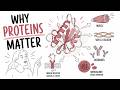
0:00 In this video we're going to talk about proteins, specifically protein 0:15 structure. 0:16 So I want you to picture your body as a city. 0:19 The DNA is the library. 0:21 It stores information. 0:23 The RNA is the messenger. 0:25 It carries instructions. 0:29 The proteins are the workers. 0:30 They build things. 0:31 They move things in your body. 0:33 They sense things. 0:34 They defend against things and control things. 0:36 If you want one sentence to remember, it's this. 0:38 Proteins are the molecules that do most of the actual work of life. 0:47 So what is a protein? 0:49 At the simplest level, a protein is a chain of amino acids. 0:55 An amino acid is like a bead, and proteins are like bead necklaces. 1:00 And we have many types of amino acids in our body. 1:04 But these aren't just random beads, these amino acids. 1:08 Every amino acid actually has a common core. 1:12 They have an amino group, a carboxyl group, a hydrogen, and a variable side 1:18 chain called 1:19 the R group. 1:20 And that R group is the whole personality of the amino acid. 1:24 It determines whether it's oily or watery, charged or neutral, flexible, or 1:31 rigid. 1:32 When amino acids link together, they form peptide bonds. 1:37 That's a bond between the carboxyl group of the amino acid here and the amino 1:42 group of 1:43 the next. 1:45 The proteins are basically polypeptides, long peptide chains composed of 1:52 multiple types 1:54 of amino acids. 1:56 Now here's the key idea. 1:59 The order of amino acids matters because the order determines the shape of the 2:05 protein 2:06 and the shape determines the function of the protein. 2:11 That's the theme of proteins. 2:17 So why are proteins so important? 2:20 Because proteins cover almost every job your cell needs. 2:24 Let's run through some big categories. 2:27 Proteins, they make up these things called enzymes. 2:31 Proteins that speed up chemical reactions. 2:34 Without enzymes, your metabolism would be painfully slow digestion, energy 2:39 production, 2:40 DNA replication, all protein driven. 2:44 Proteins also make up structural components, the scaffolding. 2:48 So for example, collagen gives strength to the skin and connective tissue. 2:53 Carotene is a protein that makes hair and nails. 2:59 Proteins can also be transport proteins, moving things around. 3:02 Hemoglobin for example carries oxygen around your body. 3:06 Albumin carries hormones and fatty acids and help maintain oncotic pressure. 3:12 Proteins make up receptors and signaling molecules as well, which is important 3:16 for communication. 3:17 For example, your insulin receptor is a protein. 3:20 So many hormone receptors, iron channels and signaling switches. 3:26 Proteins can also be motor proteins for movement. 3:28 Ached and myosin lets your muscle contract. 3:32 There are also immune proteins important for defense, such as antibodies. 3:37 These are proteins designed to recognize and neutralize threats. 3:41 So proteins aren't one thing. 3:43 They're a job description and again, they are very important. 3:51 There are four levels of what's called protein structure. 3:55 This is termed the folding story. 3:56 To understand proteins, you need to understand its structure because structure 4:00 is the whole 4:00 point. 4:01 So firstly, you have the primary structure. 4:04 Primary structure is the amino acid sequence. 4:06 This is the exact order of the amino acids. 4:11 Secondary structure is local folding. 4:14 And the two main patterns are the alpha helix, which looks like a spiral and 4:19 the beta sheet, 4:20 which looks like a folded layers. 4:24 And these are stabilized by hydrogen bonds along the backbone. 4:28 Then you have the tertiary structure, which is the overall 3D shape of one poly 4:33 peptide 4:34 chain. 4:36 This is where the R groups interact. 4:38 You have hydrophobic interactions, oily parts hiding from water, hydrogen bonds 4:44 , ionic 4:45 bonds, salt bridges and disulfide bonds. 4:53 Finally, you have the quaternary structure. 4:56 This is when multiple protein chains assemble together and a classic example is 5:01 hemoglobin, 5:02 which has four subunits. 5:06 Now, here's the big clinical question. 5:11 If you disrupt the folding, you disrupt the function. 5:14 And that can happen with mutations in proteins, temperature, in the body, or 5:20 the area pH changes 5:21 or chemical stress. 5:23 And when proteins lose their shape, we call it denaturation. 5:28 Sometimes they can refold, sometimes they clump, and those clumps can be 5:31 harmful to 5:32 the body. 5:33 That concept connects to disease, like protein aggregation disorders. 5:38 But the takeaway is that when proteins fold correctly, the protein becomes 5:43 functional. 5:44 Important, it does something. 5:46 But when the proteins become folded incorrectly, again, due to a variety of 5:51 factors, it can 5:52 become a problem, it can become impaired, and even toxic. 6:02 What makes proteins fold the way they do? 6:04 A simple rule to remember is that water is the boss. 6:08 In a water environment like the human body, proteins fold so that hydrophobic, 6:12 the water 6:12 fearing amino acids, tuck inside. 6:15 And the hydrophilic, the water-loving amino acid, face outwards. 6:19 So the protein becomes stable in water, like oil drops hiding away from the 6:23 surrounding 6:24 fluid. 6:25 And this is why changing the environment, heat, pH, salts, can change folding. 6:31 And that's why some proteins live inside membranes. 6:33 Those proteins have hydrophobic outer regions to sit inside the lipid bilayer. 6:43 Now as I mentioned, there are many types of amino acids and amino acids make up 6:48 proteins. 6:48 You have something called essential amino acids and non-essential amino acids. 6:54 So not all amino acids are equally nutritional. 6:58 Your body can make some amino acids naturally. 7:01 These are your non-essentials, but some you must obtain from diet. 7:05 These are your essential amino acids. 7:07 If you don't have enough essential amino acids, you cannot properly build 7:11 protein, especially 7:12 important in growth, healing, and muscle maintenance. 7:15 And proteins in food differ in quality based on whether they contain all 7:19 essential amino 7:20 acids in good amounts. 7:22 Animal sources are often complete, while many plant sources are incomplete 7:27 individually, 7:28 but can be balanced across meals. 7:30 For biochemistry, the main point is the body is constantly turning over 7:34 proteins, building 7:35 and breaking them, and amino acid availability matters. 7:45 And why protein matters clinically? 7:47 Well, we already talked about it, the functions of the proteins in the human 7:51 body. 7:52 Let's really look at proteins with some clinical relevance. 7:57 The first are enzymes and blood tests. 7:58 We order a lot of blood tests that really reflect protein function. 8:04 So for example, ALT and AST are enzymes. 8:08 When liver cells are injured, these protein enzymes leak into the blood. 8:11 Triponin is a cardiac muscle protein. 8:14 If your heart muscle is damaged, triponin rises. 8:16 CK is another muscle enzyme, proteins that rise with muscle injury. 8:21 Second, proteins as transport and fluid balance take albumin. 8:27 It's a protein that is made by the liver, and it does two major jobs clinically 8:31 . 8:32 It carries some hormones, fatty acids and drugs, and it helps maintain on 8:35 chronic pressure, 8:36 keeping the fluid inside the blood vessel. 8:39 And that's why low albumin can contribute to edema, and why albumin level 8:43 becomes relevant 8:45 in liver disease, malnutrition, inflammation, and nephrotic syndrome. 8:52 The third is receptors and drugs. 8:56 Most medicines talk to proteins. 8:59 So a receptor is a protein, an ion channel is a protein, and many transporters 9:04 are proteins. 9:05 So when you prescribe a beta blocker, an SSRI, insulin, antihistamines, you're 9:11 interacting 9:12 with protein targets. 9:15 And some of our most wonderful, powerful modern treatments are literally 9:19 proteins themselves. 9:20 Insulin is a protein hormone therapy. 9:22 Monoclonal antibodies, like adelimumab, retuximab, trastuzumab, these are 9:27 engineered proteins 9:29 designed to bind very specific targets, even many vaccines work by training 9:34 your immune 9:35 system to make antibodies, which are proteins. 9:39 The fourth thing about proteins and clinical medicine is protein misfolding and 9:44 disease. 9:45 Remember, the shape of the protein determines function. 9:49 When proteins fold wrong, though, the consequence can be big, for example. 9:56 In sickle cell disease, one amino acid change in hemoglobin changes how it 10:01 behaves, leading 10:02 to red cell sickling and downstream complications. 10:09 The fifth thing about proteins is nutrition and healing. 10:11 In illness, surgery burns infection, your body increases protein needs for 10:16 repair, immune 10:17 function and maintaining muscle. 10:20 That's why protein status matters in recovery, frailty and hospital medicine. 10:30 So in summary, if you zoom out, proteins sit at the center of diagnosis. 10:36 When you check biomarkers, when you check enzymes, they are important in 10:40 physiology, 10:42 so transporting things, signaling, structure of things, they're important 10:47 treatment, for 10:48 example, drug targets, targeting receptors, biologics, giving actual antibodies 10:55 and hormones. 10:56 And finally, proteins also are involved in disease mechanisms, for example, mis 11:02 folded 11:03 proteins cause some certain diseases. 11:08 Thank you for watching. 11:12 [BLANK_AUDIO]