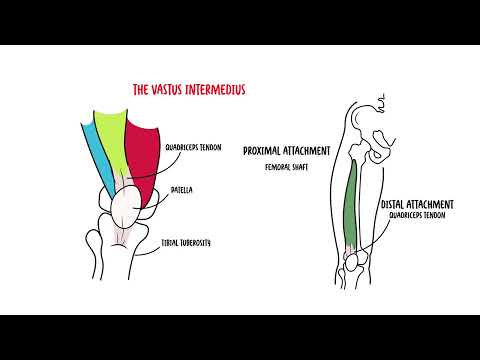
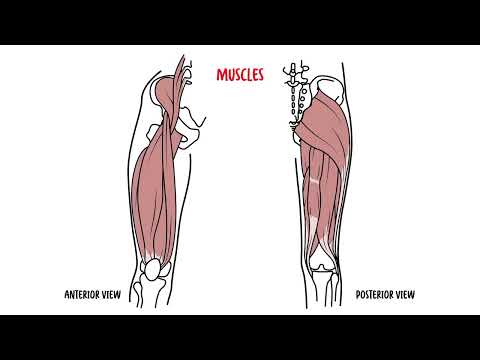
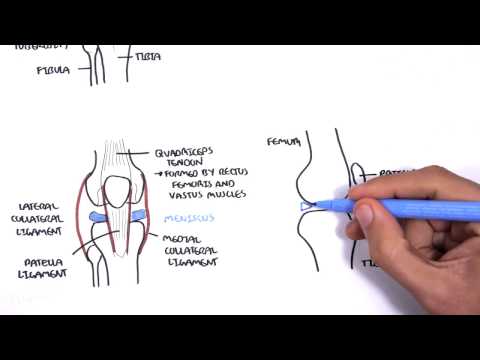
0:00 The quadriceps are a group of strong muscles in the anterior compartment of the 0:14 thigh. 0:15 Injury to the quadriceps muscle typically occurs during sport. 0:20 Common injuries include quadriceps strain or quadriceps contusion. 0:26 This causes pain and reduced function of the quadriceps muscle. 0:34 The quadriceps consist of four individual muscles. 0:37 The rectus femoris, vastus lateralis, vastus medialis, and vastus intermedius. 0:48 The quadriceps muscles have different origins, but converge and insert onto the 0:54 patella as 0:55 the common quadriceps tendon. 0:57 This tendon then envelopes the patella and inserts onto the tibial tuberosity. 1:03 The portion of the tendon that extends inferior to the patella is generally 1:07 referred to as 1:08 the patella tendon. 1:11 The patella itself is a sesomoid bone, which sits in front of the knee joint. 1:19 The combined action of the quadriceps muscle is knee extension. 1:25 The rectus femoris, which was one of the four quadriceps muscle we talked about 1:29 , help 1:30 also with hip flexion. 1:39 Mechanism of quadriceps muscle injury occur more often in sports, involving 1:46 sprinting 1:47 or explosive movements such as jumping or cutting, where the quadriceps is 1:52 needed to 1:52 generate power and elevation. 1:57 Quadriceps muscle injuries are more common in athletes. 2:05 The quadriceps muscles and tendons can sustain several types of injury. 2:12 Here we will look at quadriceps muscle sprain and quadriceps muscle contusion. 2:19 The quadriceps strain is a tear in one or more of the quadriceps muscles. 2:25 Quadriceps strain occur most frequently during maneuvers that involve sudden, 2:30 forceful eccentric 2:32 contraction. 2:33 Examples include landing from a high jump and landing while running downhill. 2:38 Once muscle strains cause pain and dysfunction, pain can occur immediately for 2:44 several days 2:45 after the insult. 2:48 Pain often increases with passive or active knee flexion or passive or active 2:56 hip extension. 2:57 Pain is often in the anterior thigh compartment with weight bearing and pain on 3:05 ambulation. 3:07 There is also tenderness over the muscle that is torn. 3:16 In terms of quadriceps contusion, this is caused by direct trauma to the muscle 3:23 , such 3:24 as being hit by a ball, a baseball or a cricket ball. 3:29 The impact damages blood vessels and muscle tissue, which can result in a hemat 3:34 oma, which 3:35 is a collection of blood outside the blood vessel. 3:44 There are complications of quadriceps contusions, and this includes myocytus oc 3:50 ificans, which 3:51 is proliferation of bone and cartilage within a muscle after the formation of 3:56 an intramuscular 3:58 hematoma, as well as anterior thigh compartment syndrome, which is a medical 4:07 emergency. 4:09 Investigations for quadriceps muscle pathology, usually the diagnosis is made 4:13 clinically based 4:14 on history and examination findings. 4:17 However, investigations that can be useful include an ultrasound, as well as an 4:23 MRI, 4:23 so look at other differential diagnoses. 4:30 Treatment of quadriceps strain involve rest-ice compression and elevation of 4:38 the muscle, followed 4:39 by slow stretching. 4:42 Treatment of quadriceps contusion is the same, with resting, ice, and 4:47 compression, but here 4:48 it's important to immobilize the area immediately in 120 degrees of flexion, 4:54 with an elastic 4:55 wrap. 4:57 This should be kept for about 24-48 hours. 5:02 Following this period, motion exercises for both leg extension and hip flexion 5:08 should 5:08 be performed several times daily, with an range of movement that does not cause 5:18 pain. 5:19 In summary, in this video we looked at the anatomy of the quadriceps, and two 5:23 injuries 5:24 involving the quadriceps muscle, and their treatment. 5:28 Quadriceps spray, and quadriceps contusion. 5:33 Thank you for watching. 5:38 [end of transcript]