
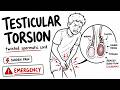
0:00 Testicular torsion is twisting of the spermatic cord within the tunic of 0:16 vaginalis in most 0:17 cases, causing vascular compromise to the testis. 0:22 It is a time-critical surgical emergency because prolonged ischemia leads to 0:28 testicular infar 0:29 oxygen and loss of the gonad, the testis die. 0:34 It can occur at any age, but peaks in neonates and adolescence are young adults 0:38 , typically 0:39 about 12-25 years of age. 0:47 Just briefly talking about the anatomy, so each testis sits in the scrotum and 0:54 is covered 0:54 by layers derived from the abdominal wall. 0:58 The testis and epidermis are partially enveloped by the tunic of vaginalis. 1:05 This is a peritoneal sac with visceral and parietal layers, but I don't want 1:11 you to 1:11 get too confused. 1:13 The testis is anchored postural, laterally, to the scrotal wall by the gubinac 1:19 ulum and 1:21 scrotal attachments, which normally limits the mobility of the testis. 1:27 Blood supply travels within this spermatic cord, which contains the testicular 1:33 artery 1:34 for the blood supply from the abdominal aorta. 1:37 It also contains the pepiniform venous plexus for venous drainage, the vasdifer 1:42 ans and lymphatics 1:43 and nerves, including genital branch of the genital femoral nerve, which is the 1:49 basis 1:50 of the cremeisteric reflex. 1:56 Now to stick to the torsion, there are two main types, intravaginal torsion and 2:01 extra 2:02 vaginal torsion. 2:03 Here is a normal adult testis to compare. 2:06 The testis sits within the tunic of vaginalis. 2:10 The tunic of vaginalis and surrounding tissues are fixed appropriately to the 2:16 scrotal wall. 2:17 The gubinacula scrotal attachment help keep the testis in position. 2:22 Essentially, in intra-vaginal torsion, this is the most common type, and the 2:28 twisting 2:29 of the testis occurs within the tunic of vaginalis. 2:34 In intra-vaginal torsion, the abnormality is usually increased testicular 2:38 mobility because 2:39 there is no good attachment to the scrotal wall. 2:44 In extra-vaginal torsion, the testis, spermatic cord and tunic of vaginalis 2:49 itself all twist 2:50 together as one unit. 2:51 In other words, the twist occurs outside or above the tunic of vaginalis 2:57 attachment because 2:58 the coverings are not yet firmly fixed to the scrotum. 3:02 This is why it is typically a neonatal event. 3:06 What happens when the mobile testis or the testis itself rotates around the 3:12 cord? 3:13 Most often, again, this occurs when the testis rotates within the tunic of 3:16 vaginalis. 3:17 This is the intra-vaginal torsion. 3:19 This is the most common type in young adults. 3:22 What you get first is venous outflow obstruction. 3:26 Because you have these thin-walled veins, and this leads to congestion and ed 3:29 ema in the 3:30 area, increasing intratisticular pressure, which then compromises arterial inf 3:35 low so 3:36 there's no blood supply leading to ischemia and infarction, basically death of 3:40 the tissue. 3:41 There's something called the bell clapper deformity, which is a key predis 3:46 posing anatomy. 3:47 What happens in this deformity, you have abnormal high attachment or absence of 3:51 normal posterior 3:52 fixation of the testis to the scrotal wall via the tunic of vaginalis. 3:57 This is typically the gumenacula abnormality, and so you get what's called a 4:02 horizontal 4:03 lie of the testis, and with this increased mobility, making torsion more likely 4:09 , it is 4:09 frequently bilateral. 4:16 As mentioned, neonates typically get extra vaginal torsion. 4:20 The testis, the cord, and tunic of vaginalis twist together in one unit, 4:25 because normal 4:26 scrotal attachments are not yet well-formed. 4:29 This can happen in utro, in the utros. 4:32 After pregnancy, after delivery, it's very important to assess the newborn. 4:38 In neonatal torsion, you can have a firm, enlarged, non-tender, or tender scrot 4:43 um, and 4:43 sometimes it can be discolored. 4:46 Most torsions beyond the neonatal period are intravaginal. 4:49 The testis twists within the tunic of vaginalis, as mentioned. 4:58 There are a lot of risk factors in association, so adolescents, pubital testis 5:02 growth may 5:03 contribute. 5:04 You have the mention bell clapper deformity, horizontal lie of the testis, 5:08 previous torsions 5:09 or intermittent self-resolving episodes, called torsion, detorsion syndrome, 5:14 family history 5:15 of testicular torsion, undescended testis, torsion can occur in the inguinal 5:20 canal, recent 5:22 minutoma or exercise can precede symptoms. 5:30 Clinical features of testicular torsion, the typical presentation is where 5:34 someone gets 5:35 really sudden, severe, unilateral typically scrotal testicular pain, often 5:39 nausea and vomiting 5:40 and may have lower abdominal goring pain. 5:43 The abdominal pain is typically referred pain. 5:49 On examination, you can have a high-riding testis versus a contralateral side. 5:54 You can have a horizontal lie testis, swollen, very tender, hemiscrotum, absent 5:59 , cremostaric 6:00 reflex, is highly suggestive of a testicular torsion. 6:05 The pain of testicular torsion is not relieved by elevation of the testis, so 6:09 this is classically 6:11 the negative friend sign. 6:13 Some red flags to remember, any adolescent with acute scrotal pain, it's test 6:17 icular torsion 6:18 until proven otherwise. 6:20 Another red flag is pain that suddenly resolves after severe onset can 6:25 represent detorsion, 6:26 and this will need urgent assessment as retorion risk is high. 6:35 There's something called a twist score, testicular workup for ischemia and 6:38 suspected torsion, 6:40 a bedside risk tool using five clinical features, testicular swelling, hard 6:45 testis, absent, 6:46 cremostaric reflex, nausea, vomiting, and high-riding testis. 6:52 So each of these are given a point or two, and interpretation are as follows. 6:57 0 to 2 is low risk, consider alternative diagnosis or ultrasound. 7:03 3 to 4 is intermediate risk, double ultrasound is necessary if it won't delay 7:08 management. 7:09 5 to 7 is high risk, immediate urological surgery without waiting for imaging. 7:19 Differential diagnosis of acute scrotum. 7:21 What's important is to distinguish from epidermal orchitis. 7:25 Typically, epidermal orchitis is gradual onset and may have urinary symptoms, 7:29 fever, and 7:30 tender epidermis first. 7:31 Other causes include torsion of the appendix testis, high dietit of morgogne, 7:36 incarcerated 7:37 inguinal hernia, trauma, hematoma, renal colic can cause referred pain to the 7:43 testis, 7:44 testicular tumor with hemorrhage, hydroseal, varicoseal, usually not acute or 7:49 severe though, 7:50 and idiopathic scrotal edema, especially in children. 7:55 Just a quick touch on torsion of appendix testis, also known as high dietit of 8:01 morgogne. 8:03 It's more common in younger boys, testis usually have a normal lie, scrotal era 8:06 thema 8:09 tends to be less marked than torsion, there's something called a blue dot sign, 8:13 where infected 8:15 appendage is visible through the scrotal skin, and this can occur but is often 8:20 absent and 8:21 can be difficult to see in darker skin tones. 8:25 Management of torsion of appendix testis is usually supportive analgesian rest. 8:35 So investigations, well, torsion is primarily a clinical diagnosis if you 8:39 suspect it do 8:40 not delay theta. 8:42 In uncertainty exists and imaging won't delay definitive care, you can do a sc 8:46 rotal doppler 8:46 ultrasound to assess profusion, essentially to assess reducer absent flows 8:52 which supports 8:53 torsion. 8:54 Note, early or intimate in torsion can still have misleading flow. 8:59 So here's an example, you can see the left testis is lying horizontally and 9:03 slightly smaller 9:04 than expected. 9:05 It appears darker and uneven on ultrasound, and there is no blood flow seen 9:10 within it 9:10 on doppler, the left epidemiose looks unusually bright and cannot be clearly 9:16 separated from 9:17 this permanic cord. 9:23 Your analysis can also be used to help support infection in differentials, so 9:27 in like epidimarcitis 9:28 for example, but a normal urine does not exclude torsia. 9:38 Out of testicular torsion, immediate action is really an urgent urology 9:42 surgical referral, 9:43 strong analgesia and anti-medics, meal by mouth, intravenous access fluids as 9:48 needed, 9:49 do not wait for ultrasound if highly suspicious, it's important to save the 9:53 testis, and this 9:54 is often best within four to six hours from symptom onset. 9:59 Salvage probability falls sharply after that, by over 12 hours, the risk of non 10:05 -viability 10:06 rises substantially. 10:10 Manual ditortion can be attempted only if surgery is not immediately available 10:15 and suspicion 10:16 is high, as a temporizing measure, classically this is called the open book 10:22 outward rotation, 10:24 but again manual ditortion, it's not definitive management, direction may be 10:29 wrong, and patients 10:30 still need urgent exploration and fixation. 10:38 So the definitive management is operation, scrotal exploration. 10:43 If torsion is confirmed, it's important to perform ditortion, as well bilateral 10:49 orchidopexy. 10:51 If non-biable, typically, orchidectomy is performed, potentially a testicular 10:57 prosthesis 10:57 may be used. 11:00 If no torsion is found, management varies by surgeon and intraoperative 11:04 findings, many 11:05 will fix the symptomatic testis if a bell clamber deformity is identified, and 11:10 consider 11:11 contralateral fixation based on risk anatomy. 11:21 Complications of testicular torsion include testicular infarction and loss of 11:24 testis with 11:24 delayed care. 11:26 Testicular atrophy can occur even after timely ditortion, subfertility risk, 11:30 especially if 11:31 bilateral involvement or delayed management, chronic scrotal pain, palpable sut 11:36 ures, infection 11:37 hematoma, psychological impact, obviously, and body image concerns. 11:47 So in summary, acute scrotum, remember it's torsion until proven otherwise, 11:51 absent cremostaric 11:52 reflex, high riding, horizontal testis, and sudden pain with vomiting, you've 11:56 got to 11:57 be thinking about testicular torsion and act fast, because, again, you want to 12:04 salvage 12:04 the testis 46 hours minimum. 12:08 Don't delay exploration for imaging in high suspicion cases, definitive 12:12 treatment is urgent 12:13 exploration, ditortion, and bilateral or keto pixie. 12:34 You