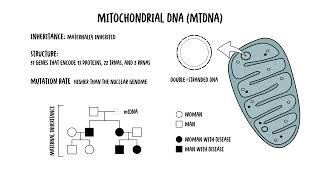
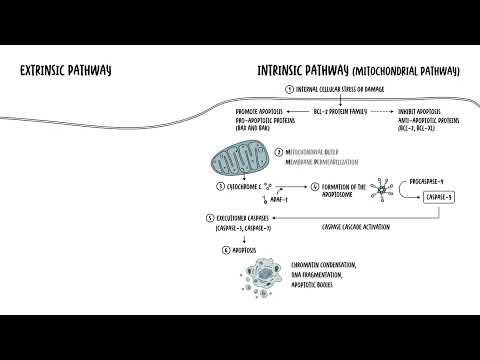
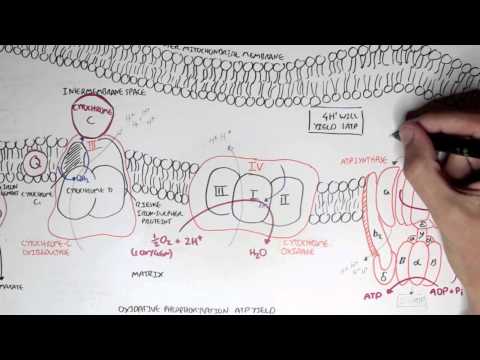
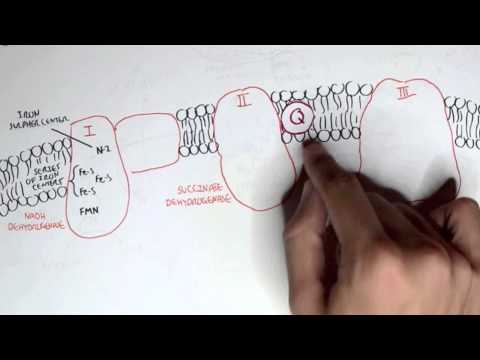
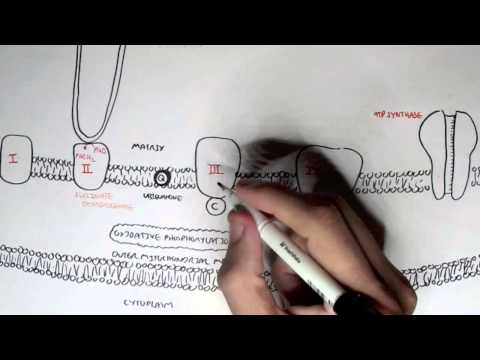
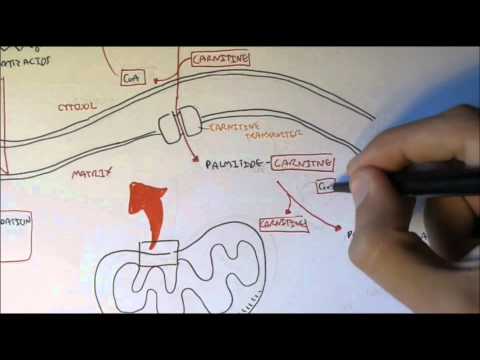
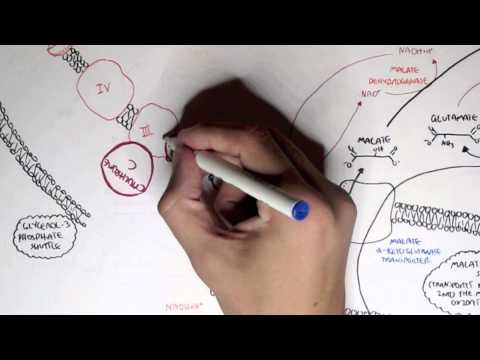
0:00 Hello, in this video, we're going to talk about the mitochondria. 0:12 The mitochondria are double membrane-bound organelles found in most eukaryotic 0:17 cells. 0:18 They're often referred to as the powerhouses of the cell due to their role in 0:22 generating 0:22 ATP through oxidative phosphorylation. 0:26 They are also involved in other critical cellular functions, including apopt 0:30 osis, calcium signaling, 0:32 and the synthesis of certain biomolecules. 0:37 Let's talk about the structure of the mitochondria. 0:44 It's made up of the outer membrane, a relatively permeable membrane, allowing 0:49 ions and small 0:50 molecules to plast through the abhorrent proteins. 0:55 The inner membrane, however, is highly imp permeable. 1:00 They don't allow stuff through, and they are extensively folded into structures 1:04 known 1:04 as Christa, which increases the surface area for the electron transport chain 1:12 and ATP synthesis. 1:13 The intermembrane space is the region between the inner and outer membranes, 1:17 and it's involved 1:18 in oxidative phosphorylation in the electron transport chain and an ATP 1:23 synthesis in general. 1:25 The matrix is the innermost compartment. 1:27 The mitochondrial matrix contains enzymes for citric acid cycle, the Krebs 1:32 cycle, as well 1:33 as mitochondrial DNA, ribosomes, and tRNA necessary for protein synthesis. 1:39 The matrix also holds important cofactors and metabolites involved in energy 1:44 metabolism, 1:45 making the mitochondria in a central hub for bioenergetic processes in human 1:50 cells. 1:56 Let's talk about the mitochondrial DNA, which is a bit odd because we already 1:59 have 2:00 DNA in the nucleus of the cell. 2:02 Well, the mitochondrial DNA is a small, it's circular, DNA, found within the 2:09 mitochondria. 2:10 It's distinct from the nuclear DNA housed in the cell's nucleus. 2:14 Similar to the nucleogenome, the mitochondrial genome is built up of double-str 2:14 anded DNA, 2:22 and it encodes genes. 2:25 In terms of inheritance, very importantly, unlike nuclear DNA, which is 2:30 inherited from 2:31 both parents, mitochondrial DNA is "maternally inherited", meaning it is passed 2:38 down exclusively 2:39 from mother to offspring. 2:41 The structure of the DNA, it contains 37 genes, and it encodes 13 proteins, 2 2:46 to tRNAs and 2:47 2 RNAs. 2:49 The mutation rate is a lot higher in mitochondrial DNA. 2:53 One cell contains numerous mitochondria, and each mitochondria contains dozens 2:59 of copies 2:59 of mitochondrial genome. 3:01 Moreover, the mitochondrial genome has a higher mutation rate, about a 100-fold 3:07 higher, than 3:08 the nucleogenome. 3:09 This means a single cell is all very different. 3:13 This is called heterogeneous, because of the mitochondria. 3:22 When the cell divides, its mitochondria are split between the two new daughter 3:27 cells. 3:28 Unlike the precise process of dividing nuclear chromosomes during mitosis, the 3:32 distribution 3:33 of mitochondria is random and less organized. 3:37 This means that each daughter cell ends up with similar, but not exactly 3:40 identical copies 3:42 of the mitochondrial DNA. 3:49 Here is an example of how mitochondrial DNA is passed through maternal 3:55 inheritance. 3:56 All children, male or female, of the mother, will receive the mother's 4:00 mitochondrial DNA, 4:02 if it's normal or if it's mutated. 4:05 However, only daughters can continue passing the mitochondrial DNA to the next 4:10 generation, 4:11 as sons do not pass mitochondrial DNA to their offspring. 4:20 So, what is the function of the mitochondria? 4:23 Well, we've alluded to some of this already earlier. 4:26 But the functions include ATP production, via oxidative phosphorylation 4:31 utilizing the 4:31 electron transport chain and ATP synthase. 4:36 It's also important apoptosis, which is programmed cell death. 4:40 They release cytochrome C from the mitochondria, which triggers the cascade 4:45 leading to programmed 4:46 cell death; mitochondria is also important for calcium homeostasis, as it 4:50 regulates intracellular 4:52 calcium levels, which are critical for various cellular processes. 4:56 The mitochondria also generates a lot of reactive oxygen species, byproducts of 5:01 oxidative phosphorylation 5:03 amongst other reactions that can cause oxidative damage, if not properly 5:09 managed. 5:09 The mitochondria is also an area where a lot of synthesis occurs. 5:13 It is actually involved in the Krebs cycle, which is important in ATP 5:18 production, synthesis 5:20 of amino acids, fatty acid oxidation, which helps further facilitate ATP 5:27 production. 5:27 So the mitochondria is really, really important. 5:36 But with its importance, as mentioned, comes a lot of issues as well that can 5:42 cause diseases. 5:44 As previously mentioned, mitochondrial DNA in humans is always inherited from a 5:48 person's 5:48 mother. 5:49 As a result, we share our mitochondrial DNA sequence with our mothers, brothers 5:55 , sisters. 5:56 Mitochondrial diseases result from mutations in mitochondrial DNA, or nucleogen 6:02 es encoding 6:03 mitochondrial proteins. 6:05 These disorders are often multi-systemic, affecting organs with high energy 6:09 demands, 6:10 such as a brain, muscles and heart. 6:17 So one example is something called levis hereditary optic neuropathy. 6:21 This is a mitochondrial genetic disorder, primarily affecting young adults, 6:26 leading to 6:27 sudden, painless loss of vision in one or both eyes. 6:30 This condition occurs due to problems in the optic nerve, the nerve that 6:34 supplies the 6:35 eye or innervates the eye, due to degeneration of retinal ganglion cells. 6:41 As an example of maternal inheritance, you can see that mitochondrial DNA is 6:46 passed on 6:46 from the mother. 6:48 Therefore the risk of passing this condition on can really affect any of the 6:52 children. 6:53 Males with mitochondrial disease are not considered to be at risk of 6:56 transmitting the 6:57 disorder to their offspring. 7:05 So in summary, mitochondria are essential for cellular energy production and 7:10 play a 7:10 crucial role in various metabolic pathways. 7:13 Mitochondrial diseases, although rare, can have devastating effects on multiple 7:17 organ 7:18 systems, highlighting the importance of early diagnosis and supportive care. 7:22 Thank you. 7:27 [BLANK_AUDIO]