
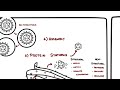
0:00 In this video, we're going to look at viral replication, and really look at the 0:12 difference 0:13 between enveloped and non-enveloped viruses. 0:16 While both these groups follow the same overarching stages of viral replication 0:21 , which include 0:22 attachment, entry to a cell, uncoating, gene expression, genome replication, 0:27 assembly, 0:27 and release, the presence or absence of a lipid envelope fundamentally changes 0:32 the mechanisms 0:33 of entry and release, influences the environmental stability and shapes typical 0:39 transmission patterns. 0:44 So envelope viruses include those such as influenza virus, herpes viruses, so 0:51 herpes 0:51 simplex virus, and varicellar zoster virus, HIV, hepatitis B virus, and coronav 0:57 iruses. 0:58 Non-enveloped viruses include adenovirus, human papilloma virus, parvivirus B19 1:05 , and 1:05 rotavirus. 1:09 Let's focus on enveloped viruses, first as of general concept of viral 1:15 replication. 1:16 So enveloped viruses possesses a host-derived lipid envelope containing viral 1:23 glycoproteins 1:24 required for attachment and entry. 1:27 The envelope is typically acquired during budding from the host membranes and 1:32 is essential for 1:34 infectivity. 1:36 Because the envelope is lipid, enveloped viruses are generally less stable in 1:41 the environment 1:42 and are readily inactivated by drying, heat, detergents, and alcohol-based 1:49 disinfectants. 1:51 The first stage of viral, these enveloped viral replications is attachment. 1:56 So attachment is mediated by envelope glycoproteins binding to specific host 2:01 cell receptors and 2:03 or their co-receptors, determining host, range, and tissue tropism. 2:09 Enveloped glycoproteins are major targets of neutralizing antibodies. 2:13 Alterations in glycoproteins can modify tropism and facilitate immune escape. 2:21 Then you have number two, which is entry. 2:24 Enveloped viruses typically enter by membrane fusion, either at the plasma 2:28 membrane or after 2:29 endocytosis, which is the engulfing of the virus. 2:34 The major mechanisms here are fusion at the plasma membrane, which is where the 2:39 virus immediately 2:40 releases the nucleocapsid into the cytoplasm. 2:45 And the second is endocytosis, as mentioned. 2:49 After endocytosis, fusion occurs in the endosome and the nucleocapsid is 2:55 released into the cytoplasm. 2:57 And this is typically released by endosomal acidification, because the endosome 3:01 can be 3:02 acidic. 3:05 Number three, stage of replication is encoding. 3:11 So following fusion and nucleocapsid delivery, uncoating releases the genome 3:17 into the cytoplasm 3:18 or directs it to the nucleus depending on the virus. 3:22 Uncoating is often coupled to fusion events and intracellular trafficking. 3:28 Uncoating failure aborts infection. 3:33 Stage 4 is gene expression and requirement for mRNA. 3:39 All enveloped viruses must generate mRNA, readable by host ribosomes. 3:46 The pathway depends on genome classes, whether the virus is a DNA virus, a 3:53 positive SSRNA, 3:54 negative SSRNA, double-stranded RNA, or a retrovirus. 3:59 So if it's a DNA virus. 4:02 Most DNA viruses replicate in the host nucleus, where host transcription 4:08 machinery is available. 4:10 Vile mRNA is typically synthesized by host RNA polymerase, while genome 4:16 replication may 4:17 use host or vile DNA polymerases. 4:21 In this group, larger genomes often encode enzymes for replication and immune 4:27 evasion. 4:28 Any DNA viruses establish latent or persistent infection patterns. 4:36 The second group are positive-sense RNA viruses, so the positive SSRNAs. 4:42 The genome of the positive-sense RNA viruses functions directly as mRNA and can 4:49 be translated 4:50 immediately upon uncoating. 4:52 Early translation commonly produces vile proteins needed for genome replication 4:56 , including 4:57 the RNA-dependent RNA polymerase. 5:01 The features of this virus is that it has rapid onset of protein synthesis. 5:07 Genome replication involves synthesis of complementary negative strand 5:14 intermediates. 5:16 The third group is negative-sense RNA viruses, or negative SSRNA. 5:21 The genome of the SSRNA virus is not directly translatable. 5:26 These viruses must carry an RNA-dependent RNA polymerase within the Vireon to 5:32 transcribe 5:33 essentially the genome into positive-sense mRNA soon after entry. 5:40 The features of this virus is that its dependence on Vireon packaged polymerase 5:45 is absolute, 5:46 otherwise they just can't function. 5:48 Some negative-sense RNA viruses are segmented enabling re-assortment. 5:59 The fourth group is double-stranded RNA viruses, or DS RNA. 6:03 Double-stranded RNA is not directly translated and is strongly immunostim 6:09 ulatory. 6:10 These viruses typically replicate within the capsid-associated complexes and 6:15 require an 6:16 RNA-dependent RNA polymerase to generate mRNA transcripts. 6:24 Then you have the retroviruses, RNA with reverse transcription. 6:28 Retroviruses are positive-sense RNA viruses that replicate through a DNA 6:33 intermediate. 6:34 After entry, reverse transcriptase generates DNA, which is then integrated into 6:39 the host 6:39 genome by integrase. 6:41 Reverse RNA polymerase is transcribed, integrated, pro-viral DNA to produce 6:46 viral mRNA and genomic 6:48 RNA. 6:51 That was a lot of information, but let's carry on with the steps of viral 6:57 replication. 6:58 So we just talked about gene expression and the requirements for mRNA. 7:02 An mRNA is really important because that's what makes the proteins and all the 7:05 structures 7:06 required to make more viruses. 7:09 And so number five is protein synthesis and genome replication. 7:14 Vile proteins include structural proteins. 7:16 So these include capsid proteins, matrix proteins, envelope glycoproteins. 7:20 Non-structural include polymerases, which are enzymes, proteases, another 7:24 enzyme and 7:24 regulatory proteins. 7:27 Enveloped glycoproteins are synthesized in the endoplasmic reticulum of the 7:31 cell, processing 7:31 the goal of the apparatus and trafficked to host membranes where budding will 7:36 occur. 7:40 The sixth stage of viral replication is assembly, also known as maturation. 7:46 Assembly involves nuclear capsid formation and localization to membrane regions 7:49 enriched 7:50 with viral glycoproteins. 7:53 Viral components self-assemble, like so, maturation may require proteolytic cle 8:00 avage within the 8:01 actual structure. 8:05 The first incorporation of glycoproteins is essential for infectivity in 8:11 enveloped viruses. 8:12 Then the final stage is release. 8:18 Release is typically via budding or exocytosis during which the virus acquires 8:24 its envelope. 8:25 Budding may preserve cell viability initially, supports persistent production 8:29 in some infections. 8:30 In contributes to immune evasion by limiting abrupt celicis. 8:35 So what about non-enveloped viruses? 8:41 How do they differ? 8:43 So non-enveloped viruses consist of a genome enclosed by a protein capsid 8:48 without the lipid 8:48 envelope. 8:49 The capsid confers greater environmental stability, supporting survival on 8:54 surfaces and resistance 8:55 to detergents and gastrointestinal conditions. 8:59 These properties commonly favor fecal oral and fomite transmission. 9:04 In the replication cycle, entry occurs without membrane fusion, and release is 9:09 typically 9:10 via celicis. 9:15 So step one is attachment. 9:18 Attachment is mediated by capsid proteins binding to host receptors. 9:23 Capsid proteins are principal targets for neutralizing antibodies. 9:28 The disruption strongly influences tropism and clinical syndrome. 9:33 Step two is entry. 9:39 Non-enveloped viruses typically enter via receptor-mediated endocytosis. 9:45 Endocytosis followed by capsid rearrangement. 9:49 There can be pole formation or membrane disruption to deliver the genome across 9:54 the endosomal 9:55 membrane. 9:59 Step three is uncoating. 10:01 Uncoating occurs through capsid conformational change and disassembly triggered 10:06 by endosomal 10:07 acidification, proteolysis or receptor interactions. 10:12 Genome delivery occurs without fusion, again, and some viruses traffic 10:15 partially disassembled 10:16 capsid to the nuclear pole. 10:22 Stage four, just like the envelope viruses, is gene expression and requirements 10:26 for mRNA. 10:27 All non-enveloped viruses must generate mRNA, readable by host ribosomes. 10:32 Replication strategy is dictated by genome class, as I already talked about 10:37 earlier in 10:38 this video. 10:41 Step five is protein synthesis and genome replication. 10:45 And again, viral proteins include the structural components, capsid proteins, 10:50 non-structural 10:50 polymerases, proteases, and regulatory proteins. 10:54 Polyprotein synthesis with proteolytic processing is common among several non- 10:58 enveloped RNA 10:59 viruses. 11:02 Step five is assembly or maturation. 11:05 Capsids, self-assemble, and package newly replicated genomes. 11:11 Maturation steps may increase particle stability and infectivity. 11:16 Military occurs in the cytoplasm or nucleus, depending on the virus family. 11:21 High capsid stability supports environmental persistence. 11:28 Then you have release, which is classically via cell lysis, producing abrupt 11:32 cell death 11:33 and inflammation. 11:35 Litic release contributes to acute tissue injury. 11:39 Non-litic release of viruses can occur for some viruses, but lysis is the 11:44 classic mechanism 11:45 for non-enveloped viruses. 11:52 So in summary, viral life cycles show the same broad stages. 11:56 You have attachment. 11:57 You have entry, un-coding, gene expression, genome replication, assembly, and 12:01 release. 12:02 But the key variations are defined by whether the virus is enveloped and how it 12:07 generates 12:07 mRNA from its genome. 12:09 Enveloped viruses typically enter by membrane fusion at the cell surface or 12:14 after endocytosis. 12:15 And, exit by budding, acquiring their lipid envelope from host membranes. 12:21 Whereas non-enveloped viruses typically enter via endocytosis, and capsid- 12:27 mediated penetration 12:28 and are typically released by cell lysis. 12:34 At the genome level, DNA viruses generally transcribe to the nucleus. 12:39 Positive-sense RNA translate their genome immediately as mRNA. 12:43 Positive-sense and double-stranded RNA viruses must carry or produce an RNA- 12:48 dependent RNA 12:49 polymerase to make mRNA. 12:52 And retroviruses reverse transcribe RNA to DNA and integrate into the host 12:57 genome, enabling 12:58 long-term persistence. 13:01 Thank you for watching.