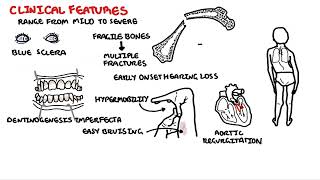
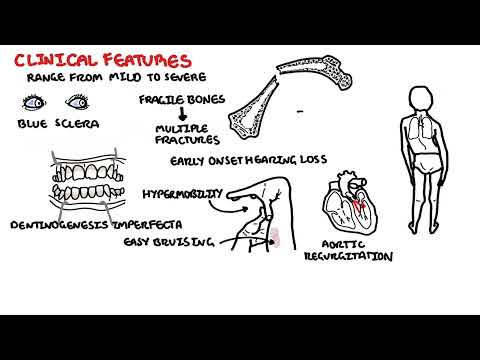
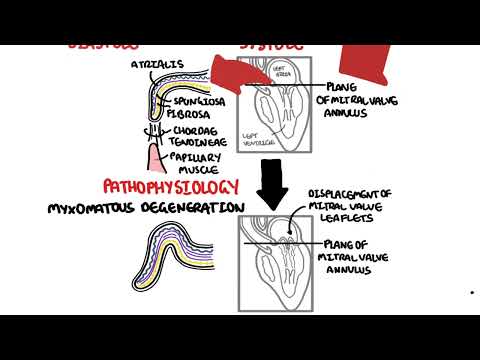
0:00 Osteogenesis Imperfecta, commonly known as brittle bone disease, is a rare 0:12 genetic 0:12 disorder that primarily affects the bone. 0:16 It disrupts the normal formation of bone and causes bone to become brittle, 0:21 osteoporotic, 0:22 resulting in multiple fractures and bone deformity. 0:26 Bone is a special form of connective tissue, which is made up predominantly of 0:33 collagen, 0:34 a collagen framework together with calcium and phosphate salts, particularly 0:42 hydroxyapatite. 0:43 Type 1 collagen in particular is the most abundant type of collagen in bone, 0:48 which is 0:49 also the major structural protein found in other tissues such as tendons and 0:56 skin. 0:57 Osteogenesis Imperfecta is a genetic problem leading to deficient amounts of 1:04 type 1 collagen, 1:05 and as a result weak and brittle bones. 1:09 The specific type of mutation, most commonly known, is a mutation or issue with 1:16 the call 1:16 1a1 or call 1a2. 1:22 And this will result in the clinical features seen in osteogenesis imperfecta, 1:27 which can 1:27 range from being mild to very severe. 1:32 Most people with osteogenesis imperfecta have fragile bones, which means they 1:36 are osteoporotic, 1:38 increasing the risk of multiple fractures. 1:41 They also can have early onset hearing loss and the development of a blue scl 1:46 era, which 1:47 is normally the white part of the eye. 1:50 The blue color appears because the veins beneath the abnormally thin sclera 1:56 show through. 1:58 The sclera is actually much more thinner in these people than normal because 2:02 collagen 2:02 is not there to help it form properly. 2:06 One may have discolid, poor developed brittle teeth called dentinogenesis 2:14 imperfecta. 2:15 You can get other features similar to people who have LSD such as hypermobility 2:21 , from ligamentous 2:23 laxity and easy bruising. 2:26 Rare manifestations include the heart. 2:29 Type 1 collagen is a major component of cardiac valves in the aortic wall, and 2:33 so issues here 2:35 can lead to valvular disease, such as mitral regurgitation, it can lead to aort 2:40 ic root 2:41 dilatation and aortic regurgitation. 2:45 The leading cause of death in osteogenesis imperfecta is pulmonary disease. 2:50 Polymery function is impaired by firstly many things, but marked scoliosis and 2:55 chest deformity 2:56 is one of them, but also intrinsic defects of long parenchimer, containing type 3:02 1 collagen 3:03 is also present. 3:08 Osteogenesis imperfecta can be classified into several types, and there are 3:11 more than 3:11 20 different types of osteogenesis imperfecta. 3:15 Here we will talk about four. 3:17 Type 1 osteogenesis imperfecta is the classic non-deforming osteogenesis 3:24 imperfecta, which 3:25 is the most common and the mildest form of all the types. 3:30 It is often recognized by the presence of strikingly blue sclera. 3:34 People can have kyphoscoliosis, and also rarely basilar invagination, where the 3:42 cervical 3:43 spine essentially moves upwards, and can even press against the lower part of 3:48 the brainstem. 3:51 Type 2 osteogenesis imperfecta is the most severe, and is lethal in utro. 3:57 Type 3 osteogenesis imperfecta is also the most severe type that does not cause 4:03 death. 4:04 Children with this type have marked bone deformity and short stature, 4:07 eventually as I grow up. 4:12 Type 4 is mild to moderate. 4:14 These people have recurrent fractures and deformity, and typically show normal 4:19 sclera without the 4:20 bluish tinge. 4:25 Synergogenesis imperfecta can be diagnosed before birth, specifically in the 4:29 severe lethal 4:30 forms where an ultrasound can pick up deformities during pregnancy. 4:37 After birth, the diagnosis really relies on history and examination, 4:40 specifically history 4:42 of fractures, family history, as well as characteristic examination findings, 4:49 including deformities 4:50 and a blue sclera. 4:55 Imaging is also important. 4:56 Here's an example of an x-ray of someone with osteogenesis imperfecta. 5:01 You can see severe deformity, previous fractures, a thin cortex with features 5:10 of osteopenia 5:11 and osteoporosis, as well as bowing of the legs. 5:18 People treated with medications called bisphosphonates, which is typically 5:22 given for patients with 5:23 osteogenesis imperfecta, can develop these bisphosphonate therapy lines called 5:30 zebra 5:31 lines. 5:33 Finally, if the diagnosis is not clear-cut, it may require genetic testing to 5:40 identify 5:40 mutations in relevant genes, and there are many, but most commonly, the call 1A 5:46 1 and 5:47 call 1A2. 5:49 Again, osteogenesis imperfecta is a genetic disorder, and typically can be 5:53 autosomal dominant 5:54 in the more typical cases. 5:58 Treatment is anti-resorptive therapy, specifically bisphosphonates. 6:02 It is important to monitor for complications of osteogenesis imperfecta, 6:05 including hearing 6:06 loss, checking poor dentition, and also ensuring that cardiac and pulmonary 6:13 functions are normal. 6:17 [MUSIC]