

Trigger Finger (Stenosing Tenosynovitis)
Overview
Trigger finger is a condition in which a finger or thumb catches, clicks or locks as it bends and straightens. It occurs when the flexor tendon cannot glide smoothly through the A1 pulley at the base of the digit. The affected digit may be painful and stiff, particularly on waking, and may need help from the other hand to straighten.
Diagnosis is usually clinical. Mild symptoms may settle with activity modification or splinting. Corticosteroid injection is a common treatment when symptoms persist, while A1 pulley release is considered for persistent or severe triggering.
Definition
- Trigger finger
- Painful catching or locking of a finger during flexion and extension due to impaired flexor tendon gliding at the A1 pulley.
- Trigger thumb
- The same process affecting the thumb.
- A1 pulley
- A fibrous band at the level of the metacarpal head that holds the flexor tendon close to the bone as it enters the digit.
- Locked digit
- A finger or thumb that becomes stuck in a flexed position and cannot readily straighten.
Anatomy & Physiology
The flexor tendons run from the forearm through the palm into the fingers and thumb. Fibrous pulleys keep the tendons close to the underlying bones and allow efficient finger flexion. The A1 pulley lies on the palmar side of the metacarpophalangeal (MCP) joint, near the distal palmar crease.
Normally, the tendon glides freely through this pulley. In trigger finger, thickening of the pulley, the tendon or both creates a mismatch between the size of the tendon and the space available within the pulley.
The site of catching is usually at the A1 pulley in the palm, even though the patient may feel the finger itself clicking or locking.
Aetiology & Risk Factors
Aetiology
The exact cause is often unclear. Repeated tendon movement and local irritation may contribute to thickening around the A1 pulley. Trigger finger can affect one or several digits and may occur without a preceding injury.
Risk Factors and Associations
- Diabetes mellitus; multiple digits may be affected and corticosteroid injection may be less successful.
- Rheumatoid arthritis and other conditions affecting the flexor tendons.
- Repetitive or forceful gripping, although a specific occupational cause is often not identifiable.
- Previous trigger finger in another digit.
Pathophysiology
Thickening at the A1 pulley narrows the opening through which the flexor tendon passes. The tendon may also develop a localised swelling or nodule. As the digit bends or straightens, the thickened portion meets resistance at the pulley and then passes through suddenly, causing a click or snap.
With greater restriction, the digit may lock in flexion. It may initially straighten with active effort, later require assistance from the other hand, or become fixed in a bent position.
Triggering is a mechanical tendon-gliding problem. A clicking finger does not by itself indicate disease inside the MCP or interphalangeal joint.
Clinical Manifestations
- Clicking, catching or snapping when bending or straightening the finger or thumb.
- Pain or tenderness in the palm at the base of the affected digit, often over the A1 pulley.
- Morning stiffness or a digit that is locked on waking.
- A palpable tender nodule at the base of the digit in some patients.
- Locking in flexion that may require passive straightening with the other hand.
- Reduced hand function when gripping, writing or handling objects.
| Clinical pattern | Typical finding |
|---|---|
| Early | Pain or tenderness at the A1 pulley, sometimes without visible triggering |
| Established | Reproducible clicking or catching during active finger movement |
| More severe | Intermittent locking that requires assistance to straighten |
| Advanced | Persistent flexion deformity or restricted movement |
Diagnosis
History and Examination
Ask the patient to demonstrate the catching or locking. Examine both active and passive flexion and extension. Palpate the palmar aspect of the MCP joint for focal tenderness or a nodule over the A1 pulley. Note whether the digit can be straightened actively, needs assistance, or has a fixed limitation.
Ask about other affected digits, diabetes, inflammatory arthritis and the effect on daily activities. A typical history with reproducible triggering and A1 pulley tenderness is usually sufficient for diagnosis.
Investigations
- Imaging is not routinely required for a typical presentation.
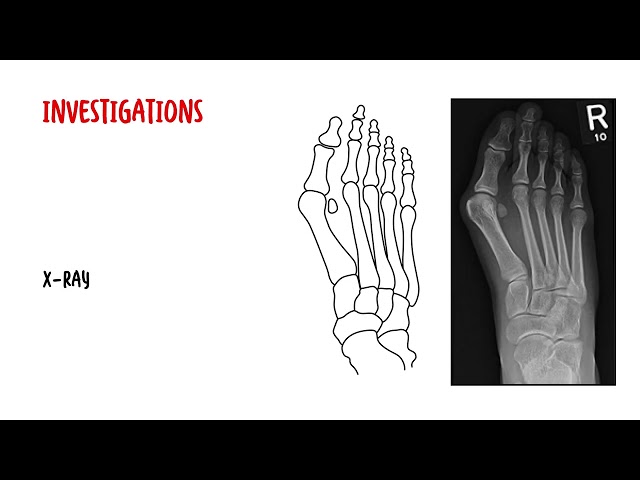
- X-ray may be useful if trauma, arthritis or another bony or joint disorder is suspected.
- Ultrasound may help when the diagnosis is uncertain or another tendon or soft-tissue lesion is being considered.
Differential Diagnosis
| Condition | Distinguishing feature |
|---|---|
| MCP or interphalangeal osteoarthritis | Joint-centred pain and stiffness, sometimes with bony enlargement |
| Dupuytren’s contracture | Palmar cord with progressive fixed flexion, usually without clicking |
| Flexor tendon injury | Reduced active flexion after injury rather than typical catching at the A1 pulley |
| Infection of the flexor tendon sheath | Acutely painful, swollen digit requiring urgent assessment |
| Other tendon or joint disorders | Consider when pain is away from the A1 pulley or the examination is atypical |
Red flag
A hot, swollen, very painful finger—particularly with fever, recent puncture or rapidly worsening symptoms—is not typical uncomplicated trigger finger. Assess urgently for infection.
Treatment
Initial Management
Management depends on symptom severity and the effect on function. Explain the mechanical cause and discuss avoiding or reducing activities that repeatedly provoke painful gripping. Mild symptoms may improve without a procedure.
A finger or thumb splint, often worn at night, can limit triggering while the area settles. Simple analgesia or an NSAID may help pain when appropriate, but medication alone does not correct the mechanical narrowing.
Corticosteroid Injection
A corticosteroid injection around the flexor tendon sheath at the A1 pulley can reduce pain and triggering. It is a common option when symptoms persist or interfere with function. Response is less reliable in people with diabetes and in some longstanding or severe cases. Discuss recurrence and injection risks; people with diabetes should also be aware that blood glucose may rise temporarily after an injection.
The purpose of the injection is to improve tendon gliding at the A1 pulley. It is not an injection into the finger joint.
Surgical Release
Refer for hand-surgery assessment when triggering remains troublesome despite non-operative treatment, repeatedly recurs, or causes persistent locking or significant loss of function. Surgery releases the A1 pulley to give the tendon more room to glide. Early finger movement after the procedure is generally encouraged according to the treating surgeon’s instructions.
Complications & Prognosis
Complications
- Persistent triggering can interfere with gripping and other hand activities.
- A longstanding locked digit may develop stiffness or a fixed flexion limitation.
- Corticosteroid injection can cause temporary pain or a transient rise in blood glucose; infection or tendon injury is uncommon.
- Possible surgical complications include scar tenderness, stiffness, infection, nerve injury and recurrent triggering.
Prognosis
- Some mild cases settle with time, splinting or activity modification.
- Corticosteroid injection relieves symptoms in many patients, although recurrence can occur and success may be lower in people with diabetes.
- A1 pulley release is usually effective for persistent trigger finger, but recovery of comfort and movement may take longer when the digit was stiff before surgery.
References
- American Academy of Orthopaedic Surgeons. Trigger Finger—Trigger Thumb. OrthoInfo.
- British Society for Surgery of the Hand. Trigger Finger/Thumb.
- National Health Service. Trigger Finger.
Members only discussions coming soon…