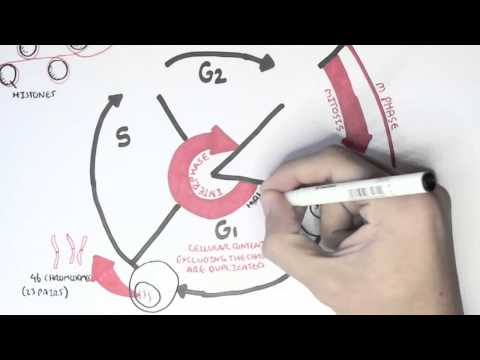
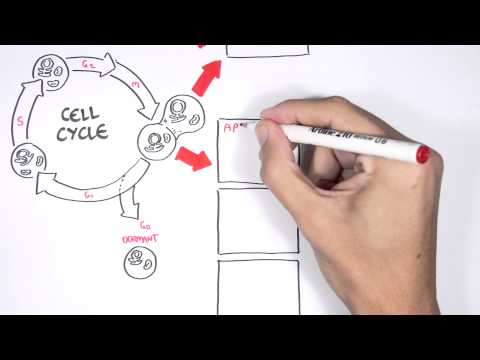
0:00 Just recapping, the cell cycle consists of two main phases, the interface and 0:19 the M phase. 0:22 Mitosis occurs within the M phase, and mitosis is the process where a cell will 0:29 divide to 0:29 produce two torture cells. 0:32 The first phase of mitosis is prophase. 0:37 Here we have a cell with duplicated chromosomes. 0:44 Just recapping what we see in prophase, we have the centrozomes, those 0:48 important structures 0:49 for cell division. 0:51 They begin forming a what's called mitotic spindle. 0:55 Looking at the genetic material of the cell during prophase, it will have 46 1:04 chromosomes 1:05 or 23 pairs of chromosomes with 92 chromatids because one chromosome has two 1:16 chromatids. 1:18 The structure in the middle here, holding the duplicated chromosome together, 1:25 is known 1:26 as a centromere, and it is important to know. 1:31 Centromere and centrozome sounds familiar, but don't get mixed up. 1:35 So during prophase, the chromosome or material condenses to form a compact mit 1:41 otic chromosome, 1:42 so it becomes visible to the chromosomes essentially. 1:45 The cytoskeleton is then disassembled, and mitotic spindle is assembled. 1:53 So the centrozomes form a mitotic spindle, the nuclear envelope is also 1:57 dispersed. 1:58 So the nucleus membrane essentially starts degrading to allow these chromosomes 2:07 to be 2:08 free, you can say. 2:10 Now prophase will then enter metaphase. 2:15 The cell in prophase will then enter metaphase. 2:19 Metaphase itself has an early stage and a late stage, but look at the early 2:23 stage first, 2:24 known as prometaphase. 2:27 Here we have the chromosomes just in the cytoplasm. 2:32 We have the centrozomes, remember, forming the mitotic spindle. 2:39 You will see in prometaphase that the cell will still have the fragments of the 2:42 nuclear 2:43 envelope that was degrading. 2:47 The centrozomes itself will form the mitotic spindle by shooting out these 2:52 microtubules 2:53 that will connect to the centromere of the chromosome, the middle part of the 2:58 duplicated 2:59 chromosome. 3:02 So during prometaphase the chromosomal microtubules attach to kinetochores of 3:08 the chromosomes. 3:10 Chromosomes are then moved to the spindle equator, which is essentially the sp 3:13 indle 3:14 equator is the middle of the cell, the equator of the cell. 3:19 Looking at the genetic material of the cell during prometaphase, it will still 3:24 have 46 3:25 chromosomes and 92 chromatids. 3:29 The cell in prometaphase will then enter metaphase, the late stage, where the 3:36 chromosomes, the 3:37 duplicated chromosome will align on the equator. 3:40 The centrozomes are an opposite side of each other in the cell, and they form a 3:45 massive 3:46 mitotic spindle with the microtubules. 3:50 In metaphase, so the chromosomes are aligned along the metaphase plate, which 3:55 is the equator 3:55 here. 3:56 This is a metaphase plate. 4:01 The duplicated chromosomes that are aligned on the metaphase plate will then be 4:07 attached 4:08 by the chromosomal microtubules at both poles. 4:14 What this means is that the centrozomes on each of the poles will have microtub 4:24 ules attaching 4:26 to the same chromosomes essentially. 4:33 If we look at the genetic material of the cell during the metaphase, it will 4:38 still have 4:39 46 chromosomes with 92 chromatids. 4:44 The cell in metaphase will then enter anaphase. 4:50 This might sound a bit confusing, but I hope you can follow this. 4:54 In metaphase, essentially, the centrozomes with the microtubules will pull the 5:03 duplicated 5:04 chromosomes apart, like so. 5:09 One chromatid will go towards one centrozome, and the other will go to the 5:15 other centrozome, 5:17 because it's being pulled apart. 5:20 In anaphase, the centromere, which hold the duplicated chromosomes together, 5:26 will split, 5:27 and the chromatids will separate. 5:30 The chromosomes will then move to opposite spindle poles, the chromatids, and 5:36 then the 5:36 spindle poles will move further apart, ready for division. 5:40 So just recapping, this is the centrozome, and this is the centromere, which 5:45 previously 5:46 held the duplicated chromosome. 5:51 So let's look at the process of what happens with the genetic material during 5:55 anaphase. 5:56 So before anaphase, we had remember a duplicated chromosomes, two chromatids 6:03 per one chromosome. 6:04 So in total, we had 46 chromosomes and 92 chromatids. 6:10 During anaphase, the microtubules with the centrozomes will split this apart 6:16 essentially, 6:18 forming two chromosomes each with one chromatid. 6:24 So therefore, in total, we would see 92 chromosomes and 92 chromatids in this 6:36 cell. 6:37 I hope this makes sense. 6:42 Now, the cell in anaphase will then enter the last phase of mitosis, which is 6:49 cellophase. 6:51 Cellophase is essentially when we see the centrozome with the microtubules 6:55 pulling the 6:56 chromosomes closer to each of their poles, and then we also see a membrane 7:01 forming around 7:03 it. 7:06 And so in cellophase, what we see is the chromosomes are clustering at opposite 7:12 spindle poles. 7:14 Like so, the chromosomes become dispersed. 7:19 The nuclear envelope will assemble and the organelles will reform. 7:25 And so this is our nuclear envelope, which is reassembling, essentially. 7:32 So now, if we were to look at the genetic material of the cell during celloph 7:39 ase, this 7:41 would represent one chromosome, which has one chromatid. 7:47 And therefore, the cell would have in total 92 chromosomes and 92 chromatids. 7:57 The cell will then enter the last phase of M phase, not mitosis, but the last 8:07 phase of 8:08 M phase known as cytokinesis. 8:11 Now, cytokinesis is not part of mitosis, but it is part of M phase. 8:15 And it's essentially the separation of the cell into two daughter cells. 8:23 And therefore, each of these daughter cells will have 46 chromosomes each, or 8:32 23 pairs 8:34 of chromosomes each. 8:36 And of course, one chromosome will have one chromatid, so it will have 46 chrom 8:43 atids. 8:44 And this is because, remember, the cell in cellophase had 92 chromosomes. 8:49 So if this cell with 92 chromosomes divide, it will have 46 on one daughter 8:55 cell and another 8:57 46 in the other. 9:01 Following cytokinesis, these cells can enter the cell arrest phase, or it can 9:05 enter the 9:06 whole interface, and then enter mitosis again after a while, or after some time 9:13 . 9:14 So now mitosis can be defined as the process by which duplicated chromosomes 9:23 separate 9:24 into two nuclei. 9:28 And this is essentially the division process. 9:34 Hope you enjoyed this video on the cell cycle. 9:37 We looked at the interface and we looked at mitosis in quite detail. 9:41 It's important to know the number of chromosomes and chromatids in each of 9:46 these steps to understand 9:47 what is actually happening. 9:49 Anyway, I hope you enjoyed this video, thank you.