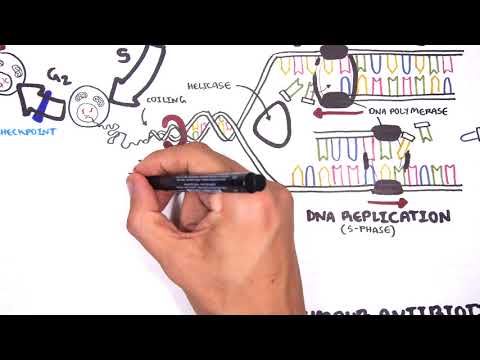
0:00 Hello in this video, we're going to talk about the pharmacology of cyclophosph 0:10 amide. 0:11 Cyclophosphamide is a powerful immunosuppressant with rapid onset of action 0:18 days to weeks. 0:19 Cyclophosphamide is a popular chemotherapy agent used to treat lymphoma, 0:23 multiple myeloma 0:24 and leukemia. 0:26 In rheumatology, it has a role in the treatment of vasculitis, life-threatening 0:30 complications 0:31 of systemic lupus erythmectosis, as well as interstitial lung disease. 0:38 Cyclophosphamide is an alkylating agent and works by disrupting the cell cycle, 0:43 targeting 0:43 rapidly dividing cells such as cancer cells, as well as immune cells which will 0:48 subsequently 0:49 cause immunosuppression. 0:52 For this example, let us just say cyclophosphamide is used to treat rheumat 0:57 ological conditions, 0:59 so the aim is to suppress the immune system here. 1:02 Normally, the immune cells enter the cell cycle to proliferate. 1:06 The G1 phase prepares the cell to enter the S phase, where DNA is replicated. 1:14 Cyclophosphamide is an alkylating agent, and its mechanism of action include 1:19 attachment 1:20 of alkyl groups to DNA bases, specifically guinine. 1:27 This causes an abnormal DNA. 1:29 DNA is damaged, forming cross links, which are bonds between atoms in the DNA. 1:38 These cross links, and this abnormal mutation now, prevent DNA from being 1:44 essentially separated 1:45 for synthesis or transcription. 1:48 And usually, if this is not corrected by the DNA repair mechanism, apoptosis 1:55 occurs, resulting 1:57 in immunosuppression essentially. 2:03 Cyclophosphamide essentially causes the cell to arrest at the G1 phase, 2:09 preventing the 2:10 S phase from occurring. 2:12 And the cell will essentially enter apoptosis, programmed cell death. 2:17 This will cause a decrease in the number of dividing cells, such as the immune 2:22 cells, 2:22 but also the cancer cells, because cancer cells are rapidly dividing. 2:27 Now, side effects then of cyclophosphamide include immunosuppression, leukopen 2:33 ia, which 2:34 increases the risk of people getting infections, hemorrhagic cystitis, ovarian 2:41 failure, cardiac 2:43 dysfunction, as well as long-term risks of bladder cancer, leukemia, and lymph 2:51 oma. 2:51 And that concludes the overview of the pharmacology of cyclophosphamide. 2:57 Thank you for watching.