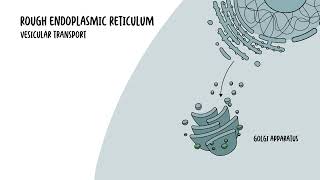
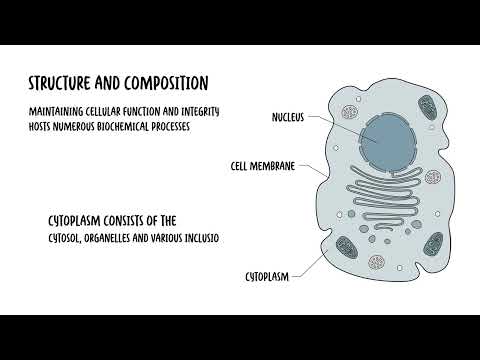
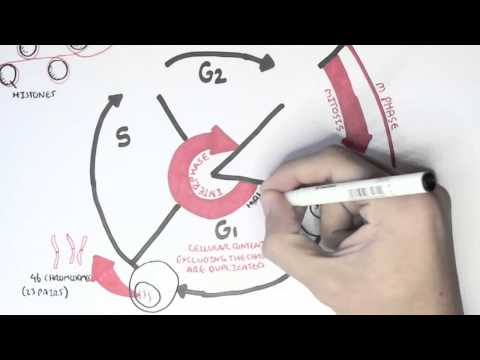
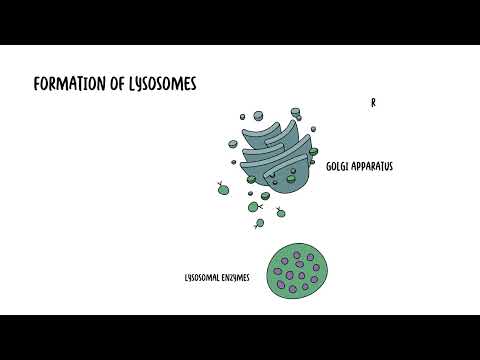
0:00 The endoplasmic reticulum is a critical organelle within eukarytic cells 0:16 involved in multiple 0:17 essential cellular processes. 0:19 It plays a role in protein synthesis, folding of proteins, quality control of 0:23 proteins and 0:24 lipid metabolism. 0:25 The endoplasmic reticulum is divided into two major types. 0:29 The rough endoplasmic reticulum and the smooth endoplasmic reticulum. 0:34 The rough endoplasmic reticulum is characterized by the presence of ribosomes 0:37 attached to 0:38 its cytoplasmic surface, giving it a rough appearance under a microscope. 0:43 The rough endoplasmic reticulum is continuous with the outer membrane of the 0:47 nuclear envelope. 0:48 The smooth endoplasmic reticulum lacks ribosomes, resulting in a smooth 0:55 appearance. 0:57 Let's take a closer look, beginning at the rough endoplasmic reticulum. 1:01 The rough endoplasmic reticulum, or rough ER I'm going to call from now on, its 1:06 membrane 1:06 is continuous with the outer membrane of the nuclear envelope, allowing direct 1:10 transfer 1:11 of molecules between the nucleus and the ER. 1:14 It's composed of flattened sacs, the cisternate, it has ribosomes giving it its 1:23 rough appearance. 1:25 When thinking of the rough ER, think of proteins. 1:28 The rough ER is responsible for protein synthesis. 1:32 The ribosomes on the rough ER synthesize proteins based on the instructions 1:37 from mRNA, which 1:38 was received from the nucleus. 1:40 Then you have these signal recognition particles, proteins that are destined 1:44 for the rough ER. 1:46 They contain a signal peptide at their amino terminus, and this signal is 1:50 recognized by 1:51 the signal recognition particles. 1:55 The signal recognition particles temporarily halts the protein synthesis and 1:57 directs the 1:58 ribosome protein complex to the rough ER by binding to the SRP receptor, the 2:03 signal recognition 2:04 particle receptor located on the rough ER membrane. 2:09 Once the ribosome is docked on the rough endoplasmic reticulum, protein 2:13 synthesis resumes 2:14 and the growing polypeptide is inserted into the rough ER lumen, or the 2:18 membrane. 2:19 And within the rough ER, the protein that is created then undergoes a number of 2:24 other 2:24 modifications and checks just like when a car is being made in a factory. 2:36 So the other function of a rough ER is protein folding. 2:39 So inside the rough ER lumen, the proteins that are created or made or assisted 2:48 by molecular 2:48 chaperones to fold into their correct three-dimensional structures, proper 2:54 folding is crucial for 2:55 the protein's actual function. 3:03 And so these proteins then undergo post-translational modification, and this is 3:07 where proteins in 3:08 the rough ER can be modified by addition of other biochemicals on the structure 3:13 . 3:14 You can think about it like tagging the new proteins within the lumen of the 3:17 rough ER, 3:18 having it to be recognized, making it more stable. 3:21 An example of a post-translational modification is n-linked glycosylation, 3:26 where a preassembled 3:28 oligosaccharide is attached to a specific aspargene residue in the protein. 3:39 The rough ER is also important for quality control and endoplasmic reticulum 3:44 associated 3:45 degradation. 3:47 The rough ER ensures that only properly folded proteins proceeds to the next 3:53 stage. 3:54 Misfolded or abnormal proteins are identified, and then they're directed 3:58 towards degradation 4:00 through the unfolded protein response. 4:04 There are retrotranslocated back to the cytosol, so outside of the rough ER, 4:11 where they are 4:12 then ubiquinated and targeted for destruction by the proteosome. 4:18 This system prevents the accumulation of defective proteins, which could be 4:22 harmful to the cells. 4:23 The proteosomes will break down the proteins to amino acids. 4:33 Rough ER is then responsible for the transportation through to the Golgi 4:38 apparatus, or Golgi apparatus. 4:41 So once the actual properly folded proteins and modified proteins are done, 4:46 they're then 4:47 packaged into transport vesicles. 4:50 These vesicles butt off from specialized regions of the rough ER known as 4:53 transitional ER. 4:56 The vesicles that butt from the rough ER are coated, which helps in vesicle 5:00 formation and 5:01 facilitates the transport of the cargo protein to the Golgi apparatus. 5:07 So then what happens after the product or the protein has been transferred to 5:12 the Golgi 5:13 apparatus? 5:14 Well, first of all, the transport vesicles move along the cytoskeleton to the 5:19 Golgi apparatus. 5:21 They then fuse with the Golgi membrane, releasing their protein content into 5:24 the Golgi lumen, 5:26 so inside for further processing and sorting out. 5:31 We won't essentially discuss what happens in the Golgi, but in summary, the Gol 5:34 gi apparatus 5:35 will then pack and sort all the incoming proteins and all this stuff, and then 5:39 transport it 5:40 outside the Golgi apparatus, either outside the cell itself or to the lysosomes 5:46 , another 5:47 organelle in the cell, or to the plasma membrane. 5:56 So the summary of the rough endoplasmic reticulum is that ribosomes on the 5:59 rough ER synthesize 6:00 proteins which are then processed and checked by the rough ER, including 6:04 modification to 6:05 the proteins before being transported to the Golgi apparatus, or elsewhere in 6:09 the cell. 6:11 The rough endoplasmic reticulum is also important to detecting misfolded 6:14 proteins and so sending 6:16 it off to degradation via the proteosome system. 6:21 Now let's move on to the smooth endoplasmic reticulum. 6:28 So the smooth endoplasmic reticulum lacks ribosome and consists mainly of tub 6:32 ular structures 6:33 giving it smooth appearance. 6:35 The smooth endoplasmic reticulum has a number of functions. 6:38 First of all lipid and steroid synthesis. 6:40 The smooth ER is crucial for biosynthesis of lipids, including phospholipids 6:44 and cholesterol, 6:45 which are necessary for membrane formation and steroid hormone production. 6:50 It's also important for detoxification. 6:53 The smooth ER in the liver cells contain enzymes like cytochrome P450 which 6:58 metabolize drugs, 7:00 toxins and other harmful substances, making them easier for the body to excrete 7:05 . 7:06 The smooth ER particularly in muscle cells, these smooth ER muscle cells are 7:12 called the 7:13 sarco-plasmic reticulum. 7:17 Here the smooth ER stores calcium ions and regulates their release during 7:21 muscle contraction. 7:23 Finally, the smooth ER is also important for carbohydrate metabolism. 7:27 The smooth ER in liver cells for example is involved in the metabolism of 7:31 carbohydrates, 7:32 including glycogenolysis that break down of glycogen into glucose. 7:42 Just some very important concepts about the endoplasmic reticulum. 7:47 In simplified diagrams of the cell, the endoplasmic reticulum is often shown as 7:52 a network of membranes 7:54 close to the nucleus. 7:56 This is partly true since the endoplasmic reticulum is continuous with the 8:00 outer nuclear 8:01 membrane and the rough endoplasmic reticulum is typically situated near the 8:06 nucleus. 8:07 Cells that are involved in the production of large amounts of lipids such as 8:12 adipocytes 8:13 or liver cells, they have an abundance of smooth endoplasmic reticulum. 8:19 The smooth endoplasmic reticulum is distributed throughout the cytoplasm in 8:24 these cells because 8:25 it is the site for lipid synthesis, including the production of triglycerides, 8:30 cholesterol 8:31 and steroid hormones, in cells that synthesize and secrete large quantities of 8:35 proteins such 8:35 as the pancreatic cells or the plasma cells which produce the antibodies, they 8:41 contain 8:42 a lot more rough endoplasmic reticulum. 8:51 Also another important concept is that the endoplasmic reticulum actually forms 8:56 physical 8:57 connections or contact sites with other organelles, which is important because 9:01 it facilitates 9:02 exchange of things and communication. 9:05 Examples include the Golgi apparatus, right? 9:07 The endoplasmic reticulum packages newly synthesized proteins into vesicles and 9:12 synthsomes to the 9:12 Golgi apparatus. 9:14 The mitochondria as well, it interacts with the mitochondria to transfer lipids 9:19 and to 9:20 regulate calcium levels. 9:23 Lysosomes is also in close contact with the endoplasmic reticulum because it is 9:26 involved 9:27 in the synthesis of the actual enzymes for the lysosomes to hydrolyze unwanted 9:31 cellular 9:32 waste. 9:38 Finally, we did mention this earlier but you have what's called the sarcoplasm 9:42 ic reticulum 9:44 in muscle cells, which are essentially specialized smooth endoplasmic reticulum 9:49 found in the 9:49 muscle cells and plays a central role in muscle contraction by regulating 9:58 calcium ion concentration. 10:02 So in summary, the endoplasmic reticulum is an important organelle divided into 10:07 rough 10:07 endoplasmic reticulum and the smooth endoplasmic reticulum. 10:11 The rough endoplasmic reticulum is important in protein synthesis, folding, 10:16 modification 10:17 and packaging to the Golgi apparatus and the smooth endoplasmic reticulum lacks 10:22 the ribosomes, 10:23 making it smooth and it's important in lipid synthesis. 10:27 Thank you for watching. 10:32 .