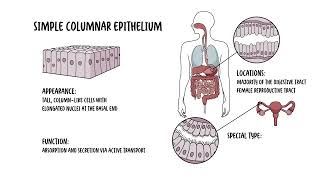
0:00 Hello, in this video we're going to talk about epithelial tissue. 0:12 Epithelial tissue primarily appears as large sheets of cells covering all 0:19 surfaces of the 0:20 body exposed to the external environment and lining internal body cavities. 0:27 It also forms a majority of glandular tissue in the human body. 0:31 Besides the skin, other areas exposed to the external environment include the 0:35 airways, 0:36 digestive tract, and the urinary and reproductive systems, all of which are 0:40 lined by epithelial 0:41 tissue. 0:43 Notably, the epithelial tissue lining vessels in the lymphatic and 0:47 cardiovascular systems 0:48 is termed endothelium, while that forming the serious membranes lining the true 0:53 cavities 0:54 is called mesothelium. 0:58 So, let's talk about some general structural features of epithelial tissue. 1:07 Despite its diverse locations and functions, all epithelial tissue shares key 1:11 structural 1:12 features. 1:14 First of all, cellularity. 1:16 Epidhelial tissue is highly cellular, with minimal, extra cellular material 1:20 between cells. 1:22 They're highly packed together. 1:26 Intercellular connections. 1:27 They are joint cells that form specialized connection, and these specialized 1:31 connections 1:32 are called cell junction, which we'll talk about later. 1:36 Polarity. 1:37 Epidhelial cells exhibit polarity with structural and functional differences 1:41 between the apical 1:42 exposed surface and the basal surface closest to the underlying tissue. 1:49 Other structural features include avascularity. 1:52 Epidhelial tissues are avascular typically. 1:54 Nutrients enter by diffusion or absorption from underlying tissues or surfaces. 2:01 Finally, epithelial tissue can rapidly replace damaged and dead cells, crucial 2:06 for its role 2:07 in protection and secretion. 2:11 So, let's talk about some general function of epithelial tissue, but to look at 2:17 the typical 2:18 function of epithelial tissue, let's take a look at an example of the 2:23 respiratory tract. 2:25 Epidhelial tissue serves as the body's first line of defense against physical, 2:31 chemical, 2:31 and biological damage. 2:32 In this case, it could be the bacteria, it could be fumes or smoke. 2:38 They act as gatekeepers, controlling permeability and allowing selective 2:43 transfer of materials 2:44 across their surfaces. 2:45 So for example, ions, chemicals, oxygen, carbon dioxide. 2:50 All substances entering the body must cross an epithelial layer. 2:55 Many epithelial cells secrete mucus and other chemicals. 2:59 For instance, the small intestines epithelium release digestive enzymes, while 3:03 the respiratory 3:04 tract epithelium here secrete mucus to trap microorganisms and particles. 3:10 Some epithelial tissue also have specialized brushes called cilia, such as in 3:15 the respiratory 3:16 tract, that help move particles in one direction. 3:20 And this can help clear the respiratory tract, for example. 3:29 As mentioned, one of the key features of epithelial tissue is cell junction and 3:37 cell 3:38 binding essentially. 3:41 The epithelial cells, which make up epithelial tissue, are held together by 3:45 three basic types 3:46 of cell-to-cell junctions, tight junctions, gap junctions, and anchoring jun 3:52 ctions. 3:52 Tight junctions restrict fluid movement between cells due to integral proteins 3:59 forming a 4:00 firm seal. 4:01 These junctions are common in the urinary bladder, preventing urine leakage, 4:06 for example. 4:07 When you have anchoring junctions, anchoring junctions provide strong yet 4:10 flexible connections 4:11 between the cells. 4:12 They include desmosomes, hemidesmosomes, and adherins. 4:17 Desmosomes link neighboring cells via cadaherin molecules embedded in protein 4:21 plates, while 4:22 hemidesmosomes attach cells to the extracellular matrix using integrins. 4:29 Adherins junctions involving either cadaherins or integrins are characterized 4:33 by the presence 4:34 of actin and influence the shape and folding of epithelial tissue. 4:39 Finally, the other type of cell junction is gap junctions. 4:42 Now, gap junctions create intracellular passageways allowing a small molecule 4:48 and ions to move 4:49 between the cells, facilitating electrical and metabolic coupling. 5:00 So how do we classify epithelial tissue? 5:03 Well, to put it briefly, epithelial tissue can be grouped into two major types. 5:08 You have the surface epithelial that line internal surfaces and cover external 5:12 surfaces 5:13 of the body, and then you have glandular epithelial that form all glands in the 5:23 body. 5:24 The cell tissue are classified by cell shape and the number of cell layers. 5:31 So the cell shapes include squamous, which are essentially flattened, cuboidal 5:37 box, or 5:38 columnar taller than wider. 5:42 And then the type of layer. 5:44 So for example, you can have simple epithelium or single layer, and these 5:50 examples include 5:51 simple squamous epithelium, simple cuboidal epithelium, and simple columnar 5:58 epithelium. 5:59 Then you can also have stratified epithelium, which is multiple layers. 6:03 So for example, you can have stratified squamous epithelium, stratified cub 6:08 oidal epithelium, 6:10 and stratified columnar epithelium. 6:14 To make these a bit more complicated, you have these two other special cells 6:18 such as 6:18 pseudo stratified epithelium, which appears multilayered, but is actually 6:23 single. 6:24 And then you have transitional epithelium, which is basically a stretchy type 6:29 of epithelium, 6:30 and you can have various shape and layers based on how stretchy this tissue is. 6:37 So let's look at each of these in a bit more detail. 6:45 Multiple squamous epithelium are thin, scale-like cells with flat, horizontal, 6:52 and elliptical 6:53 nuclei. 6:56 Their function is that they allow rapid passage of chemical compounds. 7:00 Their location or lining of capillaries, because that allows exchange, small 7:04 air sacs 7:05 in the lungs, and mesothelium, including the blura and the peritoneal cavity. 7:16 Then you have the simple cuboidal epithelium, which look like box-like cells 7:21 with round 7:23 nuclei located near the cell center. 7:26 Their function involves secretion and absorption through active transport 7:30 typically. 7:31 And their location, a good example, is the lining of the kidney tubules, so the 7:37 nephrons, 7:38 as well as the ducts of glands. 7:46 The simple columnar epithelium are tall, column-like cells with elongated nucle 7:52 i at the basal 7:53 end. 7:54 Their function typically is for active absorption and secretion via active 8:01 transport. 8:02 Location, majority are within the digestive tract, but also found in parts of 8:06 the female 8:07 reproductive tract. 8:11 You have special types of columnar epithelium, including the ciliated simple 8:17 columnar epithelium 8:18 found in fallopian tubes. 8:21 And this will aid in egg passage, and then you have also simple columnar epit 8:26 helium with 8:27 cilia, the oscillated body, and the respiratory system, which helps move 8:37 particles. 8:38 Then you have pseudo-stratified columnar epithelium, which appear as a single 8:43 layer of irregular 8:44 shaped and different sized columnar cells, giving a stratified appearance with 8:49 nuclei 8:49 at different levels. 8:51 Their function is that they line respiratory tract typically. 8:54 Some cells have cilia allowing movement of particles, and also some are able to 8:58 secrete 8:59 mucus. 9:00 An important feature of pseudo-stratified columnar epithelium is that all cells 9:05 contact the base 9:06 elaminar, so the bottom, but not all reach the apical surface. 9:15 So let's talk about the stratified layers. 9:19 The stratified epithelium consists of multiple stacked layers of cells and 9:24 served to protect 9:25 against physical and chemical damage. 9:27 The classification is based on the shape of the apical layer of the cell, which 9:33 is the 9:33 layer closest to the free space. 9:36 So types of stratified epithelium include stratified squamous epithelium. 9:42 The most common type with squamous cells at the apical surface, and either 9:47 columnar or 9:48 cuboidal cells at the basal layer. 9:50 This type may be keratinized, which are found typically in the skin, and non- 9:56 caratinized, 9:56 which are found in the lining of the oral cavity, for example. 10:01 The other type of stratified epithelium is stratified cuboidal epithelium, 10:04 which are 10:05 generally two layers of cuboid cells found in the ducts and in the sweat glands 10:17 . 10:17 At columnar epithelium, these types are relatively rare in the human body, and 10:21 they're small 10:22 amounts found in the male urethra. 10:26 Transitional epithelium are characterized by gradual changes in cell shape and 10:30 layering. 10:31 It is found only in the urinary system, the ureches and urinary bladder, and 10:35 these epithelium 10:36 transitions from cuboidal to squamous as the bladder fills and stretches. 10:47 And remember, the other type of epithelia are the glandular epithelia. 10:51 Glans are structures composed of one or more cells, modified to synthesize and 10:55 secrete 10:56 chemical substances. 10:58 Most glands consist of epithelial cells, and are classified as either endocrine 11:01 or exocrine. 11:03 So endocrine glands are essentially ductless glands, ductless glands, that 11:09 release hormones 11:10 directly into the surrounding tissue and bloodstream. 11:13 Examples include the beta cells of the pancreas, releasing insulin. 11:17 Align glands are glands that release their contents through ducts that lead to 11:23 the external 11:24 environment. 11:25 Examples of exocrine secretion include mucus, sweat, saliva, and breast milk. 11:36 So in summary, epithelial tissue are important as they line the surfaces and 11:41 cavities of 11:41 organs and structures throughout the body. 11:45 This tissue are made up of epithelial cells, which are tightly packed together, 11:49 creating 11:50 a continuous layer that serves as a protective barrier against physical damage, 11:56 pathogens, 11:56 and dehydration. 11:58 Epidhelial cells are also involved in absorption, secretion, and sensation. 12:02 They can vary in shapes such as squamous, which are flat, cuboidal, which are 12:07 cubed shaped 12:08 and columnar, which are tall and cylindrical, and that can be classified based 12:12 on their 12:12 arrangement in layers, simple, which is a single layer, or stratified, which is 12:17 multiple 12:17 layer. 12:18 Thank you.