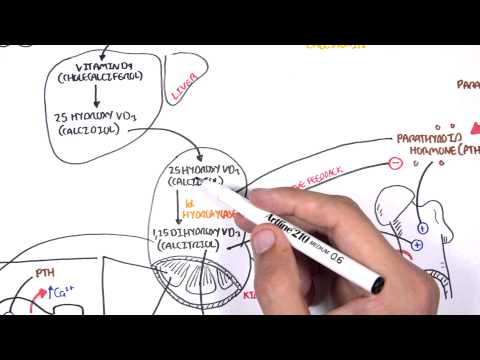
0:00 Hello, in this video, we're going to talk about familial hypochalcyaric hyper 0:11 calcemia 0:12 and other calcium sensing disorders. 0:16 Familial hypochalcyaric hypercalcemia, as the name suggests, is a cause of 0:21 hypercalcemia. 0:23 It runs in the family and is characterized by autosomal dominant inheritance 0:28 with high 0:29 penetrance. 0:31 Affected people typically present in childhood where they get hypochalcyaria, 0:36 peeing low 0:37 amounts of calcium, despite having elevated calcium levels in the blood, hyper 0:45 calcemia. 0:46 Problems with the reason for these changes is due to problems with calcium 0:51 sensing in 0:52 the body. Familial hypochalcyaric hypercalcemia is one type of calcium sensing 1:00 disorder. 1:00 Another type, a complete opposite, is autosomal dominant hypo-calcemia, which 1:06 we will touch 1:07 on later on. 1:10 Let's talk about the normal physiology first. 1:14 So parathired gland contains parathired cells, which are called chief cells. 1:21 The chief cells contain parathired hormones, which are ready to be released. 1:25 These cells respond to calcium levels in the blood, via calcium sensing 1:30 receptors, abbreviated 1:32 CASR. 1:35 This is a G protein-coupled receptor. 1:39 When CASR notices that there are low levels of calcium, the chief cells will 1:45 begin releasing 1:46 parathired hormone. 1:49 Parathired hormone, main goal, is to increase blood calcium levels, and it does 1:56 this by 1:56 targeting three main organs. 2:01 In the bones, parathired hormone promotes bone resorption, through the action 2:05 of osteoclasts. 2:07 Osteoclasts are the bone eating cells, which will release calcium and phosphate 2:13 in the 2:13 blood. 2:16 Parathired hormone also targets the kidneys. 2:19 It increases calcium reabsorption, but decreases phosphate reabsorption. 2:28 Parathired hormone also targets an enzyme in the kidneys, called one alpha hyd 2:33 roxylase. 2:33 This enzyme promotes the conversion of calcidiol to calcitryol, which is the 2:38 active form of 2:39 vitamin D. 2:41 Active vitamin D is known as 125 dihydroxycolic acid for all, abbreviated here, 2:49 and its role 2:51 is that it targets the gut increasing calcium and phosphate absorption. 3:01 In summary, parathired hormone will increase serum calcium levels. 3:07 The rise in serum calcium levels will be detected by the calcium sensing 3:12 receptor, the CASR, 3:15 and the CASR will put a break on the parathired cells to stop releasing parath 3:23 ired hormone. 3:25 It's a fine balance. 3:26 The chief cells uses the calcium sensing receptors to sense blood calcium 3:32 levels and respond appropriately. 3:37 On a side note, the production of active vitamin D has a negative feedback as 3:42 well on the parathired 3:43 gland, telling it to ease up the production of parathired hormone, because it's 3:47 no longer 3:48 required. 3:54 Real hypocalciric hypercalcemia is caused by inactivating mutation of the 4:01 calcium sensing 4:02 receptor. 4:04 And so basically in the presence of high calcium levels, the calcium sensing 4:10 receptors don't 4:11 detect this properly and will still release small eloquence of parathired 4:17 hormone, further 4:18 increasing blood calcium levels. 4:22 People with familial hypocalciric hypercalcemia typically only have mild hyper 4:31 calcemia. 4:33 Patients with familial hypocalciric hypercalcemia still have a functional 4:38 calcium sensing receptor. 4:39 It's just the set point of which it responds to high calcium levels is now 4:46 higher. 4:46 So as an example depicted by this graph, you have on the x-axis serum calcium 4:52 levels and 4:53 on the y-axis the calcium sensing receptor regulation of parathired hormone 5:00 release. 5:01 Normal serum calcium levels is between 2.2 and 2.6 millimoles per liter. 5:06 And this is well maintained by the calcium sensing receptor regulating the par 5:11 athired 5:11 hormone release, right? 5:14 Well in familial hypocalciric hypercalcemia, the graph shifts to the right, 5:21 meaning there 5:21 is decreased sensitivity to serum calcium levels. 5:26 This means that calcium sensing receptors regulation of parathired hormone 5:33 release will 5:34 only respond to higher calcium levels. 5:37 And hence, you typically only get a mild hypercalcemia because the calcium 5:44 sensing receptor is still 5:45 working. 5:46 It just requires a lot more prompting to work. 5:52 Familial hypocalciric hypercalcemia also causes physiological changes in the 5:56 kidneys. 5:57 So as we have learned, the kidneys respond to parathired hormone by absorbing 6:05 calcium 6:06 but also causes phosphate excretion. 6:10 It does so by targeting cells in the proximal convoluted tubule, inhibiting the 6:15 sodium and 6:16 phosphate symptoma, causing hyperphosphoyuria and therefore reduces blood 6:24 phosphate levels. 6:27 Throughout the nephron, the kidneys also contain these calcium sensing 6:31 receptors. 6:32 The most important effect of calcium sensing receptors here is probably found 6:36 in the thick 6:37 ascending limb of the loop of Henley. 6:40 Here in purple, the calcium sensing receptors are found on the basal surface of 6:44 the cells 6:45 and so on the bottom, close to the bloodstream. 6:49 We are now talking about normal physiology. 6:52 The thick ascending limb of the loop of Henley contains a co-transporter on the 6:57 apical surface, 7:00 basically where the lumen is where p is. 7:04 The co-transporter carries one sodium, two chloride and one potassium. 7:10 This is the transporter which the class of diuretics called loop diuretics 7:15 inhibit. 7:16 Anyway, although the process of transporting these electrolytes is electrically 7:23 neutral, 7:24 most of the potassium reabsorbed by the co-transporter leaks back into the l 7:29 umen to drive further 7:31 inward sodium chloride transport. 7:36 This movement of cationic potassium into the lumen plus the reabsorbed chloride 7:44 out of 7:45 the basal lateral surface of the cell will generate a net transepithelial 7:49 potential difference. 7:51 What does this mean? 7:52 Well, the interstitial fluid and capillaries will be negative in respect to the 7:58 tubular 7:59 lumen. 8:03 The resulting lumen electropositivity will drive the passive reabsorption of c 8:09 ations, 8:09 sodium, but also the calcium and magnesium via paracellular pathways between 8:16 the cells. 8:17 I hope that made sense. 8:19 On a side note, you have these proteins called clodins which help in parace 8:23 llular transport 8:24 of calcium and magnesium ions from the lumen into the blood. 8:31 So as we have learned, when someone has hypercalcemia, normally this tells the 8:37 parathyroid gland 8:38 to stop producing parathyroid hormone. 8:42 But also, hypercalcemia is detected by the calcium sensing receptors in the 8:46 kidneys, 8:47 which result in a number of things. 8:49 One, it will inhibit sodium-potassium ATPase here. 8:53 It will inhibit the potassium efflux pump on the apical surface and it will 8:58 inhibit clodins. 9:00 And so in summary, in hypercalcemia, calcium sensing receptors here will 9:05 respond by reducing 9:06 the reabsorption of calcium and magnesium. 9:11 And this will result in elevated calcium levels in urine, hypercalceuria, which 9:16 will help the 9:17 body transition back to normal calciumia, normal levels of calcium in the blood 9:26 . 9:27 In familial hypochalcyaric hypercalcemia, there is inactivating mutation of the 9:33 calcium 9:33 sensing receptor. 9:35 The receptors don't work, and you end up reabsorbing the calcium and magnesium, 9:41 leading 9:41 to hypocalceuria and mild hypercalcemia and hypermagnesemia. 9:56 It is an important concept to remember that familial hypocalceuric hypercalce 10:00 mia, as the 10:01 name suggests, causes hypocalceuria. 10:09 Investigations and other supportive investigations for diagnosis is a urinary 10:16 calcium and creatin 10:18 ratio less than 0.01, a reduced 24-hour urinary calcium, and genetic testing, 10:24 especially if 10:25 family history is difficult to obtain. 10:31 An important differential diagnosis is aymptomatic primary hyperparathyroidism, 10:37 which also causes 10:38 hypercalcemia, but it's important to know the difference because the cause and 10:43 treatment 10:44 of the two are different. 10:47 In primary hyperparathyroidism, the main cause is typically a benign adenoma. 10:56 It is a very common cause of hypercalcemia compared to familial hypochalcyaric 11:01 hypercalcemia, 11:03 which is a rare cause of hypercalcemia. 11:06 A good differentiating factor is that familial hypochalcyaric hypercalcemia, 11:10 there is a family 11:12 history, and it typically only causes a mild hypercalcemia. 11:18 In primary hyperparathyroidism, people can range from asymptomatic to full- 11:23 blown symptomatic 11:24 hypercalcemia, which I will not discuss what these symptoms are. 11:29 The treatment of primary hyperparathyroidism is a parathyroidectomy, whereas in 11:34 familial 11:35 hypochalcyaric hypercalcemia, it is observation and possibly calciumimetics. 11:41 Finally, in primary hyperparathyroidism, the calcium sensing receptors still 11:48 work. 11:49 They function normally, and therefore, in the presence of hypercalcemia, the 11:54 kidneys will 11:55 inhibit the reabsorption of calcium in a magnesium, resulting in hypercalcemia 12:01 rather 12:01 than hypochalcyaria in familial hypochalcyaric hypercalcemia. 12:09 Going back to calciumimetics, sorry, the calciumimetics is a drug that mimics 12:14 calcium. 12:15 The body perceives that they have much more calcium than they actually do, 12:22 which will 12:22 essentially be detected by the calcium sensing receptors, and thus, they will 12:30 respond appropriately. 12:33 That concludes the talk on familial hypochalcyaric hypercalcemia. 12:38 Another calcium sensing disorder I want to talk about is autosomal dominant hyp 12:43 ochalcymia, 12:44 which is an activating gain of function mutation of the calcium sensing 12:51 receptors. 12:51 Essentially, the calcium sensing receptors are active and tightly regulates par 12:59 athyroid 13:00 hormone release. 13:01 It essentially puts a break on the release of parathyroid hormone. 13:06 In the kidneys, the same thing, the calcium sensing receptor is activated, and 13:10 so you 13:10 are inhibiting calcium and magnesium reabsorption, and so, as a result, you get 13:17 hypochalcymia. 13:19 Now, remember, the serum calcium graph I spoke about earlier, well, now you 13:26 require a much 13:27 lower calcium level to cause parathyroid hormone release and the reabsorption 13:34 of calcium and 13:35 magnesium in the kidney. 13:37 This with autosomal dominant hypochalcymia typically have mild hypochalcymia. 13:44 Thank you for watching. 13:45 I hope you enjoyed this video.