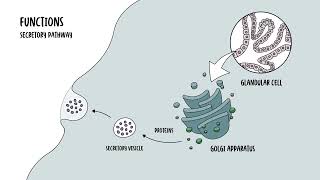
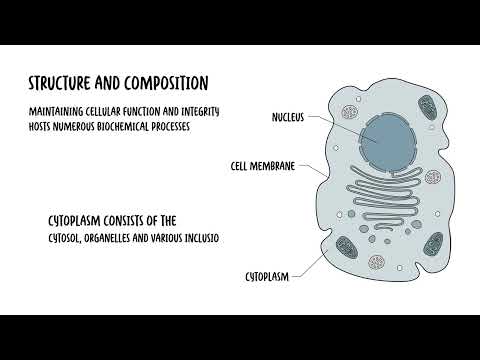
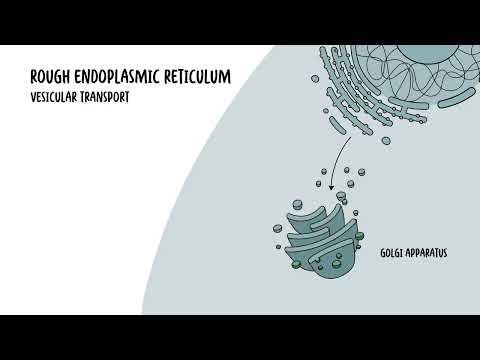
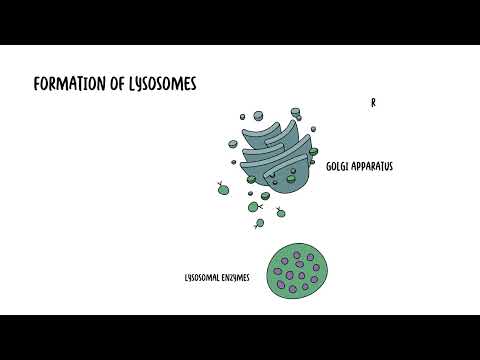
0:00 The Golgi apparatus, also known as the Golgi complex or Golgi body, is a 0:15 critical organelle 0:16 found in most eukaryotic cells, named after the Italian scientist Camilo Golgi, 0:21 who discovered 0:22 it in 1989. 0:24 The Golgi apparatus plays a fundamental role in the modification, sorting, and 0:28 packaging 0:29 of proteins and lipids for secretion, or delivery to other organelles. 0:36 Let's look at the structure of the Golgi apparatus. 0:43 First of all, it consists of a series of flattened membrane-bound saces known 0:48 as cisternase. 0:49 These cisternase are typically stacked in a parallel arrangement, with each 0:53 stack comprising 0:53 of 4 to 10 cisternase. 0:57 Although the number can actually vary depending on the cell type and its 1:02 function, the Golgi 1:03 has distinct regions that reflect the direction of the material flow. 1:08 So you have the cis-Golgi network, and this is the part of the Golgi that faces 1:14 the endoplasmic 1:15 reticulum. 1:16 The cis-face receives newly synthesized proteins and lipids from the endoplasm 1:23 ic reticulum 1:24 in vesicles. 1:26 This region is often referred to as the receiving side. 1:30 Then you have the medial cisternase. 1:32 The middle region of the Golgi, where really what happens is you get 1:36 modification of the 1:37 proteins and lipids which take place. 1:42 Then at the end you have the trans-Golgi network, and this region is located on 1:45 the 1:45 opposite side of the Golgi apparatus from the cis-face. 1:49 The trans-face functions as the shipping side, where the modified products, the 1:55 modified proteins 1:56 and lipids are sorted, and then packaged into vesicles for their final 2:01 destination. 2:03 The polarity of the Golgi with distinct cis and trans-faces is crucial for its 2:07 function, 2:07 ensuring a sequential progression of the cargo from one compartment to the next 2:18 . 2:19 Let's talk about the functions of the Golgi apparatus, and there are several. 2:23 First of all, they are involved in protein modification and processing. 2:27 Now, one of the main functions of the Golgi is to modify proteins through the 2:32 addition 2:33 of carbohydrate groups. 2:35 This process is called glycosylation. 2:39 This results in the formation of glycoproteins, because it's carbohydrate and 2:44 proteins. 2:45 Glycoproteins are important for cell recognition, signaling and protection 2:49 amongst many other 2:50 things. 2:53 Other modifications include phosphorylation and sulfation. 2:59 The Golgi also modifies proteins essentially by adding phosphate or sulfate 3:04 groups, which 3:05 again, helps with protein function, stability, and also delivery. 3:15 The other function of the Golgi apparatus is lipid metabolism and transport. 3:20 The Golgi is involved in the modification and sorting of lipids, so fats. 3:25 It plays a role in synthesizing and processing glycol lipids, which are 3:29 essential components 3:30 of the cell membrane. 3:32 It is also crucial in the synthesis of single lipids and can help transport 3:37 these lipids 3:38 to the appropriate parts of the cell. 3:40 As mentioned, sorting and packaging is the fundamental part of the Golgi 3:45 apparatus. 3:46 It packs up not only lipids, but also proteins into vesicles for transport to 3:52 various destinations. 3:54 It sends proteins to the plasma membrane, the lysosomes, another organelle, or 3:59 for secretion 4:00 outside the cell. 4:02 The trans-Golgi apparatus is the part that plays the pivotal role in 4:07 determining the 4:08 destination of the actual vesicles containing the proteins and the lipids. 4:14 It does this by tagging them with specific signals that direct them to the 4:18 actual appropriate 4:19 location, whether it's a cell membrane, the lysosome, etc. 4:30 The Golgi apparatus is also important in the secretory pathway. 4:34 What this means is that sometimes the cell that packages all these proteins, 4:39 for example, 4:39 they want to secrete it outside the cell. 4:44 This is particularly found in cells found in glandular tissue, for example, so 4:49 glandular 4:50 cells. 4:51 Proteins process in the Golgi are often packaged into secretory vesicles that 4:56 fuse with the 4:56 plasma membrane to release their contents outside the cell in a process called 5:03 exocytosis. 5:04 Finally, the Golgi apparatus is also important in the formation of lysosomes. 5:13 The Golgi apparatus is involved in the production of lysosomes, which are organ 5:17 elles that contain 5:18 digestive enzymes. 5:19 There will be a separate video on lysosomes, but essentially what happens is, 5:24 for example, 5:25 you have endocytosis, where the cell forms a vesicle containing possibly 5:31 unwanted materials, 5:33 then enzymes are packaged up by the Golgi simultaneously, and these enzymes 5:38 will then 5:38 be destined for lysosomes. 5:43 These enzymes are tagged with the marker called MANO6 phosphate in the Golgi, 5:47 which directs 5:48 them to this organelle. 5:51 And so, the enzymes with the endosome will form the lysosomes. 5:57 And these enzymes are the digestive enzymes that help break down these unwanted 6:06 material. 6:08 Aside from those particular functions we talked about, the Golgi also has a 6:13 role in what's 6:14 called the endomembrane system. 6:16 The Golgi apparatus is central component of the endomembrane system, which 6:20 includes 6:21 the endoplasmic reticulum, the vesicles, lysosomes, and the plasma membrane. 6:26 After proteins are synthesized in the rough endoplasmic reticulum, as we know, 6:31 they are 6:31 transported to the Golgi apparatus in the vesicles. 6:35 Once inside the Golgi, the proteins undergo modification that prepares them for 6:39 their 6:39 specific function or for secretion outside the cell. 6:45 But the Golgi is also involved in retrograde transport, in which the proteins 6:49 that need 6:49 further modification or recycling are transported back to the endoplasmic retic 6:55 ulum, or to earlier 6:57 parts of the Golgi apparatus. 7:00 And this is a very important system, and you can think of as a recycling sort 7:10 of system. 7:12 So in summary, the Golgi apparatus is an essential cellular organelle 7:16 responsible for the modification, 7:18 supporting and packaging of proteins and lipids. 7:21 Its unique structure, comprising distinct cystinase, organized into polarized 7:26 stack, allows for 7:27 efficient and sequential processing of cargo, by performing some modifications 7:34 like glycosylation, 7:35 and by directing proteins and lipids to their correct destination, the Golgi 7:39 apparatus supports 7:40 numerous cellular functions, including secretion, cell membrane maintenance, 7:46 and lysosome formation. 7:48 Thank you for watching.