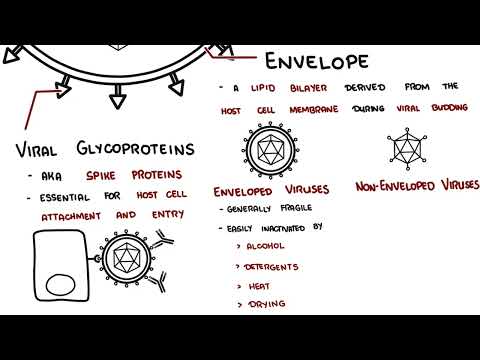
0:00 In this video, we're going to talk about viruses and overview. 0:18 This should be a two-part series. 0:20 Viruses are the smallest type of infectious particle. 0:25 This means that compared to a bacteria, for example, viruses are much smaller. 0:31 A typical size of a virus is about 100 nanometers in diameter, but it can range 0:37 between 10 nanometers 0:39 to about 300. 0:42 An erythrocyte, our red blood cells, are about eight micrometers in diameter, 0:47 which is about 0:48 100 times the size of a virus. 0:51 So this gives you an idea of how small a virus can be. 0:57 The structure of a virus differs between different types of viruses, but as a 1:02 general rule, here 1:04 we're just looking at a typical structure of a virus, you can say, as a general 1:11 rule, 1:12 they contain a capsid, which are made up of capsomyoproteins. 1:17 The capsid is important because inside this capsid, we can find the genetic 1:24 material of 1:25 the virus. 1:27 So viruses possess either genetic material made up of single-stranded RNAs, 1:32 double-stranded 1:33 RNAs, single-stranded DNAs, or double-stranded DNAs. 1:39 They can also have partial strands such as in the hepatitis B virus, which is 1:45 partial double-stranded 1:46 DNA. 1:49 The capsid, which contains the genetic material of the virus, can be either an 1:55 isocohedral 1:56 shape or a helical shape. 2:02 Some viruses also have envelope, usually consisting of a lipid bilayer, that 2:08 carry the capsid 2:09 in the genetic material. 2:11 But again, some viruses don't have it, and they only have the capsid itself. 2:18 Viruses also can have virulence factors such as certain receptors that target, 2:22 that allows 2:23 the virus to target certain types of cells. 2:27 Now why would an envelope be useful for a virus? 2:31 Well as mentioned, the virus, the envelope is typically made up of a lipid bil 2:36 ayer. 2:37 A human cell is also made up of a lipid bilayer. 2:40 So if a virus would come along, they can fuse their envelope with the host cell 2:45 , releasing 2:46 the capsid or genetic material inside the cell, like shown here. 2:51 So we can say that the envelope helps viruses attach to host cells. 2:58 Now there are many types of viruses. 3:00 Some examples include a bacteriophage that invades bacteria, herbis virus and a 3:08 canovirus. 3:09 And there are much, much more of course. 3:13 Now viruses are classified into groups or families based on the type of nucleic 3:20 acid 3:20 nucleic genetic material they contain, their structure, their shape, and their 3:26 method of 3:27 replication. 3:28 So based on all these classifications, there are a lot of different groups of 3:33 viruses as 3:34 well as subgroups. 3:37 Anyways, viruses also infect specific living cells based on the presence of 3:44 suitable receptors. 3:47 An example of this is HIV virus, which only infects the T helper cells. 3:58 Because the HIV virulence factors, it complements basically, it can attach to 4:04 the T helper cells 4:05 so-called CD4 receptor. 4:11 Now let's take a look at a popular type of virus now called the bacteriophage 4:15 and see 4:16 its mode of replication. 4:19 Remember a bacteriophage infects bacteria and not humans. 4:27 From later we will see the general overview of how virus replication occurs 4:32 inside a human 4:33 cell. 4:34 But for now we'll just see how the bacteriophage infects a bacteria. 4:41 We have to understand that all viruses, not only the bacteriophage, but all 4:47 viruses always 4:48 replicate inside another living cell. 4:52 In this case, a bacteriophage will infect a living cell and will replicate 4:59 inside the 5:00 bacteria. 5:02 And this will result in different pathways, now let's have a closer look. 5:06 The bacteriophage contains its own unique DNA here, let's call it the bacterial 5:15 chromosome. 5:17 When the bacteriophage, the virus, attaches onto the bacteria, it will release 5:22 its genetic 5:23 material. 5:24 In this case, it's releasing phage DNA from the capsid, the DNA is known as the 5:31 phage DNA. 5:34 From this point, the viral infection can enter what's called the lytic cycle or 5:39 the lysogenic 5:40 cycle. 5:41 As a general rule, you can remember the lytic, that lytic sounds like lysis and 5:46 lysis means 5:47 to burst, so this lytic cycle will result in the bacteria to burst, to die 5:53 basically. 5:54 Let's first follow the lytic cycle. 5:58 In the lytic cycle, the virus, the bacteriophage, the phage DNA will take over 6:05 the bacteriophage 6:07 cell machinery and begin synthesizing new bacteriophage DNA and proteins to 6:14 create new bacteriophage 6:16 es, new viruses within the bacteria. 6:21 The synthesis and accumulation of these new bacteriophages, these new viruses, 6:27 will cause 6:29 the bacteria to lyse, to burst basically, which will release these bacterioph 6:36 ages out. 6:37 The bacteriophages can then infect other surrounding bacteria and the cycle can 6:44 continue 6:44 on. 6:47 The lytic cycle is actually the most common outcome of the phage infection, but 6:54 sometimes 6:55 the lysogenic cycle can occur. 7:00 Following the insertion of the phage DNA inside the bacteria, the phage DNA can 7:07 actually incorporate 7:09 itself into the bacterial DNA, the bacterial chromosome, creating what's called 7:17 a prophage 7:18 or provirus. 7:20 Now what would this mean? 7:23 In this case, the bacteriophage, the virus is latent, the viral infection is 7:29 latent, and 7:30 does not cause the production or the synthesis of new phage DNA and proteins, 7:36 or does not 7:37 cause the bacteria to lyse. 7:39 So basically, this viral infection is latent, meaning that it will cause no 7:45 damage. 7:46 However, when the bacteria itself divides, because that's what bacteria do, 7:53 they divide, 7:54 the phage DNA is also copied, and this can keep occurring. 8:00 So again, each time the bacteria divides, the phage DNA will also be copied, 8:09 and so we would 8:10 have more phage DNA. 8:14 Now this can keep occurring, the bacteria can keep dividing, and the phage DNA 8:20 can keep 8:20 being copied, until one day the phage DNA decides to move out of the bacterial 8:28 chromosome. 8:30 So the prophage, the phage DNA may excise from the bacterial chromosome, and 8:38 then it 8:39 can enter the lytic cycle, and so when it, because it's out, the phage DNA is 8:46 out of 8:47 the bacterial chromosome, it can then enter the lytic cycle and cause the 8:51 bacteria to burst. 8:52 I hope that makes sense. 8:56 Of course, there is another pathway, not a cycle, but another pathway. 9:01 The lyseogenic cycle can give rise to specialized transduction, in which the 9:08 bacterial genes, 9:09 the bacterial chromosomes, or part of the bacterial chromosomes are transferred 9:15 with the phage 9:16 DNA to another bacteria through conjugation, for example. 9:22 And thus, this will result in that new bacteria becoming infected as well. 9:27 I hope that makes sense. 9:29 I hope you enjoyed this video, and next we'll look at how a virus can replicate 9:35 inside a 9:35 human cell. 9:36 Thank you.