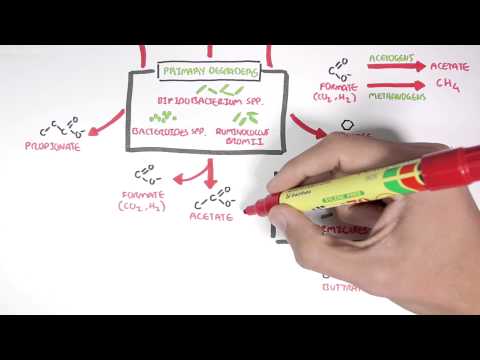
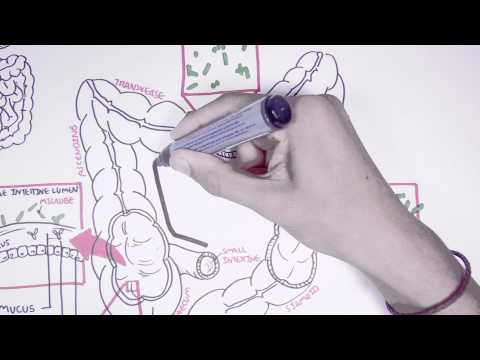
0:00 The colon is colonized by trillions of bacteria. 0:07 If we zoom into a section of the colon, we can find the colon cells. 0:12 And on top of the cells, towards the lumen is mucus. 0:16 Bacteria reside on the mucus, and within the lumen. 0:21 These bacteria have many functions in our body, one of which is fermenting 0:25 foods that have escaped digestion in a smaller testing. 0:30 Butrate is an end product of intestinal bacterial fermentation, of mainly non- 0:36 digestable carbohydrates, such as resistant starch. 0:41 So here we have resistant starch, which has reached the colon. 0:45 Bacteria will ferment the resistant starch, and through cross-feeding with 0:49 other bacteria, butrate is produced. 0:55 Butrate is a four-carbon short-chain fatty acid. 0:59 Butrate is absorbed by the colon cells, and is the main source of energy for 1:04 these colon cells. 1:06 Therefore, there are lower concentrations of butrate that enter the bloodstream 1:11 , compared to other short-chain fatty acids, such as acetate and propionate. 1:18 There is increasing interest regarding the effects butrate have on colon health 1:22 . 1:23 For example, studies have shown that butrate prevents the development and 1:27 progression of colon cancer. 1:30 It should be pointed out, however, that the knowledge and hypothesis concerning 1:34 the effects of butrate are mainly based on in vitro cell systems and animal 1:41 studies. 1:43 More human studies are needed to support some of these findings. 1:49 In this video, we will explore and discuss the effects of butrate on colon 1:54 health, based on current literature. 1:57 So here I am drawing a section of the colon again with the blood vessel. 2:01 Within the blood vessel, we can find red blood cells and immune cells, such as 2:06 the neutrophil. 2:08 The neutrophils play a key role in phagocytosis. 2:13 A butrate, as I mentioned, is produced through bacterial fermentation. 2:18 The effects butrate have on the colon in general include increasing mucus 2:21 production, decreasing cell permeability, promoting tight junctions, and 2:26 decreasing pH. 2:28 These effects all improve the colonic defense barrier, leading to enhanced 2:33 protection against lumenal antigens. 2:36 Of course, butrate does more than this, according to literature. 2:42 We will focus now in more detail on the effects butrate have on four specific 2:48 types of cells, a normal colon cell, an inflamed colon cell, a cancerous colon 2:56 cell, and the neutrophil. 3:00 Let us begin with the normal colon cell. 3:05 So here is a colon plasma membrane, the outer membrane, and here is a nucleus, 3:15 which contains the DNA. 3:19 The colon cells plasma membrane, as well as on other cell membranes, there are 3:25 a variety of short chain fatty acid receptors and transporters. 3:32 Butrate elicits its effects through the G protein receptor 109A and G protein 3:38 receptor 4143, which I have not drawn, and can be transported inside the cell 3:45 through the monocarboxylate transporter 1, MCT1, and the sodium monocarboxylate 3:50 transporter 1, SMCT1. 3:54 MCT1 works as a co-transporter for hydrogen and butrate. 4:02 SMCT1 functions as a co-transporter for sodium and butrate. 4:07 Now, if there was a lot of butrate being absorbed by the colon cell, this may 4:12 result in a lot of sodium being absorbed, thanks to the SMCT1 transporter. 4:19 And if a lot of sodium is absorbed, water tends to follow. 4:24 And because of this property, butrate is considered as an anti-diarrheal agent. 4:33 Now butrate is the preferred fuel in colon cells. 4:38 Butrate is used preferentially over glucose. 4:43 Butrate is oxidized in the colon cells to produce energy, maintaining colon 4:51 cell integrity and health. 4:55 Within cells, there is an enzyme called histone deacetylase, or HDAC. 5:02 What HDAC does is that it causes DNA to be less accessible to transcription 5:09 factors and also affects other proteins by removing acetyl groups from them. 5:16 And therefore, you can think of HDAC as an enzyme that suppresses genes and 5:24 proteins. 5:26 Butrate has been shown to be an inhibitor of HDAC. 5:31 Through this function, butrate helps maintain colon homeostasis. 5:39 Butrate can also bind onto the G protein receptor 109A, which can cause 5:46 activation or inhibition of certain transcription factors. 5:50 And we will look into this as we move through the video. 5:55 Finally, if butrate is in an undiscociated form, which is a lipid soluble form, 6:00 it can enter the cell by diffusion through the plasma membranes without 6:06 receptors or transports. 6:09 Now apart from helping in maintaining homeostasis in the colon, butrate can 6:14 exert direct anti-inflammatory effects. 6:18 The colon cells are permanently in close association with trillions of microbes 6:23 and their products. 6:25 Therefore, the colon cells must have some form of response to this potential 6:31 challenge. 6:33 So, and this is inflammation. So here we have an inflamed colon cell. 6:40 In an inflamed cell, there is activation of transcription factors that controls 6:46 the expression of inflammatory cytokines and other proteins. 6:51 One of these transcription factors is nucleofactor cappa B. 6:58 Nucleofactor cappa B will stimulate the transcription of RNA that will produce 7:04 inflammatory mediators and proteins, cytokines, that will then be released by 7:12 the inflamed cell. 7:14 These inflammatory proteins will promote the inflammatory response. 7:22 Examples of these proteins and enzymes produced are COX2 and prostaglandins. 7:29 In an inflamed colon cell, HDAC may also be suppressing important genes that 7:40 normally maintains colon cell function and health. 7:47 Butrate can enter the inflamed cell through the MCT1 and SMCT1. 7:53 From here, butrate can inhibit HDAC histone deacetylase, because butrate is a 8:02 HDAC inhibitor. 8:06 By inhibiting HDAC, there can be activation of certain genes, such as for glut 8:14 athione S transferases, or GSTs. 8:18 GSTs will reduce oxidative stress associated with inflammation. 8:27 Butrate mainly reduces inflammation by inhibiting nucleofactor cappa B through 8:35 the G protein receptor 109A, thus inhibiting the production of inflammatory 8:42 proteins. 8:44 So that was the effect butrate have on an inflamed colon cell. 8:53 Let us move on. One of the proposed beneficial effects of butrate on the human 8:59 colon health is the effect butrate has on colon carcinogenesis. 9:04 Butrate has shown to prevent and inhibit colon carcinogenesis. 9:09 So here I'm drawing a colon cancer cell. 9:15 Before continuing on, it must be noted that once a colon cell becomes cancerous 9:20 , the colon cancer cell seems to prefer glucose over butrate as an energy source 9:26 . 9:27 Also, the effect of butrate on an inflamed colon cell can apply for colon 9:35 cancer cell, such as butrate's inhibitory effect on nucleofactor cappa B. 9:46 Now within a colon cancer cell, there may be hypermethylation in the DNA, 9:50 specifically an increase in methylation on promoter regions, which are regions 9:58 that initiate transcription. 10:08 To add further to this, the expression of certain receptors on colon cancer 10:21 cells, such as the receptors for butrate are reduced, are under expressed. 10:33 And this may be directly or indirectly associated with DNA hypermethylation, as 10:40 well as an increase in histone methylation, thanks to the contribution of hist 10:47 one diacetylase. 10:49 Now it should be noted that DNA methylation and histone methylation are two 10:56 different things. 10:59 Histone diacetylases also may be more active in colon cancer cells. 11:07 Now colon cancer cells love to proliferate. At the same time, these cells 11:13 require more and more energy and nutrients. 11:18 In order to do so, there is an increase in HIF1 alpha and VEGF, which are angi 11:25 ogenic factors that promote angiogenesis, the formation and maturation of blood 11:33 vessels. 11:38 Now butrate can enter the cell or activate the G protein receptor 109a if the 11:47 channels and receptors are expressed. 11:51 By activating the G protein receptor 109a, butrate can activate P53, 11:58 independent of the histone diacetylase. 12:04 P53 is a transcription factor that regulates the expression of the stress 12:11 response gene and many anti proliferative processes. 12:17 So butrate inhibits the development and proliferation of cancer cells because 12:23 the activation of the P53 transcription factor will activate genes that encode 12:30 for proteins such as P21. 12:35 P21 acts as a stop signal for cell division. This is good because P21 will 12:42 reduce cell proliferation, one of the hallmarks of cancer. 12:50 Further, activated P53 can initiate apoptosis through activation of pro apopt 12:59 otic proteins. 13:05 Now butrate within the cell can inhibit histone diacetylase, allowing access of 13:09 certain transcription factors. 13:14 Interestingly, cancer cells appear to be a lot more sensitive to histone diacet 13:19 ylase inhibitors, such as butrate. 13:23 Inhibition of histone diacetylase, HDAC, can allow expression of genes that 13:31 code for glutathione S transferases, for example, which will reduce oxidative 13:39 damage. 13:48 Finally, butrate can affect the immune system in many ways, but for now we will 13:53 concentrate on the effects butrate have on neutrophils. 13:57 Butrate can act on the G protein receptor 43 and 41 on immune cells. 14:07 By activating G protein receptor 43, butrate has shown to have chemotactic 14:12 properties, allowing more neutrophils to be recruited to the area of interest. 14:19 By recruiting more immune cells to the area, for example, the neutrophils are 14:24 able to remove unwanted substances or bacteria from the mucosal system. 14:33 And this concludes the video on butrate. The effects of butrate are diverse and 14:38 complex. New hypotheses and findings are mainly based on in vitro data and 14:44 animal models. 14:47 More emphasis should be placed on human in vivo studies to unravel the role of 14:53 butrate in human health and disease.