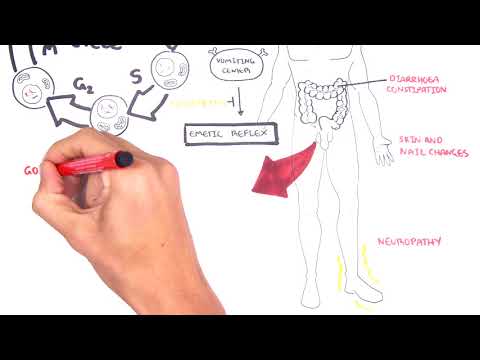
0:00 Hello, in this video we're going to talk about the physiology of vomiting. 0:08 Vomiting is also known as emesis and throwing up, amongst many other terms, and 0:14 it is an 0:15 involuntary, forceful expulsion of the contents of one stomach, essentially 0:21 through the mouth. 0:23 We will look at the so-called "ematic reflex", which is the vomiting reflex. 0:29 And in order to understand the vomiting reflex, we need to talk about the brain 0:34 . 0:34 So here is the brain and the brain stem. 0:36 There's an area of the brain stem called the medulla obendata, where we find 0:41 what's called 0:42 the vomiting center. 0:44 The vomiting center contains essentially muscularic receptors, types of 0:49 receptors, and when these 0:51 receptors are stimulated, within the vomiting center, this will trigger the 0:56 vomiting reflex, 0:57 so the process of vomiting. 1:01 Close to the vomiting center, also near the medulla obendada of the brain stem, 1:05 is another 1:06 area called the chemoreceptor trigger zone, or CTZ for short. 1:13 Now, the CTZ, as the name suggests, gets triggered by chemicals. 1:20 But the CTZ contains a few types of receptors, and these are the dopamine II 1:26 receptors, and 1:27 the VHT receptors. 1:30 VHT essentially is serotonin, so these are serotonin receptors. 1:36 It's easy to remember CTZ because we know that chemotherapy stimulates this 1:43 chemoreceptor 1:44 trigger zone. 1:46 So when the chemoreceptor trigger zone, the CTZ, is stimulated, it will then 1:51 stimulate 1:52 the muscularic receptors of the vomiting center, and when the muscularic 1:56 receptors of the vomiting 1:58 center are stimulated, this will cause the vomiting reflex, the e-matic reflex. 2:06 Though the chemoreceptor trigger zone is located in the medulla, like the 2:11 vomiting center, 2:12 the chemoreceptor trigger zone is located conveniently outside the blood brain 2:18 barrier. 2:19 Now, the blood brain barrier is a barrier preventing circulating substances in 2:24 the blood 2:25 from making contact with the brain and areas of the brain stem. 2:31 Because the chemoreceptor trigger zone is situated outside the blood brain 2:34 barrier, it 2:35 is thus more permeable to circulating substances such as cytotoxic agents 2:42 chemotherapy. 2:44 Motion sickness is a very common thing people experience, and the cause of 2:49 motion sickness 2:50 actually comes from the inner ear, a bony structure called the labyrinth. 2:57 The labyrinth is made up of many areas, one of which is called the vestibule, a 3:01 structure 3:01 important for balance in space. 3:06 Problems here will send electrical signals to the brain stem via the vestibular 3:11 cochlear 3:12 nerve, and the signals will get sent to an area specifically in the brain stem 3:17 called 3:18 the vestibule nuclei, which is located in the pongs of the brain stem. 3:24 The vestibule nuclei contain histamine 1 receptors, and also muscarinic 3:33 receptors. 3:35 So when the vestibular nuclei is stimulated during, let's just say, motion 3:40 sickness, or 3:41 during also morning sickness, these signals will then be passed on to the chem 3:48 oreceptor 3:49 trigger zone, and from here the chemoreceptor trigger zone will then send 3:53 signals to the 3:54 vomiting center in the medallablongata to trigger the vomiting reflex. 4:00 Another cause of vomiting are things that occur from the cerebrum, or the brain 4:06 , after 4:06 it has processed all this sensory information. 4:10 So what I mean is that, for example, when people are emotionally overwhelmed, 4:17 or when 4:18 people are in severe pain, or when they smell something really bad, or they see 4:24 something 4:25 repulsive, something really bad, essentially all this stuff will get sensed by 4:30 the brain 4:31 by the higher centers of the brain. 4:33 And from the higher brain centers, this will then, this signal then travel down 4:39 to the 4:39 vomiting center to stimulate the vomiting center to initiate the vomiting 4:45 reflex. 4:45 This makes sense because some people get really nauseous when they see blood, 4:51 or guts, or 4:51 they smell something like a type of food that just smells horrible. 4:56 Again, the higher brain centers stimulate the vomiting center through muscar 5:02 inic receptors. 5:04 Other causes of vomiting occur in the stomach, so let's just recap some anatomy 5:09 here. 5:09 So we have the mouth, which connects to the esophagus, which will travel down 5:14 through 5:14 the diaphragm, which is the muscle, muscular structure. 5:19 The esophagus will then join onto the stomach, and then the stomach joins onto 5:22 the small 5:23 intestine. 5:26 If we were to zoom into the stomach, we can see they form deep pits, deep pits, 5:32 and glands. 5:34 And these are lined up by many different types of cells, one of which are 5:38 called enterochromophin 5:40 cells. 5:42 The enterochromophin cells release serotonin in response to cytotoxic agents, 5:49 which is 5:50 also thought to stimulate then five HT3 receptors on sensory nerve fibers 5:58 around the area. 6:00 And stimulation of this sensory nerve fiber, which is actually the vagal nerve, 6:05 will bring 6:05 this information to the vomiting center to trigger the vomiting reflex. 6:13 In summary, all the causes of vomiting we talked about essentially will 6:18 stimulate the 6:19 vomiting center, which is the output from which the vomiting reflex or the em 6:25 etic reflex 6:26 is initiated. 6:28 Let's focus on what the vomiting reflex is, and actually what happens during 6:33 the process. 6:34 First, it actually causes the lower esophageal sphincter to relax, which makes 6:39 sense because 6:40 we need food to come up towards the mouth when we vomit. 6:45 We also need the diaphragm to contract, and also the abdominal muscles to 6:50 contract, so 6:51 that it will help push the food back up. 6:54 And this happens because we are increasing intra-abdominal pressure when we 6:59 contract 6:59 our muscles. 7:03 There are also autonomic changes such as tachycardia, which is increase in 7:08 heart rate, and we also 7:09 increase salvation as well as peristalsis. 7:14 The vomiting reflex also causes the epiglottis to close at the top part, 7:19 because we don't 7:20 want food to travel down to the lungs. 7:23 And once the vomiting reflex does all these things, then the vomit or the food, 7:29 expulsion 7:29 of food, can happen. 7:33 So that was the physiology of vomiting, the emetic reflex, the vomiting reflex. 7:38 Now let's talk about the medications that are used to treat, manage, and 7:44 prevent nausea 7:45 and vomiting in an acute as well as chronic situations. 7:50 These medications are also known as anti-emetics, basically preventing emesis, 7:55 preventing vomiting. 7:58 And the different classes of anti-emetics include histamine-1 receptor 8:05 antagonists. 8:06 Histamine-1 antagonists are also called histamine blockers, which include pro-m 8:13 ethasine. 8:14 So they're also called anti-histamines, and these class of medications, 8:17 actually just 8:18 they, as the name suggests, block histamine, specifically histamine-1 receptors 8:24 . 8:24 And these medications are actually commonly used to help relieve allergic 8:28 reactions, but 8:29 they are also effective in nausea and vomiting, specifically nausea and 8:34 vomiting to do with 8:35 motion sickness or morning sickness, as this diagram depicts. 8:41 Then there is the 5HT3 receptors antagonists. 8:46 However, these, because they end in satron, and they include on dansatron. 8:54 5HT, as we mentioned earlier in the video, is serotonin. 9:00 So 5HT3 receptors are serotonin receptors, and therefore 5HT3 receptor 9:07 antagonists are 9:08 serotonin receptor antagonists. 9:11 And these medications are used to control nausea and vomiting by working at the 9:15 chemoreceptor 9:15 trigger zone, but also, possibly, the gastrointestinal tract, which we will 9:23 talk about. 9:24 Dopamine-2 receptor antagonists work on the chemoreceptor trigger zone, and 9:30 include a 9:31 variety of subclasses, you can say. 9:36 It's easy to remember this one concept, that dopamine-2 receptor antagonists 9:40 are also 9:41 same or similar drugs that are used to treat schizophrenia or psychosis. 9:46 So these dopamine-2 receptor antagonists can be subdivided into a few groups. 9:54 The first group are the antipsychotics that end in azines, so for example pro 10:00 chloroparazine 10:01 and clopromazine. 10:04 And the second group is mettoclopromide, which actually inhibits dopamine-2 10:10 receptors, but 10:11 are thought to also stimulate gastrointestinal tract activity. 10:16 The final group is droparadol, which also inhibits dopamine-2 receptors, 10:23 similar to 10:24 haloparadol, and these guys are also used to treat schizophrenia. 10:31 So those were the dopamine-2 receptor antagonists class. 10:35 The fourth class are the muscarinic receptor antagonists, such as hyosin with a 10:44 H. These 10:45 guys block the receptors in the vomiting center, inhibiting the vomiting reflex 10:53 . 10:54 So let's look now at each of the anti-ametic classes in a bit more detail and 10:58 see what 10:59 they're good for and see what the side effects are. 11:02 Let's begin by looking at the histamine-1 receptor antagonists, such as prometh 11:08 azine. 11:09 And these guys are good for motion sickness and morning sickness. 11:12 The side effects of these drugs include drowsiness and sedation. 11:18 The serotonin receptor antagonists, ending in cetron, such as undansetron, are 11:24 good anti-imetics 11:25 for patients undergoing chemotherapy, radiation, but also patients post-surgery 11:31 as well. 11:32 The side effects of these drugs include headache as well as gastrointestinal 11:38 upset. 11:39 Remember that these drugs can also work locally at the gastrointestinal tract, 11:44 which we'll 11:44 talk about. 11:47 The next class is your dopamine-2 receptor antagonists, which are your antip 11:50 sychotics 11:51 essentially. The first group are your antipsychotic groups that end in azines, 11:58 such as procloparazine 11:58 and clopromazine, and they are good anti-metic drugs for chemotherapy and 12:03 radiation patients. 12:04 They also block histamine and muscarinic receptors as well, which may be useful 12:10 in certain situations. 12:12 The side effects include sedation, hypotension, and extra-paramidal side 12:19 effects. 12:21 It's important to mention extra-paramidal side effects here, because this is a 12:25 side 12:25 effects shed by a lot of antipsychotic medications, and we'll talk a little bit 12:32 more about that 12:33 when we get into meta-clopromide, which is your next essentially group. 12:38 So meta-clopromide is good for chemotherapy radiation patients who have nausea 12:45 and vomiting, 12:46 as well as patients with reflux and hepatobiliary disorders. 12:51 The mechanism of action of meta-clopromide not only does it work as a dopamine- 12:57 2 receptor 12:58 antagonist, but it also works in the gut, increasing gut motility. 13:04 The side effects of meta-clopromide, other than diastrointestinal upset, 13:10 include extra-paramidal 13:11 side effects. 13:14 Extra-paramidal side effects, as mentioned, is a common side effect in antip 13:17 sychotic medications, 13:19 and these extra-paramidal side effects include acasthesia, which is arrest 13:25 lessness, tardive 13:26 anesthesia, spasmodic tordicollis, oculogirous crisis, and also it can also 13:32 increase prolactin 13:34 levels, which can result in lactorrhea, menstrual problems, as well as more 13:40 lactation. 13:41 Droparidol is your sort of other group of dopamine-2 receptor antagonists, and 13:46 these 13:46 are also antipsychotics as well, and these drugs are good for acute 13:52 chemotherapy-induced 13:54 vomiting. 13:56 Droparidol is also used in surgery for post-operative nausea and vomiting. 14:03 So now, focusing on the stomach area, remember that we talked about the 14:08 serotonin-receptor 14:09 antagonists, the 5HT3 receptor antagonists, well, they can also work locally in 14:15 the gut 14:15 because there are serotonin receptors on sensory nerve fibers here, and so, 14:23 what happens is 14:25 that ondancetron, for example, can work locally here. 14:29 Thus, ondancetron is often used in pregnancy for those with bad nausea and 14:33 vomiting, although 14:35 it is not recommended in the first trimester, and there are some conflicting 14:39 sort of evidence, 14:40 you can say. 14:41 Finally, the muscarinic receptor antagonists or anticolonurgics, such as heyos 14:47 in with 14:47 a H, are good as prophylaxis for certain conditions and situations, as well as 14:54 for motion sickness. 14:56 Side effects of these medications include having a dry mouth, blurry vision, 15:01 and drowsiness. 15:02 It's easy to remember these side effects because they are anticolonergic side 15:08 effects, 15:08 and remember Alice in Wonderland for the anticolonergic syndrome. 15:14 The muscarinic receptor antagonists are good as prophylaxis and for treating 15:19 motion sickness 15:20 because they also work at the vestibular nuclei, which is where the whole 15:26 process is, if you 15:27 remember. 15:29 So that concludes the video on the pharmacology of vomiting. 15:37 So that concludes the video on the pharmacology of anti-medics. 15:41 There are obviously other anti-medics used, which I have not mentioned, but 15:44 this is the 15:44 overall group and classes. 15:47 Thank you for watching, I hope you enjoyed this video.