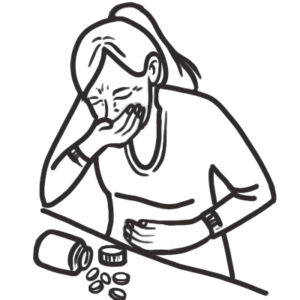
0:00 Hello. In this video, we're going to talk about non-steroidal anti-inflammatory 0:07 drugs, 0:07 also known as NSAIDs. This is a pharmacology video. Now, NSAIDs are very common 0:13 drugs 0:14 used by the public. It is used specifically for pain. So, in order to 0:20 understand its 0:21 mechanism of action, we need to revise some basic neurology, specifically the 0:26 pain pathway. 0:27 So here we have a section of the cortex where sensation is perceived called the 0:34 somatosensory 0:36 cortex. And again, this is a section of the brain where sensation is perceived. 0:41 So when 0:41 you feel pressure against your skin or when you feel pain on your arm, those 0:46 sensations 0:46 are felt in this part of the brain. And so, the somatosensory cortex can be 0:51 further 0:52 divided into areas representing different parts of your body, your limbs. So, 0:58 we'll 0:58 talk about that later on. Now, the brain connects to the brainstem, which is 1:03 made up of three 1:03 important parts. These are the midbrain, the pons, and the medulla. These are 1:08 only sections 1:09 of the main of those parts of the brainstem. The brainstem continues on and 1:14 forms the spinal 1:16 cord. Here, I'm only drawing one section of the spinal cord. The spinal cord 1:21 have nerves 1:21 coming in and out of it are represented here in yellow. Here is the right side 1:30 and left 1:30 side of the spinal cord, because remember, we are looking at this from the 1:36 front. So neurons 1:37 travel into the spinal cord through from the back, from the dorsal part of the 1:44 spinal cord. 1:45 Here in yellow is a first order neuron. This first order neuron is a sensory 1:52 neuron, which 1:53 brings in information of or action potential of a pain, temperature, pressure, 2:00 et cetera. 2:01 The sensory neurons have many receptors on their dendrites. Let's say, for 2:08 example, 2:08 this first order neuron is innervating a tissue of our skin. Let's just say it 2:14 's the right 2:14 hand, our right hand. Now imagine there is a cut or damage to that area of 2:21 tissue, the 2:22 right hand. Immune cells within the area will get activated and further recruit 2:28 more immune 2:29 cells, mounting an inflammatory response. Here you have immune cells such as 2:35 neutrophils, 2:36 macrophages, and mast cells. All these cells, as well as the damaged skin cells 2:42 , will release 2:42 inflammatory mediators. These are things such as prostaglandins, radicynin, ATP 2:48 , hydrogen 2:51 ions, as well as serotonin, and histamine, and there are many, many more. All 2:56 these mediators 2:57 will stimulate receptors on these sensory nerve fibers. Prostaglandins, for 3:04 example, 3:04 will bind onto what's called prostanoid receptors, causing a deep polarization 3:10 of the neuron, 3:12 thus stimulating essentially this first order neuron. Radicynin will bind onto 3:18 what's called 3:19 a B2 receptor, causing a depolarization as well, and thus, again, stimulating 3:26 this neuron, 3:27 stimulating the first order neuron. And the other mediators will also somehow 3:32 stimulate 3:32 the first order neuron through other mechanisms and other receptors. What's 3:38 fascinating is 3:38 that when this first order neuron is stimulated, it will further promote an 3:43 inflammatory response 3:44 by releasing other chemicals such as substance P and CGRP. Thus, this 3:51 inflammatory process 3:53 is amplified. Because there are many inflammatory mediators being produced, it 4:03 's important to 4:04 remember one of them here, which actually plays one of the main roles in this 4:09 pain pathway. 4:10 The one I'm talking about is prostaglandins, specifically prostaglandin E2 and 4:18 F2. Prostaglandin 4:19 E2 causes depolarization and, of course, will thus cause an action potential. 4:25 This action 4:26 potential will travel all the way to the end, to the back, or the dorsal horn 4:32 of the spinal 4:33 cord. At the dorsal horn of the spinal cord, the first order neuron will sign 4:39 up and relay 4:40 the stimuli to a second neuron. The second order neuron will cross over to the 4:47 other side from 4:49 the right to the left, and will enter what's called the spinal thalamic tract. 4:55 And you have 4:55 two spinal thalamic tracts, the anterior and the lateral spinal thalamic tract. 5:01 The second 5:01 order neuron will travel up towards the brain, past the brainstem, and 5:07 terminate at the thalamus. 5:10 The thalamus is a relay station in the brain. In the thalamus, the second order 5:15 neuron will 5:16 sign up with a third neuron called the third order neuron. The third order 5:21 neuron, which 5:22 is now stimulated, will carry this action potential stimuli to the somatosens 5:29 ory cortex. 5:31 And the third order neuron will actually discern which area of the body that 5:36 information originated 5:38 from. So here, it will be the hand. And so here, the somatosensory area for the 5:44 right 5:45 hand, the perception of pain is felt. Interesting point about sensation, 5:51 whatever we feel on 5:53 the right, it's processed on the left side of the brain, and vice versa. So let 5:59 's go 6:00 to the very beginning where the pain pathway started. Now, because prostate 6:05 glandans are 6:05 very important players, important mediators of inflammation and thus pain, let 6:11 us see 6:11 how it is made. During periods of trauma or injury, many cells around the area, 6:18 in this 6:18 case immune cells and damaged skin cells will convert their phospholipids, 6:22 their cell membrane 6:24 into arachidonic acid. Arachidonic acid, or double A, can be converted to prost 6:30 aglandin 6:31 H2. Prostaglandin H2 then becomes prostaglandin E2 and prostaglandin F2. These 6:39 prostaglandins 6:40 are the ones that initiate or cause fever, enhance pain and inflammation. The 6:46 enzymes 6:48 responsible for the production of these are cyclooxygenase 1, COX1 and cyclooxy 6:54 genase 2, COX2. 6:56 Interestingly, COX1 and COX2, despite being of the same name really, are very 7:04 different. 7:05 You see, COX1 is always active to maintain homeostasis in our body. It's a good 7:13 guy. 7:13 COX2 is the one active during injury, stress and trauma. For example, let's 7:21 take a look at platelets. 7:22 When we cut ourselves, we need to stop bleeding. Platelets help with this. What 7:28 happens here is 7:29 that COX1 converts arachidonic acid to prostaglandin H2. Prostaglandin H2, as 7:35 we have 7:35 just learned earlier, can then be converted to prostaglandin E2 and F2. However 7:41 , in platelets, 7:42 something different happens. Prostaglandin H2 is actually converted to thrombox 7:47 in A2. 7:48 Thromboxin A2 is a chemical causing platelet aggregation to help stop bleeding. 7:54 NSAIDs work by blocking the COX enzyme. They can be broadly divided into non- 8:02 specific, 8:02 also known as non-selective NSAIDs, where they block both COX1 and COX2, 8:08 and these drugs include aspirin, ibuprofen and naproxin, or they can be divided 8:15 into specific, 8:16 also known as selective NSAIDs, which block specifically COX2 enzyme. This is 8:25 COXib, such as 8:25 silicoxib, for example. Non-strotal anti-inflammatory drugs, such as your 8:32 common ibuprofen, 8:33 are non-selective, and so they block both COX1 and COX2. Thus, they are 8:41 actually anti-pyrtic, 8:43 analgesic, and anti-inflammatory. Side effects of these drugs mean that they 8:50 are anticoagulants, 8:52 so you can bleed easily. You can also be partially allergic to getting a skin 8:57 rash, 8:58 and also NSAIDs can induce bronchospasm, because some prostaglandins have a 9:03 role in bronchodilation. 9:05 Many people take aspirin. Aspirin is unique because they really mainly work by 9:13 inhibiting 9:14 COX in platelets, thus preventing formation of thromboxin A2. Thromboxin A2 9:21 normally 9:21 causes platelets to clump together, a process known as platelet aggregation. 9:28 Thus, aspirin 9:30 thins the blood, so you can say it reduces clotting. Unfortunately, COX1, as 9:36 mentioned earlier, 9:37 is normally active and maintains homeostasis of the body, particularly in the 9:42 stomach and in the 9:44 kidneys. And so inhibiting COX1 can have some bad effects on these organs. In 9:50 the stomach, for 9:51 example, COX1 converts arachidonic acid to prostaglandin H2, which then forms 9:58 prostaglandin E2 and 10:00 prostaglandin I2. These prostaglandins actually help decrease acid production 10:06 in the stomach. 10:07 And so by inhibiting COX1 here, you are essentially allowing more acid to be 10:13 produced in the stomach, 10:14 so side effects include dyspepsia, nausea and vomiting, gastric ulcers and 10:20 hemorrhage 10:21 are potential long-term high dose consequences. In the kidney, COX1 normally 10:27 converts 10:28 arachidonic acid to prostaglandin H2, which then makes prostaglandin E2 and 10:34 prostaglandin I2. 10:36 In the kidney, these prostaglandins help maintain renal blood flow. Therefore, 10:42 NSAIDs can actually just cause nephritis and kidney injury. NSAIDs are also one 10:49 of three drugs 10:51 which make up what's called the triple whammy. Triple whammy is a combination 10:55 of three drugs 10:55 you do not want to be on, especially if you have some kidney problem. These 11:00 three drugs drugs are 11:02 diuretics, NSAIDs and ACE inhibitors, or angiotensin receptor blockers. 11:10 So we just talked about non-selective or nonspecific NSAIDs. Now let's focus on 11:16 selective or specific NSAIDs. Now selective NSAIDs were created to reduce the 11:22 side effects 11:22 of non-selective ones. Another very common drug is paracetamol, or you can know 11:28 it as a 11:29 "panadol". It's taught to elicit its mechanism of action in a similar way. 11:33 However, it is unclear 11:35 actually how it works, but potentially it inhibits an isoform of the COX enzyme 11:41 . It is a potent 11:43 analgesic and anti-piratic but has no anti-inflammatory role. Important to note 11:51 that high doses of 11:53 paracetamol can lead to liver toxicity. I hope you enjoyed this video on the 11:59 pharmacology of 12:00 non-strotal anti-inflammatory drugs. Thank you for watching. If you want to 12:04 know more about the 12:05 pain pathway, click on the link.