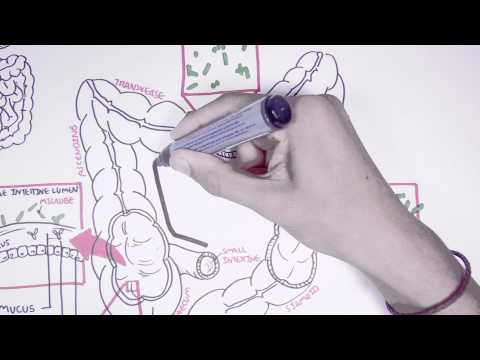
0:00 Some foods are not digested and absorbed by the small intestine, and so reach 0:14 the large 0:15 intestine, also known as the colon. 0:19 Resistant starch, for example, is a portion of starch that escapes digestion in 0:24 small intestine 0:25 because it is resistant to human digestive enzymes. 0:31 However, resistant starch still contain energy that our body needs. 0:37 And so once resistant starch reaches the colon, the resistant starch will 0:42 undergo fermentation 0:44 by the trillions of bacteria that live there. 0:48 Through fermentation, the bacteria produce substances, such as short-chain 0:53 fatty acids, 0:54 which our colon cells use as their main source of energy. 1:01 In this video, we will focus on the process of starch fermentation, starch that 1:09 has resisted 1:10 digestion in the small intestine and reach the colon are called resistant 1:17 starch. 1:18 Resistant starch will undergo fermentation by bacteria in the colon. 1:24 And starch are made up of amylose and amylopectin, which are two forms of 1:31 glucose polymers. 1:33 Fermentation of carbohydrates such as resistant starch lead to the production 1:37 of short-chain 1:38 fatty acids. 1:41 Let us look at a simple pathway of how these short-chain fatty acids are 1:48 produced. 1:48 Now within the colon, you have primary degraders of resistant starch, such as b 1:55 ifidobacterium 1:56 species, bacteroides species, and ruminococcus bromide. 2:04 The primary degraders have enzymes that are important in breaking down 2:07 resistant starch 2:08 and fermenting it. 2:12 Many products are produced through the fermentation of resistant starch by the 2:17 primary degraders. 2:21 Glucose can be released thanks to membrane-bound enzymes that cleave off 2:28 glucose polymers. 2:30 Through fermentation of glucose, these primary degraders can produce the two 2:35 carbon short-chain 2:35 fatty acid acetate and release formate in the process. 2:43 Formate is essentially gases, carbon dioxide and hydrogen. 2:47 These can later be used by other bacterial species that live in the colon. 2:54 Through the fermentation of glucose, the primary degraders can also produce the 2:58 three carbon 3:00 short-chain fatty acid called propionate, which also forms some gases as a by 3:09 product. 3:10 Now succinate and lactate are also produced by these primary degraders and are 3:16 efficiently 3:17 utilized by certain anaerobic bacteria. 3:22 The gases formed through fermentation, such as formate, can be utilized by met 3:29 hanogens 3:30 to produce methane. 3:34 Interesting fact, methane and other gases, such as carbon dioxide and hydrogen, 3:39 contribute 3:40 to the chemistry of fat and its smell. 3:44 Because these gases are produced in the lumen of the colon, they are often 3:49 expelled out. 3:51 Also, if there are sufficient amounts of formate, acetogens are able to utilize 3:55 formate to 3:56 produce acetate. 4:01 Now back to the degraders. 4:03 There are another set of bacteria called the secondary degraders that also 4:07 contribute 4:08 to the fermentation of resistance starch. 4:11 However, the secondary degraders are considered to have no enzymes that 4:17 initiate the cleavage 4:18 of glucose from the glucose polymers that make up resistance starch. 4:24 And so the secondary degraders, such as the formicute species, rely on the 4:29 primary degraders 4:30 to release glucose monomers. 4:35 The formicute species can utilize the glucose and ferment it to produce a four 4:42 carbon short-chain 4:43 fatty acid called butyrate. 4:46 Some of the secondary degraders can also utilize acetate to produce butyrate as 4:51 an end product. 4:55 So through the fermentation of starch, acetate, propionate and butyrate are the 5:00 main short-chain 5:01 fatty acids produced, normally in a 3-2-1-2-1 ratio, so more acetate being 5:10 produced. 5:11 At a low pH, about 5.5, butyrate-producing bacteria are known to dominate the 5:18 colon. 5:18 However, at a slightly higher pH, about 6.5, acetate and propionate-producing 5:25 bacteria dominate 5:26 and butyrate-producing bacteria seem to be less prominent. 5:34 From the lumen, these short-chain fatty acids are absorbed by the colon. 5:39 They're absorbed by the colon epithelial cells, known simply as colonocytes. 5:52 About 95% of the short-chain fatty acids are rapidly absorbed by the colon 5:58 cells, while 5:58 the remaining 5% are excreted in the feces. 6:04 After being absorbed by the colon cells, the short-chain fatty acids can enter 6:08 circulation 6:09 and enter the portal vein, which is blood traveling towards the liver. 6:15 Here, propionate and acetate enter the portal blood. 6:21 Butyrate on the other hand is the major energy source for colon cells, 6:26 resulting in low concentrations 6:29 of butyrate in portal blood. 6:34 Now let's briefly find out the fates of the short-chain fatty acids. 6:40 So acetate is the principal short-chain fatty acid in the colon. 6:44 It is metabolized in peripheral tissues. 6:47 In the liver, acetate has shown to stimulate lipogenesis, the synthesis of fats 6:53 . 6:53 Acetate is also the primary substrate for cholesterol synthesis. 7:01 Acetate travels to the liver and is used as a substrate for gluconeogenesis. 7:10 Butyrate is the preferred fuel for colon cells. 7:13 About 75% of energy for colon cells come from butyrate. 7:19 And because of this, there are lower amounts of butyrate in the blood, compared 7:23 to the 7:23 other short-chain fatty acids. 7:26 In the liver, butyrate is oxidized, preventing toxic systemic concentrations. 7:37 And that concludes this video. 7:40 We looked at starch fermentation and how fermentation of resistance starch by 7:46 bacteria produce short-chain 7:48 fatty acids, such as acetate, propionate, and butyrate, all of which have many 7:55 effects 7:56 on human health and disease.