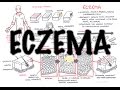
0:00 Hello, in this video we're going to talk about eczema. 0:07 This is an introduction, an overview. 0:11 So eczema is a highly puritic, itchy inflammatory skin condition and primarily 0:16 affects young 0:16 children and is often associated with atopic disorders. 0:21 The prevalence of eczema has greatly increased in industrialized countries. 0:27 So some signs and symptoms of eczema include young age, paritis, which is 0:33 itching, cirrhosis, 0:35 which is having a dry skin. 0:37 You can have hypopigmentation in the skin lesion itself, excoriations, also 0:43 known as 0:43 scratch marks, as well as presence of other atopic disorders such as rhinitis 0:50 and asthma. 0:52 Other skin findings include erythema, scaling, vesicles, and papules. 1:02 Now eczema mainly affects flexor surfaces, and this includes the cubital fossa 1:06 area of 1:07 the elbow, behind the knees, around the groin area, and in front of the neck. 1:15 Let us look at the pathological changes we see in the skin of someone who has 1:21 eczema. 1:22 So here I'm drawing a normal skin. 1:26 The skin has three layers, the very top is the epidermis, then the dermis and 1:29 then the 1:30 hypodermis. 1:32 Let us zoom into the epidermis layer, the epidermal layer of the normal skin. 1:37 The epidermis is the very top layer of the skin and contains tightly packed 1:43 cells, which 1:43 are well hydrated. 1:45 On the very top of this layer, we have bacteria reciting on the surface. 1:52 This is normal and they don't usually cause any problems. 1:56 However, if this skin progresses to eczema, we can see some big changes. 2:04 Eczema can be either acute, subacute, or chronic. 2:09 In acute eczema, the cells that were once tightly packed, loosen, because of 2:14 the dysfunction 2:16 of adhesion proteins. 2:18 This results in intracellular edema, forming micro vesicles. 2:25 You also get water loss as a result and bacterial invasion due to the cellular 2:30 adhesion proteins 2:32 not working. 2:34 As eczema progresses from acute to chronic, the pathology of the skin begins to 2:40 look similar 2:41 to a skin with psoriasis. 2:44 We see epidermal acanthosis and hypergranulation. 2:49 We also see hyperkeratosis, which is essentially a lot of skin cells. 2:55 The skin of the patient with eczema is itchy, and when it flares, often becomes 3:00 red and painful. 3:03 The management of eczema include education on the use of medication and what to 3:08 avoid, 3:09 use of moisturizers to keep the skin hydrated, antibiotic use for skin 3:14 infections that can 3:15 occur, steroid creams, and in serious cases, oral steroids.