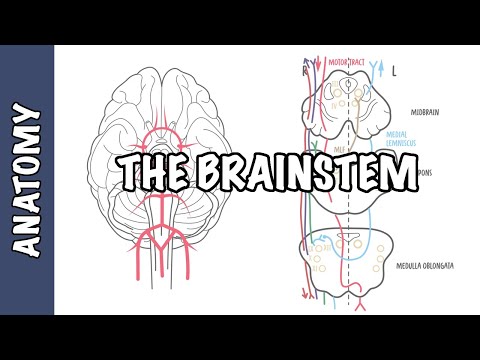
0:00 Hello, in this video, we're going to talk about the anatomy of the midbrain. 0:10 The midbrain, or the Amise and Keflon, is one of the three regions of the brain 0:15 stem, 0:15 the others being the pons and the medulla. 0:18 It is the most superior part of the brainstem and acts as a conduit between the 0:23 four brain 0:24 above and the pons and the cerebellum below. 0:28 The midbrain is approximately two centimeters in length, making it the smallest 0:32 of the three 0:33 regions of the brainstem. 0:35 As it ascends, it travels through the opening in the tantorium cerebelli. 0:45 The midbrain is made up of two major parts, the paired cerebral peduncles and 0:51 the tectum. 0:52 The paired cerebral peduncles are found at the anterior surface of the midbrain 0:56 , whereas 0:57 the tectum is found at the posterior, at the back of the midbrain. 1:04 The paired cerebral peduncles consist of the crura cerebri, or the crus cerebri 1:11 and 1:12 the tagmentum. 1:15 The crus cerebri and the tagmentum are separated by the substantia nigra. 1:28 The crus cerebri is found at the most ventral area, the front of each cerebral 1:34 peduncle, 1:36 and contains three descending pathways. 1:41 The descending pathway means from the brain or the cerebral cortex out, the 1:47 down through 1:48 the brainstem. 1:49 So these are usually motor information. 1:54 These pathways include the corticospinal pathway, the corticonucleopathway, and 1:59 the corticopontine 2:01 pathways. 2:04 Collectively, these are called the longitudinal pontine fibers. 2:14 The tagmentum is the central part of the midbrain and contains their reticular 2:19 and cranial 2:20 nerve nuclei, as well as several neural pathways. 2:24 In particular, it contains the oculomotor nerve 3, trochlear nerve which is 2:29 cranial nerve 2:30 number 4, and one of the nuclei of the trigeminal nerve which is cranial nerve 2:36 5. 2:37 You can also find what's called the red nucleus in this area. 2:41 The red nucleus receives input from this cerebellum and cerebrum. 2:48 Input output is via the rubrospinal tract. 2:52 It is part of the extra-paramidal system and is important for regulating the 2:56 activity of 2:57 motor neurons. 3:04 The other major part of the midbrain is the tectum, also known as the quadri-g 3:11 eminal plate. 3:12 It consists of two pairs of relay nuclei. 3:15 The superior coliculi and the inferior coliculi. 3:20 Collectively, these are called the corpora quadri-geminali. 3:24 The superior coliculi are involved with the processing of visual information, 3:31 whilst the 3:32 inferior coliculi are involved with the processing of auditory information. 3:43 Some important tracts, as well as the descending tracts which we mentioned 3:50 previously, found 3:51 in the cruce cerebrite, the most ventral part of the midbrain. 3:56 The midbrain also provides passage for the ascending pathway. 4:00 So up through the brain stem, the midbrain to the brain basically. 4:07 And these include the superior cerebella peduncles, which carries proprio 4:13 ceptive information into 4:15 the cerebellum. 4:18 Superior cerebell peduncles also carries information out of the cerebellum into 4:22 the red nucleus. 4:24 You also have the medial longitudinal fasciculus and the medial liminiscal 4:35 tract. 4:36 Next is blood supply. 4:38 The vascular supply of the midbrain comes from the basilar artery and its 4:44 branches. 4:45 The major vessels are the posterior cerebellar artery and its peduncular 4:52 branches. 4:53 The superior cerebellar artery, the posterior choroidal artery, and the inter- 4:59 peduncular 5:00 branches of the basilar artery. 5:03 So essentially, the majority of the blood supply is from the basilar artery and 5:09 its branches. 5:15 Now let's look at some clinical anatomy or clinical cases related to the 5:19 anatomy we 5:20 have learned, beginning with Parkinson's disease. 5:24 Parkinson's disease is a neurodegenerative disorder that is caused by 5:28 destruction of 5:30 dopaminergic neurons in the past compactor of the substantia nigra, located in 5:38 the midbrain. 5:39 It is also part of what's called the basal ganglid system, even though it's not 5:45 really 5:45 within that area. 5:47 As dopamine is a neurotransmitter with an important role in movement and 5:51 coordination, 5:52 depletion of the dopamine results in the cardinal signs and symptoms of 5:55 Parkinson's disease. 5:57 These include resting tremor, bradykinesia, limb rigidity and postural 6:06 instability. 6:07 The second clinical anatomy, which is important to note within the midbrain, is 6:13 argal roberts 6:14 and pupil, which describes physical exam, which shows bilaterally small pupils 6:20 that 6:20 do not constrict when exposed to bright light, but the pupils do constrict when 6:27 focused 6:28 on a nearby object. 6:33 The rostral midbrain, which is located near the sylvian aqueduct, is thought to 6:39 be the 6:40 most likely location of the lesion that causes argal roberts and pupil. 6:46 Which to this area would affect the efferent pupillary fibers located on the 6:52 dorsal aspect 6:53 of the edinger westfile nucleus, EWN. 6:58 And essentially, this whole reflex results in no pupils to constrict, so there 7:05 is no 7:06 light reflex present. 7:09 Argal roberts and pupil is a highly specific sign of late stage syphilis. 7:14 However, other causes include diabetes, midbrain lesions, such as tumours, inf 7:20 arction, demyelination, 7:23 as well as a Wernicke's ankyphalopathy. 7:31 Thank you for watching. 7:32 There's a second part of this video which will look into the midbrain syndromes 7:38 , so 7:38 lesions that occur in the midbrain that cause classical signs and symptoms.