

Scaphoid Fracture

Overview
Scaphoid fracture is the most common carpal bone fracture, accounting for ~60–70% of all carpal fractures. It occurs most frequently in young adults (15–40 years) following a fall on the outstretched hand (FOOSH). The scaphoid’s tenuous blood supply predisposes to non-union and avascular necrosis, especially in proximal fractures. Early recognition is essential as delayed or missed diagnosis is common and may lead to long-term disability.
Definition
FOOSH: “Fall On Outstretched Hand,” common mechanism of wrist injuries.
Anatomical snuffbox: Depression between tendons of extensor pollicis longus and brevis; tenderness here is pathognomonic for scaphoid fracture.
Avascular necrosis (AVN): Bone death due to disruption of blood supply. A common site for avascular necrosis is to the scaphoid bone as well as the hip.
Non-union: Failure of bone fragments to heal within expected timeframe.
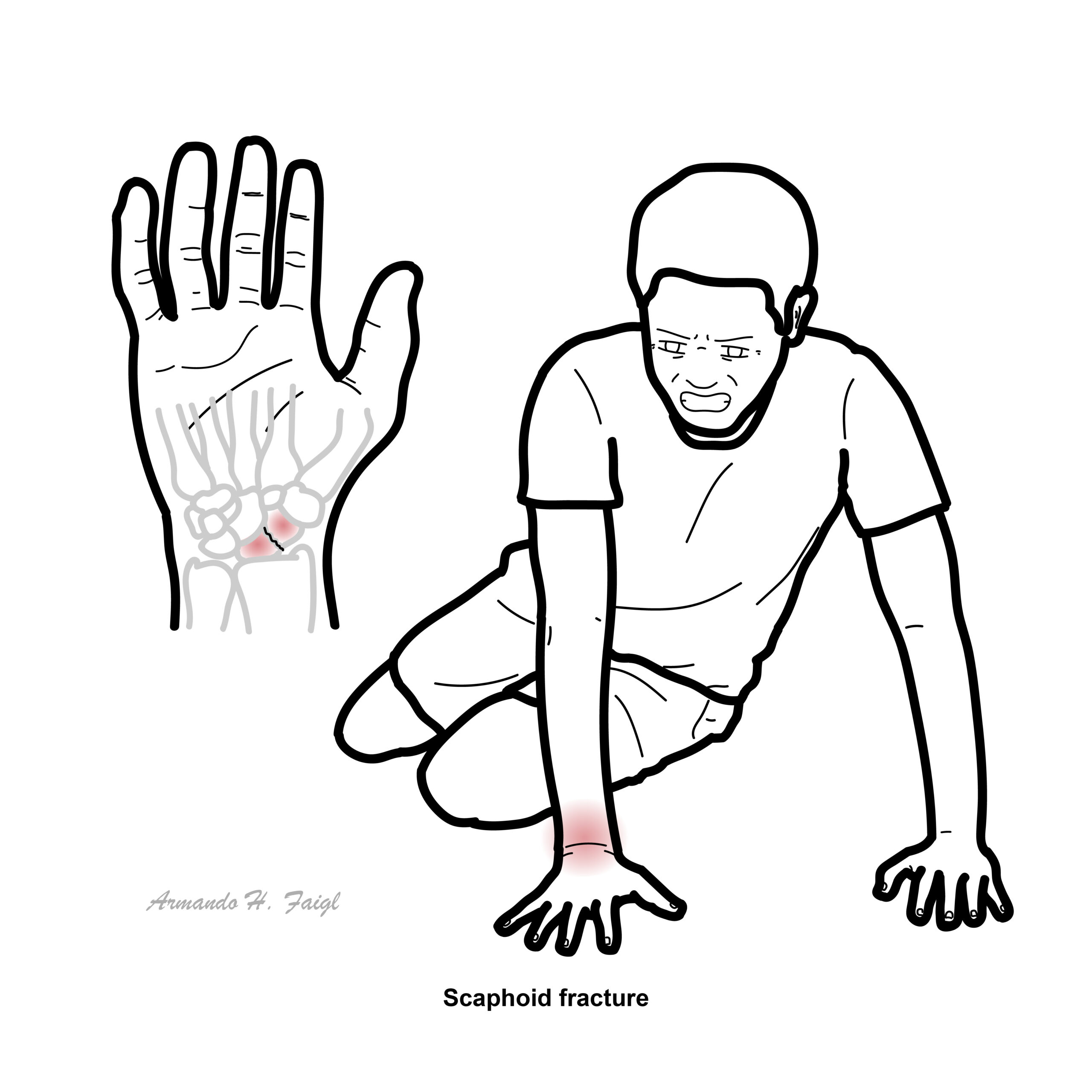
What to notice
Detailed image description
Anatomy & Physiology
- Scaphoid: Boat-shaped carpal bone on radial side of wrist; articulates with radius, trapezium, trapezoid, capitate, lunate.
- Blood supply: Retrograde from dorsal carpal branch of radial artery → enters distally → supplies proximal pole last.
- Clinical relevance: Proximal fractures at highest risk of AVN due to poor vascularity.
Proximal pole = poor healing → high risk AVN.
Aetiology & Risk Factors
Aetiology
- Direct trauma: FOOSH (most common).
- Less common: Punching injuries, direct blow to wrist.
- Young, active adults (sports injuries, falls).
- Males > females.
- High-energy trauma (e.g., motor vehicle accidents).
Pathophysiology
- FOOSH → axial load transmitted through radial styloid.
- Scaphoid bone compressed against distal radius.
- Fracture occurs, most often at the waist (70%), less at proximal pole (20%) or distal pole (10%).
- Retrograde blood supply disrupted → risk of delayed healing or AVN (especially proximal).
Mechanism + vascular anatomy explains why scaphoid fracture is high risk despite being a “small bone.”
Clinical Manifestations
- Wrist pain after FOOSH.
- Clinical examination
- Anatomical snuffbox tenderness (classic).
- Tenderness over scaphoid tubercle (volar wrist).
- Pain with axial compression of thumb.
- ↓ wrist motion, swelling may be minimal.
- Often subtle → patients may continue to use wrist.
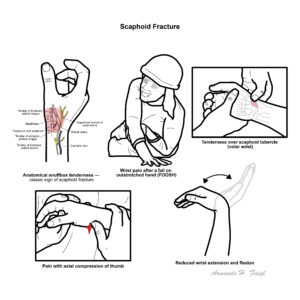
Snuffbox tenderness = scaphoid fracture until proven otherwise.
Diagnosis
- Clinical suspicion: FOOSH + snuffbox tenderness.
- X-ray (wrist, scaphoid views): May be normal initially (up to 30% missed).
- Repeat imaging: X-ray after 10–14 days if initial negative.
- MRI (gold standard): Detects occult fractures within 24 hours.
- CT scan: Best for assessing union and fracture displacement.
| Condition | Differentiating Features |
| Distal radius fracture | More swelling/deformity, visible on plain films |
| Wrist sprain | No bony tenderness, normal MRI |
| Scapholunate ligament injury | Pain on Watson’s test, widening on imaging |
Always immobilise if suspicion is high, even with negative initial X-ray.
Classification
- Distal pole (~10%) – good healing, low risk AVN.
- Waist (~70%) – most common.
- Proximal pole (~20%) – poor healing, high risk AVN.
Treatment
- Non-displaced distal/waist fractures: Immobilisation in thumb spica cast for 6–12 weeks.
- Proximal or displaced fractures: Surgical fixation (percutaneous screw or open reduction).
- Follow-up imaging: CT/MRI for union assessment.
- Rehabilitation: Gradual mobilisation once union confirmed.
Distal = cast; Proximal = screw.
Complications & Prognosis
- Non-union (5–15%).
- Avascular necrosis (esp. proximal pole).
- Osteoarthritis (SNAC wrist – Scaphoid Non-union Advanced Collapse).
- Chronic pain, stiffness, ↓ grip strength.
- Good if treated early
- Poor outcomes with delayed diagnosis.
References
- Gelberman RH, Menon J. The vascularity of the scaphoid bone. J Hand Surg Am. 1980;5(5):508–13.
- Yin ZG, Zhang JB, Kan SL, et al. Diagnostic accuracy of imaging modalities for suspected scaphoid fractures: meta-analysis. BMJ. 2012;344:e3052.
- Fowler JR, Hughes TB. Scaphoid fractures. Clin Sports Med. 2015;34(1):37–50.
- Ibrahim T, Qureshi A, Sutton AJ, et al. Surgical vs non-surgical treatment of acute scaphoid fractures: systematic review and meta-analysis. Cochrane Database Syst Rev. 2008;(4):CD006770.
- Buijze GA, Ochtman L, Ring D. Management of scaphoid fractures in adults: what’s new? Injury. 2010;41(11):1120–8.
Members only discussions coming soon…