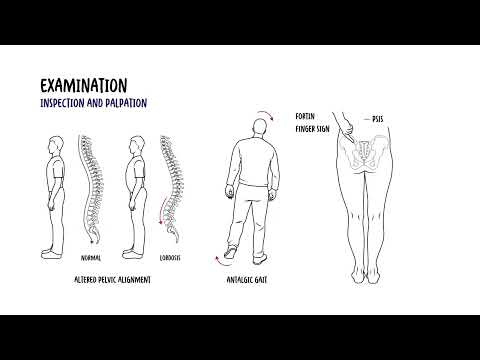
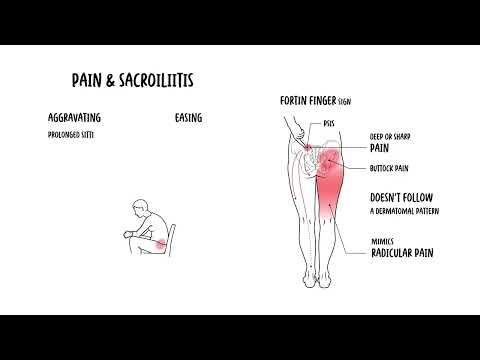
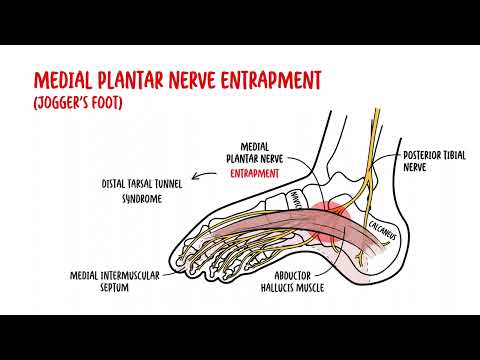
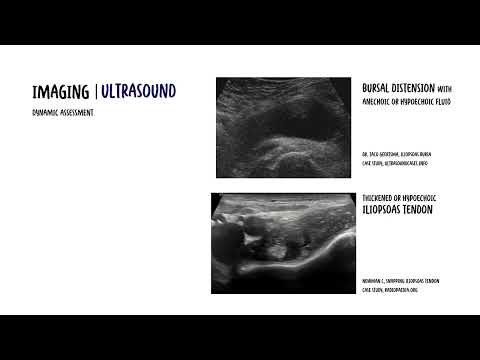
0:00 Periformer syndrome is caused by irritation or compression of the sciatic nerve 0:15 at the 0:16 piriformis muscle. 0:19 The syndrome is characterized by tingling numbness and pain along the path of 0:23 the sciatic nerve 0:24 in the affected leg, basically like sciatic or symptoms. 0:29 The causative factors include an abnormal tenseness or spasticity of the pir 0:35 iformis caused 0:36 either by trauma and overuse, or by muscle and nerve anatomical anomalies. 0:48 Let's revise some of the anatomy. 0:50 The piriformis muscle is a small muscle which originates from the sacrum, the 0:55 sciatic notch, 0:57 in the sacro-tuberous ligament, and then runs through the greater sciatic for 1:03 amen to attach 1:04 to the greater trocans of the fema. 1:12 The main action of the piriformis is to externally rotate the hip, so external 1:19 rotation. 1:20 When the hip is in a flex position, it also acts as a partial hip abductor. 1:33 The sciatic nerve runs just adjacent to the piriformis muscle. 1:40 Hence, whenever the piriformis muscle is irritated or inflamed, it also affects 1:45 the sciatic nerve, 1:47 which then results in sciatica-like pain. 1:51 In the past, many cases of sciatica were attributed to the piriformis syndrome, 1:55 however, most 1:56 if not all cases of sciatica are due to lumbosacral reticulopathy, such as a 2:03 disc protrusion 2:04 at the lumbosacral spine or osteoarthritis at the lower lumbosacral area. 2:17 The causes of piriformis syndrome are a number. 2:21 For example, abnormal tenseness or spasticity of the piriformis muscle can be 2:27 either caused 2:28 by trauma or overuse injuries, post-traumatic piriformis syndrome may be 2:34 secondary to a 2:35 contusion to the gluteal area, the bum, which normally occurs in middle-age 2:41 recreational 2:42 athletes, playing tennis, running, cross-country skiing, for example. 2:48 Another causes hypertrophy of the piriformis muscle, which could compress the 2:53 sciatic nerve 2:54 and hypertrophy of the piriformis muscle can occur in athletes. 2:59 Anatomical anomaly of the muscle and the nerve can also cause piriformis 3:04 syndrome. 3:05 In about 6% of the population, supposedly the sciatic nerve passes right 3:10 through the 3:11 piriformis muscle, and then there's something called bipartite piriformis 3:18 muscle. 3:19 And then this is really what's called bipartite piriformis muscle. 3:25 Chum is invading directly to the piriformis, can then obstruct the sciatic 3:30 nerve, and then 3:31 you have vascular anomalies such as gluteal artery aneurysms, which can also 3:36 cause features 3:37 of piriformis syndrome. 3:44 The clinical features of piriformis syndrome is really pain-located maximally 3:49 at the middle 3:50 upper part of the bum during and after physical exercise. 3:54 Pain can radiate to the posterior thigh, calf, outer leg, ankle, and heel, 3:58 basically 3:59 sciatica type pain. 4:01 There may be also pain at night. 4:04 In terms of posture, the leg on the affected side may be held in semi-flexion 4:09 and in external 4:10 rotation to alleviate the pain. 4:16 There are a few differential diagnoses to consider. 4:23 Firstly, entrapment of the gluteal nerves can cause similar pain. 4:27 Entrapment of posterior cutaneous nerve of thigh can also cause hamstring pain. 4:33 And then you've got to think about the other causes of sciatica. 4:36 So remember that sciatica is a common term for a number of back and leg 4:41 symptoms associated 4:42 with the sciatic nerve, and again, the most common cause of sciatica is 4:47 actually a disc 4:49 prolapse or rupture and osteoarthritis within the lumbosacal spine. 5:00 For clinical examination though, there is pinpoint tenderness on palpation of 5:04 the upper 5:05 middle gluteus. 5:08 When performing what's called a straight leg raised test, this would be 5:12 negative in 5:13 piriformis syndrome, but it's positive in patients with sciatica from a lumbos 5:18 acal pathology. 5:20 However, this is not very sensitive as it can also be technically positive in 5:24 patients 5:25 with piriformis syndrome. 5:28 There can be pain with the log roll test, and this is internal and external 5:34 rotation 5:35 of the hip joint. 5:41 The fair maneuver or the flexion, adduction, internal rotation maneuver would 5:47 be positive. 5:49 So with the patient lying, the examiner passively flexes, add ducts, and 5:55 internally rotates 5:57 the hip stretching the piriformis muscle, which can then aggravate the pain. 6:09 Reflexes, motor function and sensation are usually normal. 6:15 There's another test called the local anaesthetic infiltration test, so 6:19 basically when you put 6:20 local anaesthetic in the piriformis region, if the pain disappears, the test is 6:31 positive. 6:32 Investigations to order an MRI scan can be ordered and can demonstrate the size 6:37 and thickness 6:38 of the piriformis muscle, the differences between the left and the right side, 6:43 and any anomalies, 6:44 or any anatomical differences. 6:48 An electro-neuromyography examination may demonstrate distal reticulopathy, or 6:54 changes 6:55 of proximal, but not lumba nerve root pathology, which can help differentiate 7:01 between lumbosacal 7:02 pathology to piriformis syndrome. 7:09 Finally, treatment includes conservative management, stretching the muscle, 7:17 pelvic posture correction, 7:20 core stabilization, hip and sacroiliac joint mobilization, strengthening of the 7:27 gluteal 7:28 and pelvic musculature. 7:30 Local anaesthetic and a steroid injection into the piriformis muscle can be 7:34 useful if 7:35 physiotherapy fails, and it's important not to actually inject directly onto 7:40 the sciatic 7:40 nerve. 7:46 Then there's surgical management, and it's often offered after failure of the 7:50 conservative 7:50 management I mentioned earlier. 7:53 Piriformis muscle is divided, and the sciatic nerve can be released during 7:59 surgery. 8:00 The results are good in majority of cases. 8:09 So in summary, the piriformis syndrome is caused by irritation or compression 8:12 of the 8:12 sciatic nerve at the piriformis muscle. 8:16 The syndrome is characterized by tingling, numbness and pain along the path of 8:20 the sciatic 8:20 nerve in the affected leg. 8:23 Really, similar symptoms to sciatica. 8:26 Thank you for watching. 8:30 [BLANK_AUDIO]