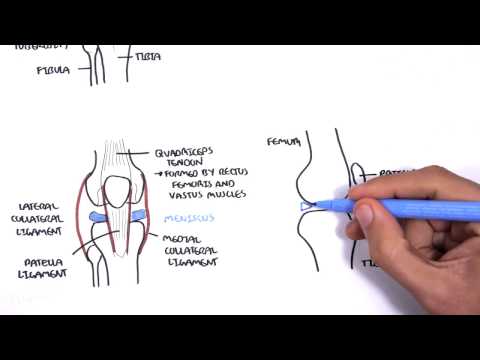
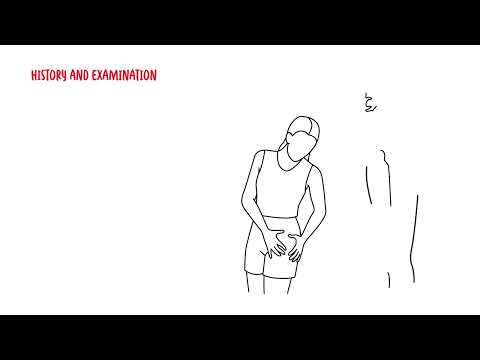
0:00 Iliotibial band syndrome is a common overuse injury causing pain at the outside 0:10 of the 0:10 knee and is typically seen in runners and cyclists. 0:15 The Iliotibial band, or ITB, is a fibrous band that runs longitudinally along 0:21 the lateral 0:22 aspects of the thigh, from its origin at the iliacrest to the proximal tibia. 0:28 The ITB is formed proximally at the hip by the fascia of the gluteus maximus, 0:36 gluteus 0:37 medius, tensor fascia latte, and vastus lateralis muscle. 0:43 The ITB has many attachments distally and these include the cadriceps patellar 0:49 patellar tendon 0:51 complex, the lateral femoral epicondyle, LFE, and the biceps femoris muscle 0:58 tendon 0:59 fibular complex. 1:03 Distally again, the ITB actually causes over the lateral femoral epicondyle 1:09 before inserting 1:11 at Gerti's tubercle at the anterolateral tibia, just below the knee joint line. 1:22 The ITB is thought to assist with knee extension when the knee is near terminal 1:27 extension and 1:28 with knee flexion once the knee is flexed beyond 30 degrees. 1:33 The ITB also provides lateral knee stability. 1:43 The mechanism of injury, iliotibial band syndrome occurs from overuse, not 1:50 acute trauma. 1:51 The exact mechanism however, of the pain is unclear. 1:56 Previously, pain was thought to be due to friction from the iliotibial band 2:01 moving back 2:01 and forth over the lateral femoral epicondyle during activities such as running 2:13 or cycling. 2:15 Risk factors for ITB include sudden increase in running or cycling distance, 2:21 high weekly 2:22 running mileage, excessively long strides causing increased hip flexion and 2:29 increased 2:30 strain at the lateral knee, incorrect pedal position when cycling, exercising 2:42 during 2:42 cold weather, anatomical and biochemical factors including weak hip abductors 2:52 leading to increased 2:54 hip adduction, knocked knees and increased internal rotation at the knee, 3:01 thought to 3:02 cause strain at the ITB, also increased hip abduction, genu, varu or bow legs, 3:15 with increased 3:16 ankle supination are thought to develop increased tension of the ITB at the 3:22 lateral femoral 3:23 epicondyle. 3:30 Clinical presentation of iliotibial band syndrome is sudden onset of pain, 3:34 localized really 3:36 where the iliotibial band courses over the lateral femoral epicondyle. 3:42 Initially, the pain occurs during sports, describe the sharp or burning when 3:48 the knee 3:48 is slightly bent or when the knee extends during cycling or during foot strike 3:54 when running. 3:56 Pain may become constant and deep. 4:04 On examination, there is focal tenderness at the distal iliotibial band where 4:09 it courses 4:10 over the lateral femoral epicondyle. 4:14 You also get what's called a positive noble compression test. 4:19 To perform this test, the examiner's thumb is placed with moderate pressure on 4:23 the posterior 4:24 border of the iliotibial band close to the lateral femoral epicondyle with the 4:29 patient's 4:30 hip slightly flexed. 4:33 The examiner then passively flexes the patient's knee. 4:37 The test is positive when pain is reproduced with a thumb is placed, pain is 4:42 more pronounced 4:44 at approximately 30 degrees. 4:54 The diagnosis of iliotibial band syndrome is based on history and clinical 4:59 examination. 5:00 However, investigations that could be ordered include an ultrasound which may 5:05 show thickening 5:07 of the iliotibial band at the lateral epicondyle, an x-ray and an MRI, only if 5:14 the diagnosis 5:16 is unclear. 5:23 Treatment of iliotibial band syndrome in the acute setting is rest and avoid 5:28 activities 5:29 that worsens the pain, using eyes, analgesia such as ibuprofen. 5:36 And then eventually gradually rehabilitation with stretches and strengthening 5:43 exercises. 5:44 People should also slowly return to their sports or regular activities, less 5:48 than 50% 5:49 of normal capacity. 5:53 In the chronic phase, when these acute treatments do not work, glucocorticoid 5:59 injections may 6:00 be used. 6:03 Also release of the iliotibial band is also an option for complicated cases. 6:16 So in summary, this video discussed iliotibial band syndrome, which is where 6:21 you have pain 6:21 over the iliotibial band as it passes over the lateral femoral epicondyle. 6:28 A Nobel compression test is a useful clinical examination to diagnose iliotib 6:34 ial band syndrome. 6:37 Thank you for watching.