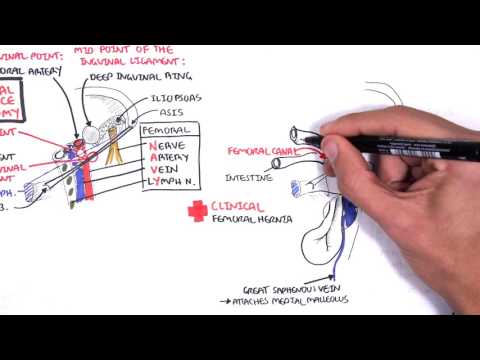
0:00 For moral fractures, also known as broken thigh bones, are a serious injury 0:12 that can occur 0:13 in both adults and children. 0:15 The femur is the largest and strongest bone in the body, making it difficult to 0:18 break. 0:19 However, when the fracture does occur, it can cause significant pain and 0:28 disability. 0:29 Let's revise some of the anatomy before delving into fractures of the femur. 0:34 Now the femur, again, is the largest and strongest bone in the body. 0:37 Approximately, the femur is composed of the specialized metaphasial region, 0:42 consisting 0:43 of the head, neck, and the greater and lesser trochanters. 0:48 Distally, the femur comprises the metaphasial flare, which continues into the 0:53 medial and 0:54 lateral femoral condyles. 0:57 The condyles are separated by the inter-condola notch. 1:01 The shaft, or the diaphysis, is the segment inferior to the lesser trochanter 1:07 and ends 1:08 at the metaphasial flare and condyles. 1:13 The femur itself has an anterior bone. 1:17 The linear aspirin is the rough crest of bone running down middle third of the 1:24 posterior 1:25 fema and is the attachment side for various muscles and fascia. 1:32 There are three abundant muscular compartments that envelope the fema. 1:43 The main blood supply to the femur derives from the femoral artery, a 1:47 continuation of 1:48 the external iliac artery. 1:52 The femoral artery passes under the mid portion of the inguinal ligament and 1:55 divides into the 1:56 superficial femoral artery and the deep femoral artery, also known as the prof 2:03 unda femoris. 2:04 The neck of the femur is supplied by the lateral and medial circumflex arteries 2:10 . 2:10 I have a separate video that talks in more depth about the anatomy of the fema. 2:21 Now in this video we're going to mainly focus on femoral shaft fractures. 2:27 Femoral neck fractures will not be discussed in this video and will be 2:31 discussed in a separate 2:32 one. 2:34 There are several types of femoral shaft fractures, including what's called a 2:39 transverse fracture, 2:41 which is a break that is perpendicular to the long axis of the fema. 2:46 Then there are spiral fractures, a break that spirals around the femoral shaft, 2:51 oblique 2:52 fractures, a break that is diagonal to the long axis of the femur, and common 2:57 uted fractures, 2:58 a break that occurs in multiple locations may cause the bone to shatter into 3:01 several pieces. 3:09 The classification of femoral shaft fractures can be either through the molar A 3:15 O system. 3:16 However, this is quite complex. 3:19 The windquist enhancement classification can also be used and is based on the 3:24 extent 3:25 of diminution of the fracture. 3:31 Practically anatomical description is the simplest way. 3:35 So to describe a femoral shaft fracture, first you talk about the location, 3:40 whether it's 3:41 proximal, mid or distal shaft, configuration, whether it's a transverse 3:46 fracture, oblique 3:47 fracture or a spiral fracture, and then lastly, the number of fragments. 3:58 So for example, in this example, you have a mid to distal shaft spiral fracture 4:04 of the 4:05 fema. 4:11 In terms of the cause of a femoral shaft fracture, trauma is the most common 4:15 mechanism of these 4:16 fractures. 4:17 In children, femoral fractures are typically caused by high energy injuries 4:21 such as car 4:21 accidents or falls from a significant height. 4:25 In adults, car accidents are stress fractures from repetitive exercise. 4:30 In the elderly, femoral shaft fractures are likely to occur as a result of low 4:35 energy 4:35 trauma, usually as a result of osteoporosis, a condition that weakens the bone, 4:41 making them 4:41 more susceptible to fractures. 4:44 There are also what's called pathological fractures, which are, for example, 4:48 due to a 4:48 metastatic process of cancer in the bone. 4:52 Finally, there are also things called atypical fractures, which are related to 4:56 bisphosphonate 4:58 use, an anti-resalptive agent for osteoporosis. 5:04 Symptoms of femoral fractures may include severe pain in the thigh or groin 5:08 area, on 5:08 the affected side, swelling and bruising, inability to weight bear on the 5:13 affected leg 5:13 and deformity or a visible bump on the thigh. 5:22 In terms of examination, it may reveal a tense swollen thigh. 5:27 Blood loss in a closed femoral shaft fracture is usually about 1 to 1.5 liters. 5:35 Blood loss in open fractures may be double that of a closed fracture. 5:41 Again, when looking at someone with a femoral shaft fracture, they will have 5:46 usually a 5:47 shortened leg on the affected side and tenderness around the thigh. 5:52 Please be wary of associated injuries, such as injuries to the head, neck, ribs 5:56 , hip 5:57 or knee. 6:02 In terms of diagnosis, femoral fractures are typically diagnosed with a 6:06 physical examination, 6:08 x-ray and sometimes a CT scan may be warranted. 6:16 Treatment Once a diagnosis has been made, treatment options 6:19 include non-surgical treatment or surgical treatment. 6:24 Surgical treatment involves intramadolary nailing, usually the method that is 6:28 appropriate 6:29 in adults. 6:31 Plate and screw constructs can be used if there is a distal metaphysial 6:35 extension, temporary 6:37 external fixation is occasionally required when patient is unstable or has 6:41 multiple injuries, 6:43 and then this can be followed by an actual intramadolary nail once the patient 6:49 is stable. 6:50 For children, usually a non-operative measure is used because femoral fractures 6:54 nearly always 6:55 heal and remodel. 6:59 Having surgical or non-surgical approach rehab and exercise is important. 7:07 It is important to note that there are many complications associated with fem 7:11 oral shaft 7:11 fractures pre- and post-surgery. 7:14 These include compartment syndrome, fat embolus with the possibility of acute 7:23 respiratory 7:25 distress syndrome following, infection of the actual hip joint itself, pre- and 7:31 post-surgery, 7:35 non-union of the fracture, thromboembolic disease, neurological injury, mal 7:41 union and 7:41 pressure sores, pneumonia, urinary tract infections if patients are 7:46 conservatively treated because 7:48 they're in bed most of the time. 7:55 So in summary, femoral shaft fractures occur in children, adults and elderly. 8:01 They typically occur in the setting of osteoporosis which is weakening of the 8:07 bones. 8:08 They're classified as either proximal mid to distal femoral shaft fractures and 8:15 also the 8:16 mechanism including trauma or atramatic. 8:20 It is important to note for complications associated with these fractures 8:24 whether it's 8:25 pre or post-surgery. 8:27 Thank you for watching. 8:38 �