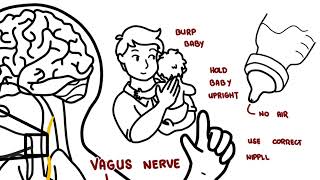
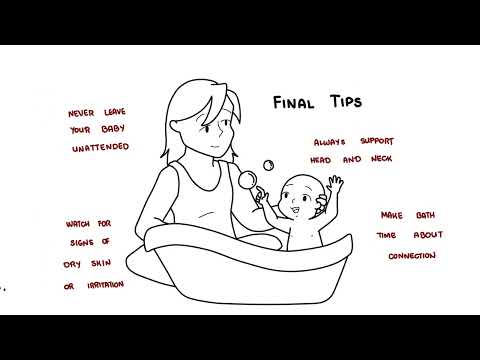
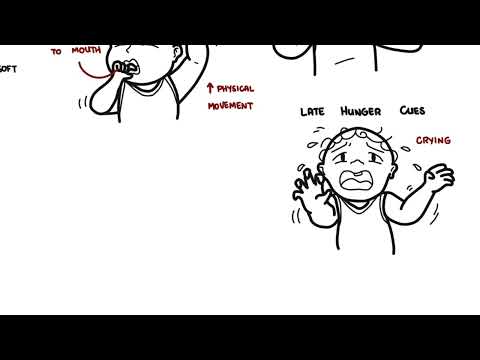
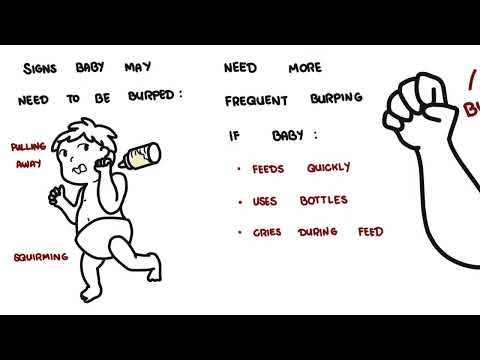
0:00 Hiccups are one of those curious bodily quirks that we all experience from time 0:09 to time, 0:10 but they're especially common in babies. 0:12 If you've ever held a newborn and felt their tiny body jump with a rhythmic hic 0:16 , you might 0:17 have wondered what causes this and whether it's something to be concerned about 0:21 . 0:21 Fortunately, in most cases, hiccups are completely harmless, and even expected 0:26 during infancy. 0:27 At the most basic level, a hiccup is caused by a sudden involuntary contraction 0:31 of the 0:32 muscle called the diaphragm. 0:35 This muscle sits just below the lungs and play a viral role in breathing. 0:39 When it spasms, it causes you to suddenly inhale, right afterward a small flap 0:44 in your 0:45 throat called the glottus quickly closes, creating the classic hic sound. 0:50 This reflex is the same in babies, children, and adults, but babies tend to 0:55 experience 0:56 it much frequently. 1:01 So why are hiccups so common in babies? 1:06 Now there are a few important reasons. 1:08 The first, a baby's nervous system is still maturing. 1:12 The diaphragm, which is controlled by nerves, coming from the brain and spinal 1:17 cord, is 1:17 often more reactive in newborns. 1:20 This means it can spasm more easily in response to mild triggers, such as a 1:26 full stomach swallowing 1:27 too much air while feeding or even a change in temperature. 1:32 Another major factor is the vagus nerve. 1:34 Now, the vagus nerve runs from the brain to the stomach and helps regulate many 1:38 internal 1:39 organs, including the diaphragm. 1:41 In babies, this nerve is highly sensitive. 1:44 If the stomach becomes stretched from feeding, or if there's a bit of reflux, 1:49 it can stimulate 1:50 the vagus nerve and trigger hiccups. 1:52 This is why hiccups are often seen after a feed, especially if the baby has 1:55 swallowed 1:56 air or eaten quickly. 2:00 Interestingly, hiccups may also be a leftover reflex from life in the womb. 2:07 Feeders can start hiccuping as early as a second trimester, and some scientists 2:12 believe 2:13 this is part of how their body prepares for life outside the uterus. 2:17 These rhythmic contractions may help develop the diaphragm and lungs, 2:21 essentially giving 2:22 the baby practice for breathing. 2:25 The important thing to know is that hiccups in babies are almost always normal. 2:30 They usually don't cause any discomfort and often go away on their own. 2:35 Most babies aren't even aware of their hiccuping. 2:38 Parents don't need to do anything unless the hiccups seem to interfere with 2:41 feeding 2:42 or cause distress, which is very rare. 2:46 If you want to help settle your baby's hiccups, there are a few gentle options. 2:50 You can try burping your baby during and after feeding to reduce air swallowed 2:55 during feeding. 2:57 Holding them upright after a feed may also help digestion and reduce the chance 3:01 of reflux. 3:02 Make sure the bottle nipple is full of milk before feeding to reduce air intake 3:07 , which 3:08 can worsen hiccups. 3:10 Use the right nipple size and flow for your baby's age, too fast or too slow 3:15 can cause 3:15 problems, so just as your baby grows. 3:20 What you should avoid are outdated or unsafe remedies, like startling the baby 3:24 or giving 3:25 them water, which can be risky for infants. 3:29 So in summary, baby hiccups are a fascinating and a normal part of early 3:34 development. 3:34 They reflect the baby's growing and adapting nervous system, and the natural 3:38 processes 3:39 of learning how to breathe and digest. 3:42 If anything, that little hicc is a sign that the body is doing its job, just 3:48 still getting 3:49 the hang of it.