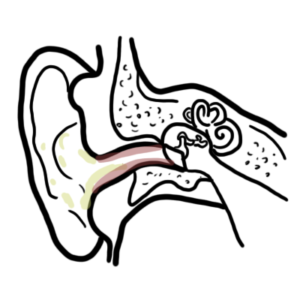
0:00 In this video, we will look at the anatomy of the ear. 0:08 So the ears, in general, can be divided into three sections. 0:12 The external ear, which goes to the eardrum, here the middle ear from the eard 0:17 rum to the 0:18 over window, and the inner ear, which is basically your cochlea and your hair 0:23 cells, 0:23 this shell-looking structure. 0:26 So let us first look at the external ear. 0:29 The external ear is composed of the outer oracle and the external acoustic me 0:35 atus. 0:36 The lateral one-third of the external acoustic meatus is surrounded by cart 0:41 ilage, and then 0:42 the inner two-thirds of the external acoustic meatus, so the more medial is 0:48 made up of bone. 0:51 Let us look at the middle ear, which contains our three bones called the 0:57 auditory ossicles. 0:58 Let us look more closely at what makes up our middle ear. 1:03 The middle ear has boundaries. 1:06 Here is the bone and the eardrum. 1:09 The top border is called the tegmental wall, which is made up of the temporal 1:14 bone. 1:14 The bottom of the middle ear is called the jugular wall or floor, because this 1:18 is where 1:19 the jugular vein passes. 1:21 The lateral wall is called the membranous wall, because this is where your eard 1:27 rum is. 1:28 The medial wall is the labyrinth wall, because this is where the labyrinth of 1:34 the inner ear 1:35 is located. 1:38 Then we have the anterior, and then we have the posterior wall, so the front 1:41 and the back. 1:43 The posterior wall is your mastoid bone, and the anterior wall is your carotid 1:48 wall, because 1:49 your carotid passes through there. 1:52 Now the content of the middle ear, as I mentioned earlier, are your auditory o 1:56 ssicles, which 1:57 are made up of three bones. 1:59 These are the smallest bones in your body, and these are your malleus, incus, 2:06 and stapes. 2:07 The stapes bone interacts with the inner ear through the oval window. 2:13 Then you have muscles of the middle ear, which are your stepedius muscle, step 2:18 edius muscle, 2:19 which as the name suggests, anchors the stapes bone, and the second muscle is 2:24 the tensor tympanic 2:25 muscle, which sort of interacts with the malleus and the tympanic membrane. 2:34 That was a little bit about the middle ear. 2:36 Let us talk about the inner ear. 2:39 The inner ear receives mechanical signals, vibration signals, from the stapes 2:44 bone through 2:45 the oval window, and the inner ear is made up of a shell-looking thing where we 2:50 have three 2:51 semi-circular canals, the vestibule, which is important for balance, and then 2:57 the cochleo, 2:58 which contains the hair cells. 3:01 If you remember the physiology of hearing, it's the vibrations coming from the 3:06 bones in 3:07 the middle ear that vibrate the fluid within the cochleo, which will 3:11 subsequently move 3:12 the hair cells, which will then send the hearing signals to the brain. 3:18 It's important to know that signals being received by the cochleo, vibrating 3:22 the fluid, 3:23 have to come out somehow to adjust the pressure, and it comes out through the 3:27 round window 3:28 of the cochleo here. 3:30 Anyways, the movement of the hair cells causes signals, these hearing signals, 3:36 sound to be 3:37 sent to the brain through nerves. 3:40 So here we can see nerves leaving the cochleo and the vestibule. 3:46 These nerves are sensory nerves, and form cranial nerve 8, also known as the 3:52 vestibule cochleo 3:54 nerve, hence where it's coming from. 3:58 Cranial nerve 8, the vestibule cochleo nerve, passes through a small opening in 4:02 the bone 4:03 here called the internal acoustic meatus, and the nerve goes towards the pons 4:08 of the 4:09 brain. 4:11 The pons is part of the brainstem. 4:14 Here is the brainstem, and you have the pons and the medulla oblongara. 4:19 And remember, the brainstem will continue to form your spinal cord. 4:24 And of course, we have two vestibule cochleo nerves, one for both ears, one for 4:32 one ear. 4:33 And yeah. 4:34 So there's another cranial nerve that actually travels through, well, travels 4:39 along together 4:40 with the vestibule cochleo nerve through the internal acoustic meatus. 4:45 This cranial nerve is cranial nerve number 7, also known as the facial nerve. 4:50 The facial nerve also originates in the pons next to the vestibule cochleo 4:54 nerve, and is 4:55 responsible for muscles of facial expressions, secretory glands, amongst many 5:01 other things. 5:03 Anyways, I hope you enjoyed this video on the introduction to the anatomy of 5:07 the ear. 5:08 Next video we will go into a bit more detail. 5:10 Thanks for watching.