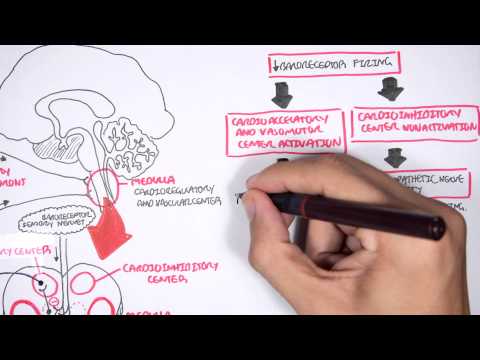
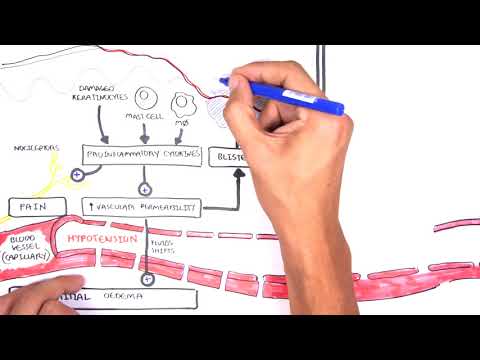
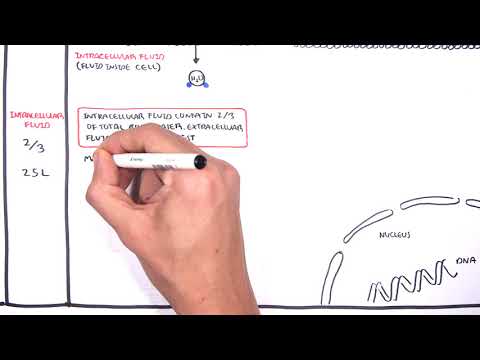
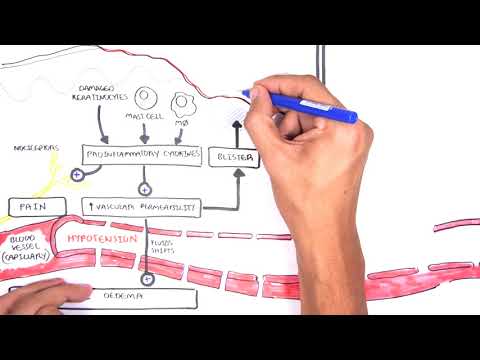
0:00 Hello, in this video we're going to talk about shock. 0:09 Shock occurs when the body's organs and tissues don't receive enough blood and 0:14 oxygen. 0:14 There are many different types of shock, but they're all categorized by a 0:18 sudden drop 0:18 in blood pressure and inadequate blood supply to organs and tissues, leading to 0:25 hypoxia. 0:26 Shock is a life-threatening condition and is reversible if treated early; 0:31 however, 0:32 the effects of shock can become quickly irreversible, resulting in multi-organ 0:37 failure and death. 0:42 The symptoms of shock reflect the body's compensatory response to low tissue 0:47 perfusion 0:48 and will vary depending on the cause and severity. 0:53 The main symptoms of shock include hypotension, tachycardia, tachypnea, olig 1:00 uria, skin changes 1:03 including cool, clammy, pale, with reduced peripheral perfusion, a change in 1:11 mental 1:12 state, agitation, confusion or unresponsiveness. 1:17 There's some important definitions we need to be aware of. 1:20 Low attention is defined as low blood pressure, typically less than 90/60 mill 1:25 imeters mercury, 1:27 some say less than 100. 1:30 Tachycardia, which is rapid heart rate, greater than 100 beats per minute, t 1:35 achypnea, rapid 1:36 breathing, greater than 25 breaths per minute, and oliguria, which is low urine 1:41 output, less 1:42 than 400 mls in 24 hours. 1:49 An important concept to understand is that of mean arterial pressure when 1:53 talking about 1:54 shock. 1:56 So blood pressure is classically made up of two readings, this systolic blood 2:01 pressure 2:01 over the diastolic blood pressure. 2:04 An average blood pressure for normal healthy adult is 120/80 millimeters 2:10 mercury. 2:11 Shock occurs when the blood pressure is low, causing inadequate supply of 2:15 oxygen to the 2:16 tissues or the organs. 2:19 The mean arterial pressure or MAP is a good indicator of tissue perfusion 2:25 rather than 2:26 the systolic blood pressure. 2:29 The mean arterial pressure is the average arterial pressure throughout one 2:35 cardiac cycle. 2:37 The two major determinants of mean arterial pressure are cardiac output and 2:43 peripheral 2:44 resistance. 2:45 The relationship between mean arterial pressure and its determinants is given 2:49 by the following 2:49 equation, where mean arterial pressure is equal to cardiac output times total 2:55 peripheral 2:56 resistance. 2:57 It is important to note that the equation only represents the relationship 3:03 between the 3:03 mean arterial pressure and its determinants. 3:06 The actual mean arterial pressure can be calculated using the following formula 3:11 , where mean arterial 3:13 pressure is the diastolic blood pressure, essentially, plus the systolic blood 3:19 pressure 3:20 minus the diastolic blood pressure over three. 3:26 A normal mean arterial pressure is somewhere around 65 to 100 millimeters 3:32 mercury. 3:33 Current guidelines recommend targeting a mean arterial pressure goal of 65 mill 3:39 imeters 3:40 mercury to meet organ perfusion. 3:45 There are many types of shock. 3:48 Shock can be divided into four main types, hypovolemic, cardiogenic shock, 3:54 obstructive 3:55 shock, and distributive shock. 3:59 Distributive shock is further divided into septic shock, anaphylactic shock, 4:05 and neurogenic 4:06 shock. 4:08 Now these different types of shock usually have a similar clinical 4:14 manifestation, which 4:14 is hypotension, tachycardia, tachypnea, and altered mental status, cold, clammy 4:22 extremities 4:23 with modeling of the skin and oliguria. 4:29 Other features will depend on the type of shock, so for hypovolemic shock you 4:34 can have 4:34 dry mucus membranes, a low jugular venous pressure, and cardiogenic shock, you 4:40 can have 4:40 chest pains, in septic shock, febrile and rigors, and in anaphylactic shock, 4:46 angioedema 4:47 and urticaria. 4:52 There are also stages of shock where pre-shock you have early, compensated 4:57 shock where symptoms 4:58 are absent or mild, then shock, the compensatory mechanisms become overwhelmed 5:05 and symptoms 5:06 of organ dysfunction begin to appear, then you have end organ dysfunction where 5:12 you have 5:12 progressive shock that leads to irreversible organ damage and death. 5:21 Investigations to order for individuals with suspected shock include a full 5:24 blood count 5:25 where you want to look for any drop in hemoglobin and the white cell count to 5:29 see if they are 5:30 septic, urinalysis to check the white cells if there is an infection, arterial 5:36 and venous 5:37 blood gas to check for acidosis and hyperlactatemia, an electrocardiogram, coag 5:43 ulation studies, 5:46 an echocardiogram if possible, a chest x-ray, and you can consider a further 5:51 imaging, the 5:51 CT/T chest abdominal pelvis for example, infective screen which includes blood 5:57 cultures and 5:58 C-reactive protein and procalcitonin, specifically if you are concerned of an 6:05 infection. 6:06 The general approach to management really depends on the severity and cause of 6:10 the shock. 6:12 The aim of treatment is to reduce the mortality and treat the underlying cause. 6:18 Understanding first aid is very important, fluid replacement due to the person 6:24 being 6:25 hypotensive, blood transfusion if needed, medications can be used to increase 6:31 blood pressure such 6:33 as metaraminol, emergency surgery if indicated, intravenous antibiotics if they 6:41 are septic, 6:43 such as steroids and allergy medications if they are in anaphylactic shock. 6:49 Let's talk about the different types of shock and the causes. 6:53 So remember shock can be categorized as hypovolemic, cardiogenic, obstructive 6:59 or distributive shock. 7:01 However, it is possible for patients to have a combined shock where more than 7:06 one type 7:06 is present, undifferentiated shock is when shock is recognized but the cause is 7:12 not clear. 7:14 Here is a schematic diagram representing the body circulation, the heart 7:19 pumping blood 7:20 around the body and the vessels contracting and dilating to maintain a normal 7:26 blood pressure 7:28 and organ perfusion. 7:30 Remember the important relationship of mean arterial pressure is equal to 7:36 cardiac output 7:36 multiplied by total peripheral resistance. 7:42 The first type of shock is hypovolemic shock and this is caused by a sudden 7:46 decrease in 7:47 circulating blood volume. 7:49 This can be divided into hemorrhagic and non hemorrhagic causes. 7:56 The causes include a decrease in blood volume due to blood loss such as trauma, 8:02 internal 8:03 bleeding, intraoperative or post-operative bleeding. 8:08 Non hemorrhagic causes is a decrease in blood volume due to fluid loss other 8:12 than blood 8:13 such as burns, loss of sodium and water from the gastrointestinal tract, the 8:18 skin and the 8:19 kidneys. 8:21 Clearly loss of blood volume results in both a reduced total peripheral 8:27 resistance and 8:29 or a reduction in cardiac output which will result in a reduced mean arterial 8:37 pressure. 8:38 Cardiogenic shock is caused by the heart's failure to pump blood around the 8:43 body. 8:43 There are many causes of cardiogenic shock which can be divided into four main 8:49 categories. 8:49 Cardiomyopathic involves problems with the heart muscles, the myocardium. 8:54 These can include myocardial infarction and ischemia, myocardial depression and 8:59 myocarditis. 9:01 Arithmic causes, you know, problems with the heart rate or rhythm. 9:06 This can include arterial and ventricular tachyorhythmias or arterial and vent 9:11 ricular 9:11 brady arrhythmias. 9:14 Colloidal causes of cardiogenic shock involve problems with the heart structure 9:20 itself. 9:20 So for example valve insufficiencies or defects, aortic dissection or abscess, 9:26 ventricular 9:27 septal defect or rupture of the ventricles or a tumor that's present. 9:35 Other causes of cardiogenic shock include toxic substances such as alcohol, 9:40 recreational 9:40 drugs, infection involving the heart or the body as well as severe hypertension 9:47 causing 9:48 damage to the actual heart itself. 9:51 All these causes will lead to a reduced cardiac output which means a reduced 9:57 mean arterial 9:58 pressure. 10:01 The third type of shock is obstructive shock and this is caused by an 10:04 obstruction to cardiac 10:06 outflow or filling. This can result from pulmonary embolism which is a lot clot 10:12 in the pulmonary 10:13 trunk or artery, severe pulmonary hypertension, cardiac tamponade which is a 10:19 significant amount 10:20 of fluid around the heart impacting filling of the heart, tension pneumothorax 10:25 which will 10:26 impact filling of the heart, constrictive pericarditis where you have thickened 10:30 and 10:30 fibrotic pericardium, restrictive cardiomyopathy, stiffening of the heart 10:36 chambers as well as 10:37 abdominal compartment syndrome which can also cause an obstructive shock. 10:42 Obstructive shock really causes obstruction of cardiac output through multiple 10:48 ways, therefore 10:49 reducing cardiac output means you have a reduced mean arterial pressure and 10:54 therefore a low 10:54 perfusion to organs. 10:58 The final type of shock is distributive shock and this is caused by a system 11:03 wide vasodilation 11:05 where intravascular volume is redirected to the interstitial space. The three 11:10 subtypes 11:11 are septic, anaphylactic and urogenic shock. 11:16 Septic shock is when you have uncontrolled inflammatory response to infection 11:20 resulting 11:20 in systemic vasodilation and capillary leakage. Infections including gram 11:25 positive bacteria, 11:27 gram negative bacteria, viral, fungal and parasitic infections can cause this. 11:32 Septic 11:32 shock is more common in ICU and immunosuppressed patients. 11:38 Anaphylactic shock is where you have a severe allergic reaction where the aller 11:43 gen enters 11:44 the bloodstream resulting in an exaggerated immune inflammatory response. This 11:51 includes 11:51 a massive release of histamine that triggers systemic vasodilation, bronchial 11:57 constriction 11:58 and tongue swelling. Neurogenic shock is where you have severe traumatic brain 12:03 or spinal 12:04 cord injury that compromises the sympathetic nervous system resulting in an un 12:10 opposed 12:11 parasympathetic response which will lead to a decrease in vascular resistance, 12:17 vasodilation. 12:18 This autonomic nervous system imbalance often presents with hypertension, brady 12:23 arrhythmias 12:24 and temperature dysregulation. Neurogenic shock occurs with spinal cord injury 12:31 above 12:31 the level of T6. In summary, distributive shock causes systemic vasodilation 12:39 and therefore 12:40 reduced total peripheral resistance which means it reduces mean arterial 12:45 pressure and 12:46 organ perfusion. So in summary, shock occurs when the body's organs and tissues 12:53 don't 12:54 receive enough blood and oxygen. There are four main types of shock, hypovole 13:00 mic shock, 13:01 cardiogenic shock, obstructive shock and distributive shock. Resuscitation is 13:07 important to maintain 13:08 an adequate blood pressure to maintain organ perfusion.