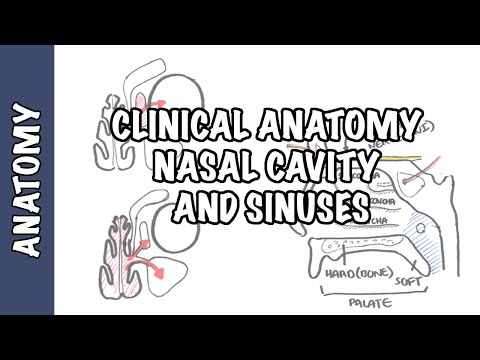
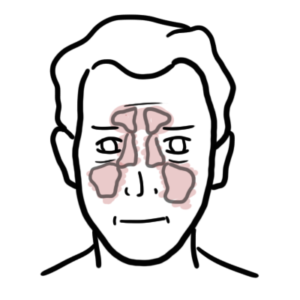
0:00 Hello, in this video we're going to talk about the clinical anatomy of the 0:09 nasal cavity focusing 0:10 particularly on nosebleeds or epistaxis. 0:15 Let us begin by cutting a cross-section of the nose and looking at the general 0:20 structure 0:21 and look at the blood supply in the nasal cavity. 0:25 The internal carotid is a branch of the common carotid artery. 0:28 The internal carotid artery does not have any branches until it reaches the 0:32 skull basically, 0:34 where it will give off the ophthalmic artery. 0:37 The ophthalmic artery supplies the eyes, mainly, but also has several branches 0:42 coming off it. 0:43 Firstly, it has a branch called the posterior ethmodial artery, and then the 0:49 anterior ethmodial 0:49 artery. 0:51 The anterior and posterior ethmodial artery sort of meet at a section within 0:55 the nasal 0:55 cavity and supplies blood to this area. 0:59 The sphenopalentine artery is a branch of the maxillary artery and also 1:03 connects to this 1:04 area here. 1:06 The greater palentine artery is also another branch, a ventral branch of the 1:10 maxillary 1:10 artery. 1:12 Finally, the superior labial artery is a branch of the facial artery and also 1:16 converged somewhat 1:17 to the same area. 1:19 This area here, which I'm talking about a lot, is essentially where a lot of 1:23 these arteries 1:24 meet up, and this is called the Kesselbach area, or Littles area, and this is a 1:29 common 1:29 source or site of nosebleeds. 1:33 Nosebleeds are also called epistaxis. 1:37 There can be anterior nosebleeds or posterior nosebleeds, so anterior epistaxis 1:41 or posterior 1:42 epistaxis. 1:44 Posterior nosebleeds are more dangerous. 1:47 With anterior nosebleeds, blood essentially runs anteriorly, so it comes out of 1:51 the nose, 1:53 whereas posterior nosebleeds tend to be more aggressive, and it allows blood to 1:58 run backwards 1:59 down the throat. 2:00 There is an increased risk of blood clotting, which can run into the oral 2:05 cavity, into your 2:06 mouth, but also can go down towards the esophagus, and this can cause 2:10 aspiration if it moves 2:11 down towards the lungs. 2:15 It is a posterior epistaxis if you can see blood in the oral cavity, as well as 2:19 if you 2:19 can see it coming out of your nose as well. 2:23 And again, posterior nosebleeds are more serious, and bleed a lot more. 2:29 The causes of epistaxis include idiopathic, just out of the blue, hypertension, 2:34 having 2:34 a nasal allergy, which causes irritation essentially and then subsequent 2:39 bleeding. 2:39 It can also occur following trauma, like a punch in the nose, tumors around the 2:44 air 2:44 can cause it, post-surgery, and having quagulopathies or vascular problems. 2:54 The first thing with the management of epistaxis is to ask, does this person 2:58 need resuscitation? 2:59 Is the person stable? 3:01 Then you essentially go on to conservative management, which is usually good 3:05 enough for 3:06 anterior nosebleeds, and this essentially includes compressing the fleshy part 3:10 of the 3:10 nose, not the cartilage, for 20 minutes. 3:14 Taking them to sit up and forward, but have the head comfortable. 3:19 You can also use vasoconstrictures, such as local anesthetics, to also reduce 3:24 the pain. 3:26 This can be a spray or gel, and little's area is targeted in this case. 3:33 Following local, there is also the option of cauterization, sealing off the 3:37 bleeding area, 3:38 or packing the nasal cavity. 3:41 So what happens here, for example, in anterior nosebleeds, a nasal tampon can 3:48 be used, and 3:49 a nasal tampon will essentially expand and absorb all this blood, which is in 3:55 the area. 3:56 With posterior nosebleeds, you can pack the nasal cavity with gauze, and this 4:01 can help. 4:02 Or a step up is using a foley's catheter, which can also be useful to stop the 4:08 bleeding, 4:09 causing pressure of a dilated balloon, essentially.