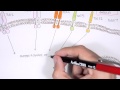
0:00 Arman Doha Surigand, Biology and Medicine videos, please make sure to subscribe 0:05 , join 0:05 the forming group for the latest videos, please visit Facebook, Arman Doha Sur 0:09 igand. 0:11 Now in this video we will look at toll-like receptors which are important 0:15 receptors in 0:17 innate immune system, they're found in immune cells, for example. 0:30 Let's begin by drawing out a plasma membrane of an immune cell, now it can be a 0:38 macrophage, 0:40 for example. 0:42 So the plasma membrane, the outer membrane is made up of a phospholipid bilayer 0:47 , here 0:47 is the intracellular fluid within the cell and extra-cellular fluid outside the 0:52 cell. 0:53 Here inside the cell we also have a double lipid membrane that makes up the 0:58 nucleus. 0:59 Here I'm only drawing one lipid membrane, but the nucleus has two lipid 1:03 membranes. 1:04 Anyways, within the nucleus is where we find our genetic material, which is DNA 1:09 , DNA contains 1:10 genes that we can read and essentially transcribe to make RNA and then proteins 1:18 . 1:18 It is important to understand this concept because toll-like receptors initiate 1:23 this 1:23 process, you can say. 1:26 Okay, so toll-like receptors are also abbreviated T-L-R and they are plasma- 1:30 bound receptors, 1:34 so they are always found on the membrane. 1:39 In humans there is approximately 10 toll-like receptors, they have recently 1:44 found 11th one 1:45 in the human gene, but I don't think it actually makes anything, yeah, but in 1:51 mice it does. 1:53 So as I mentioned, toll-like receptors help initiate and promote the immune 1:58 response, 1:59 but how? 2:00 Well, toll-like receptors essentially recognize different foreign agents, 2:04 components, structures, 2:06 or materials that don't normally belong to our body. 2:09 So let's have a look at the different things these toll-like receptors 2:13 recognize and look 2:14 at the different toll-like receptors themselves. 2:18 So toll-like receptor 1 and toll-like receptor 2 are found on the outer 2:24 membrane here and 2:26 they will bind to each other to form a dimer when they recognize things such as 2:32 peptidoglycans 2:33 of bacteria, lipotyricoic acids of gram-negative bacteria, lipoproteins as well 2:39 as zymosins 2:40 of fungi. 2:44 So all these different things will activate toll-like receptor 1 and toll-like 2:47 receptor 2:48 2 that will cause toll-like receptor 1 and 2 to form a dimer. 2:56 And what happens after this I'll talk about later, but we'll just focus on what 3:00 these 3:01 different toll-like receptors recognize first. 3:04 Toll-like receptor 2 can also form a dimer with toll-like receptor 6 when they 3:09 recognize 3:10 a foreign component as well. 3:12 And they recognize these same foreign components such as peptidoglycans and lip 3:18 oproteins. 3:19 Now toll-like receptor 4 recognizes lipopolysaccharides of gram-positive 3:24 bacteria. 3:25 And when toll-like receptor 4 recognizes this it will form a dimer with another 3:28 toll-like 3:29 receptor 4. 3:32 Toll-like receptor 5 recognizes flagella. 3:35 Notice that toll-like receptor 5 does not form a dimer. 3:40 Now toll-like receptor 11 gene as I mentioned is found in humans but don't 3:44 think they're 3:45 actually functional. 3:47 In mice they recognize uropathinogen, uropathogenic bacteria, bacteria that 3:53 target the urinary 3:54 system as well as prophylin. 3:56 Now prophylin is found in grass or wheat for example. 4:01 Anyway, then you have toll-like receptor 10 which I am not sure what it does or 4:06 the function 4:06 is not certain but it is found on the human plasma membrane nonetheless. 4:12 Now you might be thinking what about toll-like receptor 3, 6, 7 and toll-like 4:16 receptor 9 which 4:17 have skipped or missed. 4:19 Well these remaining toll-like receptors are found within endosomes. 4:23 Somehow these remaining toll-like receptors begin being expressed within endos 4:29 omes. 4:30 So the story is when viruses, bacteria or fungi contain their own genetic 4:37 material such 4:38 as double-stranded RNA and single-stranded RNA viruses as well as CPGDNA in 4:45 bacteria 4:46 for example. 4:48 Now CPGDNA essentially is DNA that contains cytosine and guanine and dinucleot 4:53 ides that 4:54 are un-methylated but you don't have to know that much detail. 4:57 Just know it's DNA. 5:00 So these genetic materials can either enter this cell through endocytosis or 5:06 they can 5:06 be released by the pathogen when the pathogen is also endostized. 5:13 Either way the genetic material will be within the endosome. 5:19 Now some toll-like receptors are found within the endosome. 5:23 These toll-like receptors don't need to form dimers. 5:27 Toll-like receptor 3 recognizes and are activated upon contact with double-str 5:32 anded RNA viruses. 5:34 Toll-like receptor 7 and toll-like receptor 8 are activated upon contact with 5:38 single-stranded 5:39 RNA viruses. 5:42 Toll-like receptor 9 recognizes and are activated upon contact with CPGDNA of 5:47 bacteria in fungi 5:48 for example. 5:50 Okay, now that we know the toll-like receptors and what they recognize, what 5:58 happens next? 5:59 Well, to put it into simple terms, they become activated. 6:04 The activation of toll-like receptors will initiate a cascade of events that 6:09 will essentially 6:11 lead to the activation of search and transcription factors. 6:16 The main transcription factors that are activated are AP1, IRF, and NFKB. 6:24 Now we'll go through each of these transcription factors and what they do in 6:30 this scenario. 6:31 But what you have to first understand is that this is a very simplistic diagram 6:35 in reality. 6:36 Toll-like receptors activate different transcription factors, but they're all 6:41 really connected 6:41 in some way. 6:43 So let's look at AP1. 6:45 AP1 stands for Activated Protein 1 and this will essentially enter the nucleus 6:52 and transcribe 6:53 and will stimulate or activate certain genes within the DNA to transcribe a 6:59 specific RNA. 7:01 Now this specific RNA will be translated by ribosomes out in the endoplasmic 7:07 reticulum. 7:07 This RNA will be translated to form proteins for cell signaling. 7:13 Now AP1 will essentially lead to differentiation, proliferation, and even apopt 7:21 osis. 7:21 Then you have IRF and NFKB that can also enter the nucleus. 7:26 IRF stands for Interferon Regulatory Factor. 7:31 That will activate certain genes in the DNA that will make a specific RNA. 7:36 Now this specific RNA will be translated by the ribosomes into interferons. 7:43 Now interferons are essentially protein molecules that are a defense mechanism 7:49 for immune cells 7:51 or other cells likewise. 7:54 And we'll talk about them a bit more later. 7:59 Now NFKB stands for Nuclear Factor Kappa B and this is probably the most famous 8:04 transcription 8:04 factor. 8:05 It's like associated with many types of diseases. 8:09 NFKB will stimulate or activate genes in DNA that will transcribe for a 8:14 specific RNA that 8:15 will make essentially cytokines. 8:20 So the specific RNA will be translated by ribosomes to make pro-inflammatory 8:26 cytokines. 8:27 Now these pro-inflammatory cytokines as the name suggests everything to do with 8:32 inflammation 8:33 it will promote inflammation. 8:35 The main inflammatory cytokine is TNF alpha. 8:40 But also other cytokines, pro-inflammatory cytokines produced are pro-interleuk 8:45 in-1b and 8:46 pro-interleukin-18. 8:49 Now pro-interleukin-1b and pro-interleukin-18 are actually in an inactive form 8:55 because they 8:56 have a pro before them. 8:58 Now these proteins they actually have to be activated and they are activated by 9:03 special 9:04 enzyme within the cytoplasm called Caspase I. 9:08 So Caspase I here is responsible for the proteolytic cleavage of pro-interleuk 9:15 in-1b and pro-interleukin-18. 9:19 And this will lead to the maturation and release of these two cytokines. 9:25 So what do all these products do? 9:28 Well, interleukin-1b and interleukin-18 when they're released they will 9:33 essentially enhance 9:34 the immune response substantially they will activate lymphocytes and they also 9:38 have a 9:38 chemotactic effect. 9:40 But they also have other functions that I won't really talk about but those are 9:44 the 9:44 main ones. 9:45 TNF alpha main function is to enhance the immune response essentially. 9:50 TNF alpha also induces apoptosis by binding onto receptors of other cells that 9:57 are infected 9:58 or whatever and these TNF alpha will essentially cause that cell to commit 10:05 suicide. 10:06 Now let's talk a bit more about interferons. 10:10 So interferons are produced when there's a viral infection. 10:15 You see the cell will produce interferons and will secrete interferons. 10:22 These interferons will then signal to other cells about that specific virus and 10:27 tell the 10:28 cells to up their defense. 10:30 So it's a very important communication sort of molecule. 10:37 So I hope you enjoyed that video, this video on an overview of Tolic Receptors. 10:41 The next video will look at the inflamazome and how it's related to this actual 10:45 diagram 10:45 but it is a separate video nonetheless. 10:48 Hope you enjoyed it. 10:49 Thank you.