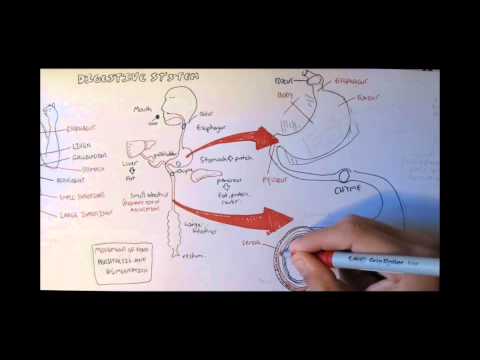
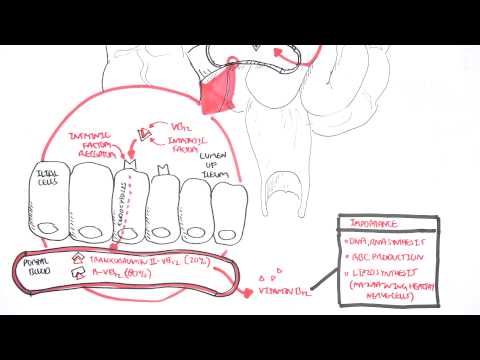
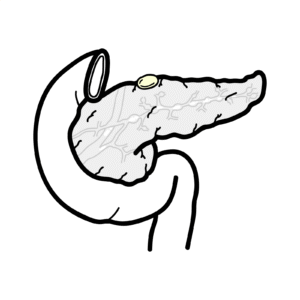
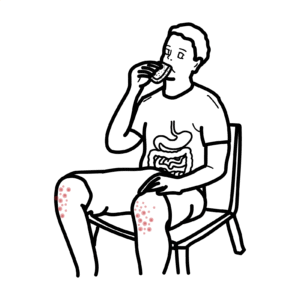
0:00 In this video we're going to talk about fat digestion and absorption. 0:10 We will also talk about the causes of fat malabsorption and the clinical 0:16 manifestations 0:17 of this. 0:19 Fat is an important component of our diet. 0:22 It is both a protective and also it contributes to heart disease, depending on 0:27 the type of 0:28 fat. 0:29 In its complete form, the fats are made up of a lot of triglycerides and 0:35 triglycerides 0:36 are essentially where you have three fatty acids combined to a glycerol 0:42 backbone. 0:43 Our body needs to break down this structure into its building blocks in order 0:49 to absorb 0:49 it into our body and use it as we wish. 0:54 Fat breakdown begins in the mouth with lingual lipase and mastication. 1:01 Lipase hydrolyzes and break down lipids, the fats. 1:05 The partially digested lipids travel to the stomach to be further greeted by 1:10 the gastric 1:11 lipase. 1:13 The broken down lipids are still in triglyceride chunks, which move into the du 1:19 odenum, bringing 1:20 with it the acidity from the stomach. 1:24 Fat droplets and the acidity from the stomach will stimulate the small 1:30 intestinal cells 1:30 to produce two important hormones, cholycystokinin, C-C-K, and secreting. 1:41 C-C-K stimulates bile production and secretion. 1:51 C-C-K also stimulates pancreatic enzyme release, known as the pancreatic juice. 2:01 Secretin, on the other hand, will stimulate bicarbonate secretion from the panc 2:06 reas, 2:07 and this is in order to raise the interluminal pH to approximately 6.5, which 2:14 is the optimum 2:16 sort of environment for fat digestion. 2:20 So let's put it all together and look at the lipids that have just entered the 2:24 small intestine 2:25 and are going to be exposed to the bile and the pancreatic enzyme, specifically 2:32 the lipase. 2:33 Bile, specifically bile salts, help with emosification of lipids, basically 2:39 coating it, and this 2:41 allows for digestion by the pancreatic lipases. 2:47 Bic lipase will help break down the triglycerides further into fatty acids and 2:53 monoglycerides 2:54 and help form what we know as micelles. 2:59 These micelles are essentially a ball composed of the broken down products of 3:03 fat, the building 3:04 blocks of fat. 3:06 Micelles are composed of bile salts, the fatty acids, the monoglycerides, 3:12 cholesterol, 3:13 and all this is coated also by phospholipids. 3:17 Now in this form, the monoglycerides and the fatty acids are able to be 3:23 transported and 3:25 absorbed across the apical membrane of enterocytes, mainly in the proximal 2/3 3:31 of the jejunum, 3:33 which is essentially the middle part of the small intestine. 3:37 The bile salts themselves remain in the intestinal lumen because they do not 3:42 get reabsorbed here. 3:44 They actually reach the terminal isleum where they are actively reabsorbed and 3:50 enter the 3:51 portal circulation into the liver. 3:54 And this cycle is known as the enterohapatic circulation, entero as in 4:00 intestine and hepatic 4:02 as in liver. 4:03 So the bile salts that are reabsorbed here and are in the liver are then 4:07 essentially recycled 4:08 and re-secrated into bile to be used again. 4:13 The fatty acids and the monoglycerides which were absorbed in the jejunum will 4:19 be packaged 4:20 up in the cells to form fully mature chylomicrons. 4:27 And these chylomicrons will bind to the basal lateral membrane and is 4:33 transported to the 4:34 intestinal lymphatics. 4:36 And from the intestinal lymphatics, it will then enter the general circulation 4:41 to be transported 4:42 around our body. 4:44 Now it's also important to know that vitamins such as vitamins A, D, E and K or 4:51 ADIC rely 4:52 on fat to be absorbed in the jejunum while vitamins B and C are more water 4:59 soluble and 5:00 they do not rely on fat absorption or digestion. 5:05 So fat malabsorption which is when you have deficiency of fat or you're not 5:11 absorbing 5:11 and digesting fats properly will cause someone to have pale and voluminous 5:17 stool, diarrhea 5:19 without flatulence as well as stiateria. 5:23 Further, the fat soluble vitamins we mentioned earlier, you can also have 5:27 deficiency of these 5:28 so ADIC. 5:30 If you have vitamin A deficiency, you can develop follicular keratosis and 5:35 night blindness. 5:36 Vitamin D deficiency, osteopenia, weak bones, osteomalacia and osteoporosis. 5:43 Vitamin E deficiency, neuromuscular disorders and hemolysis can occur. 5:49 And vitamin K deficiency, you get easy bleeding. 5:56 So what are the different etiologies of fat malabsorption? 6:00 Well, a good way to think about it is think about problems along the fat 6:05 digestion pathway 6:06 and absorption. 6:08 So if we look at the first part of fat digestion, we see that gastric lipase 6:13 has a role in fat 6:14 digestion and so problems with the stomach including a previous gastric surgery 6:20 can cause 6:20 some form of fat malabsorption. 6:24 Another cause of fat malabsorption is bile salt deficiency because bile salts 6:29 are needed 6:30 to in the digestion of fat. 6:32 So things such as chronic liver disease including cirrhosis which will cause a 6:37 decrease in bile 6:38 acid synthesis. 6:40 You have chollelithiasis, any cause of biliary system obstruction reduces the 6:46 secretion 6:46 of bile, terminal isleal disease such as Crohn's disease or resection because 6:51 really 6:51 you're not reabsorbing the bile salts if you remember through the interhepatic 6:57 circulation. 6:58 Small intestinal bacterial overgrowth is when you have overgrowth of certain 7:02 bacteria which 7:03 deconjugates bile acids rendering the bile acids ineffective for fat absorption 7:11 . 7:12 Then another category of the causes of fat malabsorption are problems with the 7:18 pancreatic 7:18 enzymes or pancreatic insufficiency. 7:21 The causes include pancreatitis, chronic pancreatitis, pancreatic cancer, 7:28 autoimmune pancreatitis, 7:30 cystic fibrosis, amyloidosis, hemochromatosis which are in full-trader disease 7:37 and very 7:38 importantly, Zolenga Ellison syndrome which is when you have inactivation of 7:44 pancreatic 7:44 lipases because the environment is so acidic in the duodenum. 7:52 Another category are mucosal defects so disease involving the small intestine, 7:58 the epithelial 7:59 lining. 8:00 Celiac disease causes villus atrophy, lymphoma, you have small bowel ischemia 8:08 or inflammation 8:09 resection so you can't absorb anything, inflammatory bowel disease, infiltrated 8:15 diseases such as 8:17 amyloidosis and hypogammaglobinemia and Whipple's disease. 8:25 Another category that causes fat malabsorption are to do with the final end 8:29 part where transportation 8:31 of fat occurs and that's really problems with the lymphatic system so things 8:36 such as 8:37 cancer infiltrating the lymphatics can cause obstruction and flow of the 8:41 absorbed fat from 8:43 the intestine. 8:45 Intestinal lymphangiectasia which is basically disrupts the lymphatic movement 8:51 of the chylomicrons 8:52 which are absorbed. 8:55 So in summary, fat digestion involves lingual lipase, gastric lipase, pancreat 9:01 ic lipase 9:01 as well as bile acid secreted from the biliary system. 9:07 Fats are absorbed in the duodenum and the bile salts are not absorbed here 9:12 rather they 9:12 are reabsorbed in the terminal islam where they enter the enteripatic 9:16 circulation. 9:18 The clinical manifestation of fat malabsorption is stereorrhea and pale stools 9:24 and the different 9:25 causes can be easily divided into the sections of fat digestion including bile 9:32 acid issues, 9:34 pancreatic issues, mucosal issues as well as the lymphatic issues and gastric 9:40 issues. 9:40 Thank you for watching.