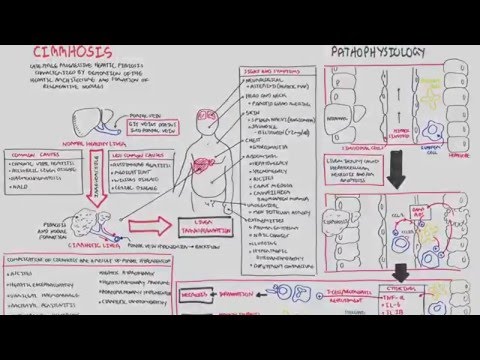
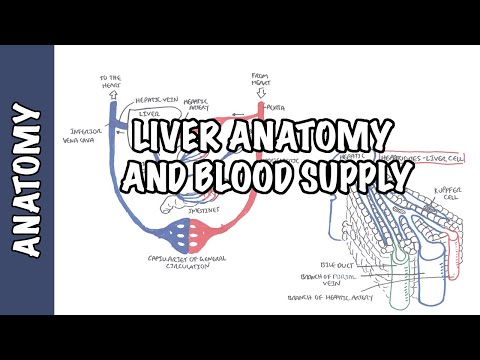
0:00 Autoimmune hepatitis, as the name suggests, is when the body's own immune cells 0:11 attack 0:11 the liver cells, resulting in inflammation. 0:16 The disease may be asymptomatic, meaning no symptoms initially, or can start as 0:22 acute 0:23 hepatitis and progress to chronic liver disease and even liver cirrhosis, which 0:30 is scarring 0:31 of the liver. 0:33 Autoimmune hepatitis is four times more common in women than in men. 0:37 It can occur at any age. 0:39 Let's learn a bit more about how the disease process starts. 0:45 Well, the precise cause of autoimmune hepatitis is not known, but there are a 0:54 few theories 0:55 that exist. 0:57 The first is what's called molecular mimicry. 1:00 Some people's immune system may mistakenly target proteins in their own liver 1:07 cells. 1:08 The liver cells are known as hepatocytes. 1:11 Now this can happen because these proteins on the liver resemble proteins found 1:16 in other 1:17 microorganisms, such as a virus, for example, hepatitis C virus. 1:23 The immune cell is meant to attack the hepatitis C virus, but mistakeens the 1:28 liver cells as 1:29 hepatitis C virus due to the similar protein structure between the liver cells 1:34 and the 1:35 hepatitis C virus, and this will result in inflammation of the liver caused by 1:40 the immune 1:41 cells. 1:47 The second theory for autoimmune hepatitis is what's called immune activation 1:52 upon self 1:53 antigen presentation. 1:56 So basically what happens here is that the body's own liver proteins are being 2:03 presented 2:04 by the specialized antigen presenting cells. 2:08 The cells present the liver proteins to what's called CD4-T helper cells, and 2:14 then this cell 2:15 will trigger an immune response that leads to liver damage causing autoimmune 2:25 hepatitis. 2:27 The final big theory is what's called loss of self tolerance, and normally 2:34 everyone has 2:36 some immune cells that target their own tissues. 2:40 There are usually mechanisms in place to prevent these cells from causing harm. 2:46 And the specific cell here is the T regulatory cell. 2:52 Now when this mechanism falls when we have no regulation, it can contribute to 2:58 the development 2:59 of autoimmune diseases such as autoimmune hepatitis. 3:08 And so autoimmune hepatitis can have a range or a variety of presentation. 3:15 Typically, people can present with asymptomatic elevation of deranged liver 3:21 function tests, 3:22 the transaminases, specifically AST and ALT levels. 3:27 They can have some fatigue and weight loss, or they could present with acute 3:32 hepatitis 3:32 where someone can be jaundiced and develop right upper quadrant pain. 3:37 Rarely someone will present with acute liver failure. 3:41 And hepatitis is associated with other autoimmune conditions. 3:45 So many people may already have an underlying autoimmune condition such as 3:51 autoimmune thyroid 3:52 itis, which is the most common association, rheumatoid arthritis, type 1 3:58 diabetes mellitus, 3:59 all sort of colitis, celiac disease, and systemic lupus erythmatosis. 4:10 People with autoimmune hepatitis will typically show elevated AST and ALT 4:16 levels. 4:17 They have also high immunoglobulin G, IgG levels, with typically normal immun 4:24 oglobulin 4:25 A and immunoglobulin M. 4:28 Most importantly, people who have autoimmune hepatitis have presence of autoant 4:38 ibodies. 4:39 People with autoimmune hepatitis are divided based on these autoantibodies 4:44 typically. 4:45 And there are two main types. 4:48 So firstly is type 1 autoimmune hepatitis, which is responsible for over 90% of 4:55 cases. 4:56 You have the classic autoantibodies here. 4:59 Antibodies, ANA, anti-smooth muscle antibodies, ASMA, anti-active antibodies, 5:09 AAA. 5:10 And then you have type 2 autoimmune hepatitis, which mainly affects children 5:14 and is generally 5:15 more severe form of the disease. 5:18 Here autoantibodies can be found that are against liver kidney microzomes, ALKM 5:27 1, alone 5:28 or accompanied by liver cytosol antigen ALC1. 5:38 The other investigation to be performed is a liver biopsy, and a liver biopsy 5:42 is necessary 5:43 to establish a diagnosis of autoimmune hepatitis. 5:47 Now, the histological change in a normal liver looks something like this, with 5:52 presence 5:53 of the portal triad, the central vein, and the hepatocytes. 5:58 However, with autoimmune hepatitis, what you see is dense mononuclear and 6:03 plasma cell 6:04 infiltration of the portal areas, which expands to the liver lobules leading to 6:10 damage of 6:11 the hepatocytes at its periphery with erosion of really the ends of this area. 6:19 And this is termed interface hepatitis. 6:22 However, there is no single histological feature that is pathonumonic for 6:27 autoimmune hepatitis. 6:30 Then you can have imaging of the liver, but really, there are no characteristic 6:35 imaging 6:36 features that can help diagnose autoimmune hepatitis, possibly an ultrasound 6:41 that can 6:41 show some inflammation. 6:44 The diagnosis of autoimmune hepatitis, therefore, is based on a criteria and 6:50 include a number 6:51 of things. 6:52 Firstly, they need elevation of the liver function test, specifically AST and 6:58 or ALT. 6:58 They must have positive autoantibodies, elevated IgG, exclusion of other 7:05 diagnoses and differentials, 7:07 such as wilson's disease, viral hepatitis, or drug induced liver disease, and, 7:12 you know, 7:12 a liver biopsy can help, which can show inflammation and some of the 7:17 characteristic features we 7:18 discussed earlier. 7:26 Once autoimmune hepatitis is diagnosed, treatment should be started, and there 7:30 is often a dramatic 7:31 response. 7:33 Treatment includes prednisone and as a fire print for most patients. 7:39 Prednisone monotherapy is less preferable due to side effects, as a fire print 7:44 also 7:45 requires monitoring due to cytopenias. 7:48 Other treatment options include other immunosuppressive agents, such as mercapt 7:53 or purine or microphenolate. 7:58 Histological response can lag by many months, and the duration of treatment 8:02 should be two 8:02 to three years at least before considering withdrawing treatment. 8:09 A liver biopsy is also recommended to determine the histological change to the 8:14 treatment before 8:16 considering stopping the treatment. 8:19 Finally, a liver transplantation is also considered in people who have more 8:24 aggressive disease, 8:25 especially if they have no response to the treatment for a few years. 8:35 So in summary, autoimmune hepatitis is a rare liver disease caused by the 8:39 immune system 8:40 mistakenly attacking the liver cells that have parasites. 8:44 It is characterized by the presence of certain autoantibodies in the blood, 8:47 increased levels 8:48 of immunoglobulin G, and specific changes in the liver tissue on biopsy. 8:54 It is believed that the disease occurs when the body's immune system loses its 8:59 ability 8:59 to recognize liver cells as friendly and starts attacking them. 9:10 Thank you for watching.