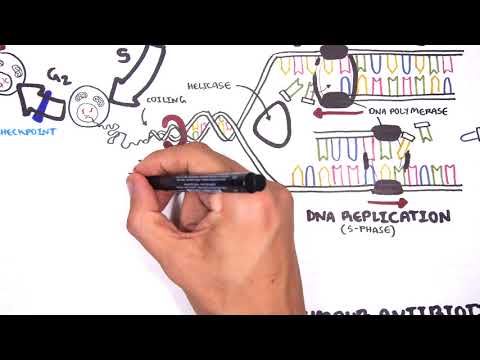
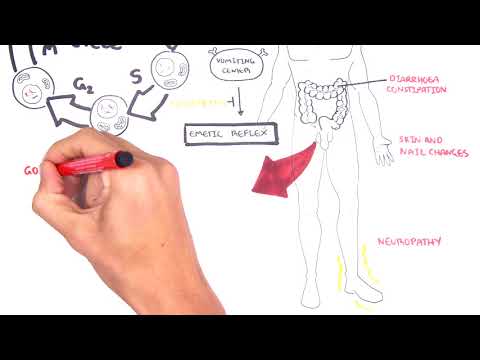
0:00 Hello, in this video, we're going to talk about another disease-modifying anti- 0:10 romatic 0:10 drug by the name of azathioprine. 0:14 Azathioprine is an immunosuppressant used in various inflammatory diseases, 0:19 including 0:20 rheumatoid arthritis, and is the preferred disease-modifying anti-romatic drug 0:25 in systemic 0:26 lupus erythmatosis patients who are pregnant. 0:32 Azathioprine is also used to prevent renal transplant rejection. 0:38 Azathioprine is a prodrug of six mercaptor purine, which is then metabolized 0:45 through 0:46 different pathways. 0:49 For example, metabolism into six theogwinin nucleotides is of benefit, because 0:56 this is 0:57 where azathioprine exerts its immunosuppressive effects. 1:03 T&B cells enter the cell cycle to proliferate. 1:12 In the DNA synthesis phase, or the S-phase of the cell cycle, six thiogwinin 1:19 nucleotides 1:20 incorporates into DNA as a false purine base, essentially. 1:25 An additional cytotoxic effect is related to its incorporation into RNA. 1:31 Anyway, when six theogwinin incorporates into the DNA, this results in a 1:36 mutation that 1:37 would stop the cell cycle promoting repair or apoptosis. 1:43 Further, thiogwinin promotes activation of RAC1 within T-cells, for example, 1:50 when co-stimulated 1:52 with CD28. 1:54 This will induce T-cell apoptosis through a number of pathways. 2:02 An alternative metabolic pathway of six mercaptor purine is via xanthine oxid 2:07 ase, which will 2:08 form six thioyuric acid. 2:12 Six thioyuric acid is non-toxic and can be cleared by the body. 2:19 Another alternative metabolic pathway of mercaptor purine is via theopurine 2:24 methyltransferase, 2:26 forming six-methyl mercaptor purine. 2:30 Each six-methyl mercaptor purine is also non-toxic and can be cleared by the 2:37 body. 2:38 Myelosuppression, or even immunosuppression, is a primary side effect of as a 2:43 thioprine 2:43 and can lead to malignancies forming, especially skin cancers and lymphoma. 2:50 Therefore, it is important not to use, for example, xanthine oxidase inhibitors 2:56 , such 2:56 as allopurinol or phoboxestat, and these medications are typically used in gout 3:03 . 3:03 These medications shouldn't be used while on as a thioprine, as this will 3:08 increase as 3:09 a thioprine toxicity, driving the metabolic pathway to immunosuppression. 3:15 Similarly, a defect in thiopurine methyltransferase means shifting the 3:22 metabolic pathway to six 3:25 thiogwiny nucleotides causing more immunosuppression. 3:32 Theopurine methyltransferase testing allows for identification of patients with 3:37 decreased 3:37 or absent enzyme activity at high myelosuppression risk. 3:44 As a thioprine can cause photosensitivity reactions and patients should be 3:48 advised to wear sunscreen 3:49 and protective clothing. Other side effects include nausea and vomiting.