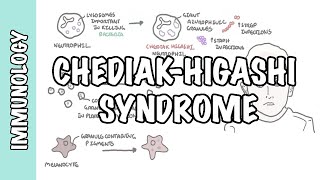
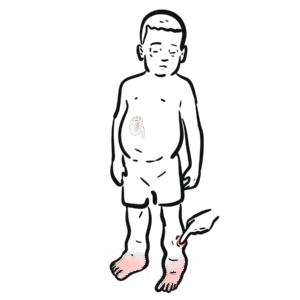
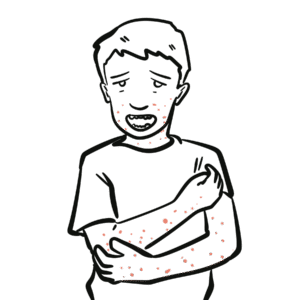
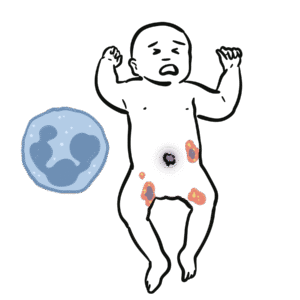
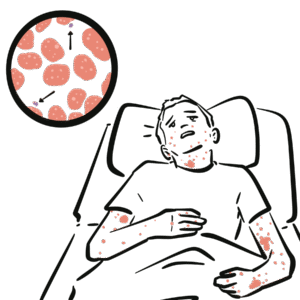
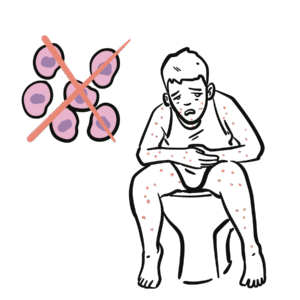
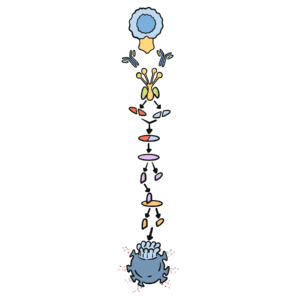
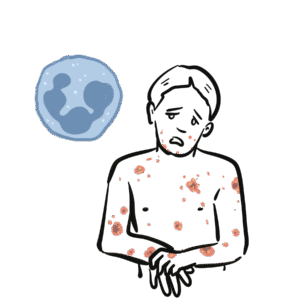
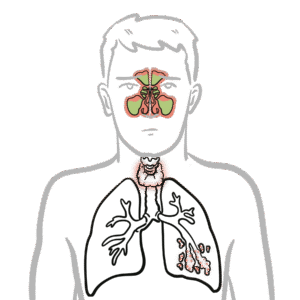
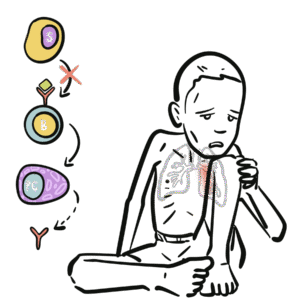
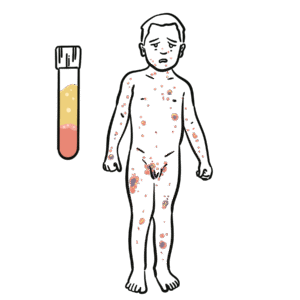
0:00 Diseases of immune dysregulation is a category of primary immunodeficiencies 0:11 characterized 0:12 by defects in self-tolerance resulting in autoimmune diseases with or without 0:18 recurrent infection. 0:20 To put it simply, it's essentially an uncontrolled, hyperactive immune state, 0:27 causing autoimmune 0:28 disease, which can be associated with infection. Examples of diseases of immune 0:35 dysregulation 0:36 include Chetayak Higashi Syndrome, which is a syndrome caused by mutation in 0:42 the list gene, 0:43 and then you also have hemophagocytic lympho-histeocytosis, which is a disease 0:49 caused by 0:50 hyperactive macrophages and cytotoxic T lymphocytes. Chetayak Higashi Syndrome 0:57 can progress and lead to hemophagocytic lympho-histeocytosis. 1:03 So let's focus on Chetayak Higashi Syndrome, which is a condition where there 1:11 is mutation 1:12 of the lysosomal trafficking gene, or the list gene for short. This will result 1:19 in the dysfunctional 1:21 or altered lysosome and granules. Lysosomes are small organelles found in cells 1:28 that are important 1:29 in digesting bacteria or pathogens, and granules are tiny particles that are 1:36 stored within cells 1:38 that have multiple functions and are secreted, for example, pigments. So lysos 1:43 omal and granule 1:45 dysfunction affects multiple cells. Neutrophils normally contain lysosomes, 1:51 which are important 1:52 in killing bacteria. In Chetayak Higashi Syndrome, the neutrophils have giant a 1:58 zerophilic granules. 2:00 As a result, the neutrophils are unable to destroy the bacteria, and so you get 2:06 recurrent infections, 2:07 typically pyogenic infections from staff and strep species. 2:14 Platelets normally contain dense granules, important in platelet function, 2:18 which is to stop bleeding. 2:19 In Chetayak Higashi Syndrome, the platelets have deficiency of granule stores, 2:25 as well as function, 2:26 and this essentially increases the risk of bleeding in the person. 2:30 Melanocytes also contain granules containing pigments. 2:34 In Chetayak Higashi Syndrome, there are enlarged pigment granules, which are 2:41 not released, 2:42 and so you get less pigmentation. You get this albino type picture. 2:47 So the characteristic of a person with Chetayak Higashi Syndrome, there's a 2:55 pentad. Firstly, 2:57 you get recurrent pyogenic infections, staff and strep species. Anywhere, the 3:02 skin, the respiratory 3:03 tract, the gastrointestinal tract. You get oculocutaneous albinism, so because 3:08 of low pigmentation. 3:11 You can get neurologic abnormalities, mild coagulation defects, as well as 3:17 possible progression to 3:19 hemophagocytic lymphohistiositosis. Patients who do not die from infection 3:26 eventually will enter the 3:27 accelerated phase of the disease, which is characterized by hemophagocytic 3:33 lymphohistiositosis. 3:35 And the mechanism of the disease and the mechanism of hemophagocytic lymphohist 3:42 iositosis will be 3:43 discussed in a separate video, which you can click on.