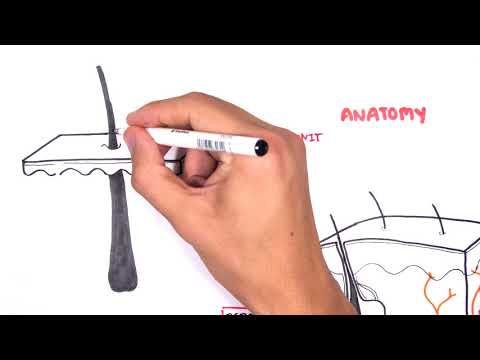
0:00 On one of our Instagram biology medicine videos, please make sure you subscribe 0:02 to the appointment 0:03 group for latest videos. 0:04 Please visit the place where they're on Instagram. 0:05 Please like and you can also ask questions, answer questions, and post some 0:07 interesting 0:07 things, including outlooks. 0:08 And if you also change the quality settings to the highest one, look at the 0:11 graphics. 0:12 In this video, we can look at the intergimetry system, an overview. 0:16 And I called it germatology because germatology is a field of medicine that 0:21 focuses on the 0:22 intergimetry system. 0:23 I just wanted to call it a bit fancier. 0:27 Now when we think of the intergimetry system, or dermatology, we think of the 0:32 skin. 0:33 That is the main component of the intergimetry system. 0:37 The skin is the largest organ in the human body. 0:41 Its average weight is about four to five kilograms. 0:43 The skin's main function is to protect the interior of the body from the 0:48 external environment. 0:50 It also has a role in the metabolism of vitamin D amongst other things. 0:55 Here I'm drawing a person just to explain that our body consists of basically 1:02 two types 1:02 of skin. 1:04 We have a thin skin and if you haven't realized, we have a thick skin. 1:09 For example, the soles of your foot and the palm of your hands. 1:12 They're much thicker and they're less elastic. 1:16 They're also hairless. 1:20 But for now, we will focus on the thin skin. 1:23 So here we're just zooming into the deltoid region and we're looking at this 1:27 person's 1:27 skin. 1:29 We're looking at the different layers as well as the anatomy of the skin. 1:35 As you can see, we have hairs coming out and other structures below it. 1:40 The skin is divided into two main layers, the epidermis and the dermis. 1:47 The dermis can be divided further into the papillary layer and the reticular 1:52 layer. 1:53 The papillary layer is important in forming our own unique fingerprints. 2:01 We have the third layer below the dermis called the hypodermis, hypo as in 2:07 below. 2:08 That is actually not part of the skin. 2:11 The hypodermis contains many adipose tissue. 2:18 Adipose tissue are just fat tissue, essentially. 2:24 So as mentioned, the papillary layer is responsible for forming our own unique 2:30 fingerprints and 2:31 this is because it contains dermal pebbleae, these bumps. 2:37 Of course, there is a rich blood supply to the intergimetry system but the 2:42 vessels do 2:42 not supply blood to the epidermis, rather the blood vessels arise from the der 2:47 mis and 2:48 supplies blood in the dermis layer and only to the base of the epidermis layer. 2:57 So the top or middle of the epidermis don't really get any blood at all and we 3:03 'll soon 3:04 see what this means. 3:06 Adipose tissue as mentioned is part of the hypodermis layer and it is to help 3:11 in maintaining 3:12 temperature, homeostasis amongst other things and it's basically fat tissue as 3:17 I mentioned. 3:18 Now, the appendages of the skin are appendages that can be found within skin 3:23 structures. 3:24 These include the hair, the hair root and hair follicle here, where the hair 3:30 comes from. 3:33 Added to the hair follicle, we have sebaceous glands, which secrete oil to 3:39 lubricate and 3:40 waterproof the skin and the hair. 3:45 We also find echryme glands around the dermis area and which will go up to the 3:52 epidermis 3:53 and these echryme glands secrete are basically sweat glands and secrete sweat 3:59 are sweat. 4:00 We find these everywhere in our body, a good example is in the armpits. 4:06 Then we have muscles that connect to the hair root or follicle, which are the 4:11 muscles responsible 4:12 for pulling our hair, for example when we have goosebumps and these muscles are 4:17 known 4:17 as arachitopilae muscles. 4:21 So those are the appendages of the skin. 4:23 We also have nerve structures in our skin as well, which send information to 4:27 the brain 4:28 as well as from the brain. 4:31 These nerve structures include the hair follicle receptors for our hair, the 4:35 lamellae corpuscle, 4:37 which are actually a type of nerve ending. 4:40 It's a mechanoreceptor that is sensitive to vibration and pressure. 4:44 So when we feel pressure in our skin, someone pushing down, these lamellae 4:48 corpuscles are 4:49 activated. 4:51 Then we have other free nerve endings that branch out all the way to the epider 4:56 mis below 4:56 the epidermis and these nerve endings include pain receptors, for example. 5:04 Now let's talk a bit more about the epidermis layer. 5:06 The epidermis layer is not as simple as showing the diagram, it looks just like 5:10 one layer. 5:11 But the epidermis layer actually consists of many layers, it's made up of squ 5:16 amous epithelial 5:18 cells. 5:19 Let's have a look at each of these layers in the epidermis. 5:23 The epidermis is a vascular, meaning it has no blood supply. 5:26 It consists of keratinized sheet of squamous epithelium. 5:31 Remember we are looking at the epidermis layer now. 5:34 Now the very top layer of the epidermis is known as a stratum corneum, where we 5:40 have 5:41 20 to 30 layers of dead cells. 5:45 These dead cells are known as keratinocytes, which are keratin cells. 5:50 So basically on the top of our skin we have a dead cell, so if we rub our skin 5:55 now, flakes 5:56 of dead cells will fly off. 6:00 Now that was the very top of the epidermis. 6:05 Let's look at the very bottom layer of the epidermis. 6:08 The very bottom layer of the epidermis is the stratum basily, basily, basily as 6:13 a base, 6:14 where we have actively dividing cells, actively dividing keratinocytes, the ker 6:20 atin cells. 6:21 And these cells as they are actively dividing, they will begin moving up, 6:25 basically pushing 6:26 up and pushing the dead cells out. 6:30 Why are they actively dividing? 6:32 Well, it's because there is some blood supply at the very base of the epidermis 6:37 , which is 6:38 the stratum basily. 6:40 So with the blood supply, it means that they can divide. 6:44 They are alive. 6:46 But as they move up, they will slowly lose this blood supply and they will die. 6:52 There are other cells found within the stratum basily, such as melanocytes, 6:56 which are responsible 6:57 for producing melanin, which is responsible for the color of our skin. 7:02 Then we have tactile cells also, which are basically nerve endings for sensing 7:09 things. 7:10 Above the stratum basily, we have another layer known as a stratum spinosa. 7:15 And this is where we have layers of keratinocytes, which are all connected by 7:21 desmosones. 7:22 Desmosones are basically junctions. 7:24 So here I'm drawing cells with black lines connected to each other. 7:28 These black lines represent desmosones. 7:31 So they're tightly packed. 7:34 We can also find dendritic cells here. 7:36 Now dendritic cells are just basically part of the immune system, responsible 7:41 for taking 7:41 up pathogens or destroying pathogens, basically. 7:45 Above the stratum spinosum, we have another layer known as a stratum granulosum 7:50 , where 7:51 we have layers of keratinocytes with the organelles slowly being destroyed, the 7:59 degeneration 8:00 of organelles. 8:02 And this is because there is no blood supply in the slayer, essentially. 8:08 So these black dots I'm drawing with in the cell represent the organelles 8:11 degrading. 8:12 And so as this moves up to the top layer, the keratinocytes are already dead. 8:21 So as we just learned, the epidermis of the thin skin consists of four layers, 8:27 from the 8:27 top of the stratum corneum, granulosum, spinosum, and basily. 8:33 Below the vasily, below the epidermis, we have the dermis layer, the highly 8:37 vascularized 8:38 layer. 8:39 The dermis consists of two layers itself, the papillary layer, which contains 8:44 the dermal 8:45 peppole, and also the papillary layer connects to the epidermis. 8:51 The papillary layer is important because it forms fingerprints due to these 8:55 bumps here, 8:57 the dermal peppole. 9:00 The other layer is the reticular layer, which is composed of connective tissue 9:04 fibers. 9:05 This is a pretty dense area, tightly packed cells. 9:10 So that was just, we looked at an example of a thin skin just then, of the del 9:15 toid, right? 9:15 But remember we have two types of skins, we have the thin skin and the thick 9:20 skin. 9:20 What is the difference? 9:22 Well there's actually not much difference. 9:25 The thin skin is hairy, we have hair. 9:28 So we have hair follicle here and we also have a thin layer of adipose tissue 9:32 of the hypodermis. 9:34 The thick layer is hairless, it contains no hair, and it has a thick layer of 9:39 adipose 9:39 tissue. 9:40 An example of a thick layer is the sole of our foot, and we don't find hair 9:46 there. 9:47 But the main difference that I want to explain is an anatomical point of view 9:54 is that the 9:55 epidermis layer, it consists of five main layers instead of four. 10:02 So from the top, we actually have the stratum corneum, the stratum locidium, 10:07 stratum granulosum, 10:09 stratum spinosum, and stratum basale. 10:12 As you can see, the additional layer is the stratum locidium. 10:18 We don't find the stratum locidium in the thin skin. 10:23 I hope that made sense. 10:25 So now let's look at a hair follicle, let's learn a bit more about hair. 10:29 So here I'm just drawing the hair. 10:31 The hair root coming up and the hair shaft above our skin. 10:38 We have blood vessels supplying the hair because the hair needs blood vessels 10:43 to grow, and 10:44 the blood vessel is supplied from the hair root. 10:47 And it's supplied from the hypodermis or just on the base of the dermis. 10:52 This layer consists of many adipose tissue. 10:56 We have the hair shaft here, the hair root, the bottom, and we have erector p 11:01 ili muscles 11:01 connecting the hair root, which are responsible for pulling the hair, such as 11:06 that when we 11:06 have goosebumps or a frightened. 11:09 We actually also find melanocytes cells within the hair root. 11:14 The melanocytes, remember, are responsible for producing melanin for color, and 11:20 that's 11:20 why you can set the hair of this dark color. 11:25 And the final thing that I want to point out is that connected to the hair root 11:28 , the 11:29 hair follicle down here, we have glands known as cemaceous glands, which sec 11:34 rete oil. 11:35 The cemaceous gland is important because it lubricates the hair as well as the 11:39 skin and 11:39 also makes it waterproof. 11:44 I hope you enjoyed this overview of the intergumetry system. 11:48 Please share, comment, like, and thank you all.