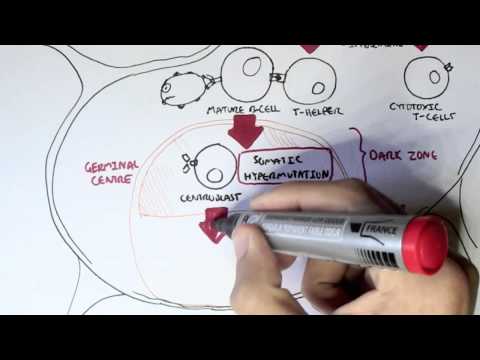
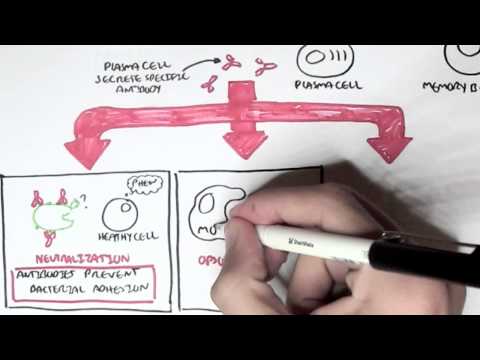
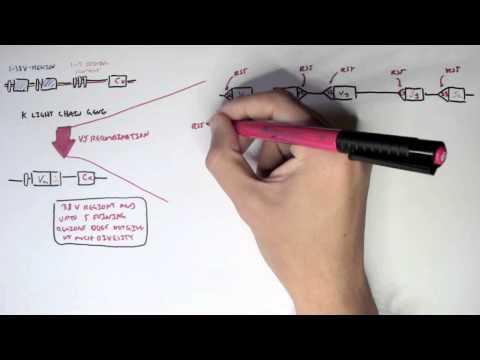
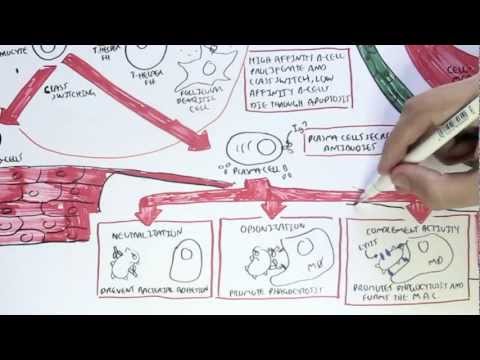
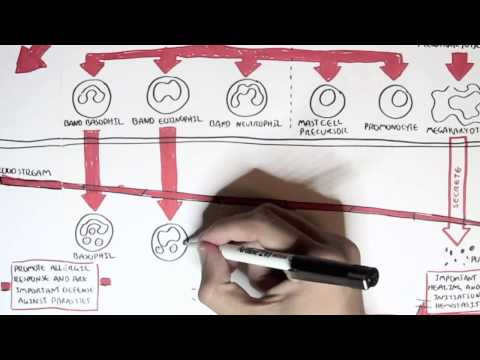
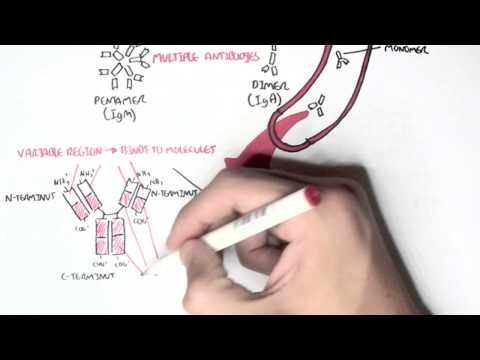
0:00 Ataman Duhasudhagan, Biology and Medicine videos, please make sure to subscribe 0:05 , join 0:05 the form and group for latest videos, please visit Facebook, Ataman Duhasudh 0:09 agan, make 0:09 sure to like, and here you can also ask questions, answer questions, and post 0:13 interesting things 0:14 such as outworks. 0:16 And you can also change the quality settings to the highest one for better 0:20 graphics. 0:20 In this video, we are talking about somatic mutation, hyper mutation, and class 0:25 switching 0:25 in B cells. 0:27 So to get an appreciation of hyper mutation and class switching, let's begin 0:31 from the 0:32 very beginning, in the bone marrow, where a progenitor B cell, through somatic 0:37 recombination 0:38 of the heavy chain first, will make a precursor B cell, and the precursor B 0:44 cell will undergo 0:46 a second somatic recombination of the kappa or lab Duh light chain, which will 0:52 essentially 0:53 make create a unique antibody, usually an IgM class, immunoglobulin M class, 0:58 immature 0:59 B cell. 1:01 After an immature B cell has been formed, the immature B cell will then migrate 1:04 to the lymph 1:04 nodes, where it will come in through the afferent lymphatics into the lymph 1:10 node, and cells 1:11 that go out of the lymph node will obviously leave through the efferent lymph 1:17 atics. 1:18 And the black structures coming in the lymph nodes are the veins and arteries. 1:21 Now let's take a cross section of the lymph node and see what immature B cell 1:25 is, and how 1:25 it becomes activated within the lymph node, and what it does to undergo hyper 1:32 mutation 1:33 and also class switching. 1:35 So in the lymph node, we have certain designated areas. 1:38 The cortex, which is usually abundant in B cells and the paracortics, usually 1:42 abundant 1:43 in T cells. 1:45 Now within the lymph node, we have areas called the germinal center, and the 1:50 germinal center 1:52 consists of a dark zone and a light zone. 1:55 Now the immature B cell, when it goes to the lymph node, it becomes a mature B 2:01 cell. 2:02 And at this stage it can express not only IgM, immunoglobulin M, but immunoglob 2:07 ulin D antibodies. 2:08 Now the mature B cell, which is usually abundant in the cortex, will move to 2:12 the paracortics 2:13 to get activated by T helper cells or alternatively you can get activated by an 2:17 antigen of a pathogen 2:19 or even a follicle-dendritic cell. 2:21 Now when this mature B cells gets activated, regardless, it will move into the 2:25 germinal 2:26 center, the dark zone, and begin to proliferate, a process called clonal 2:31 expansion. 2:32 Now it is still that the mature B cells, when it proliferates into cells called 2:36 centroblasts, 2:37 an intracellular enzyme called AID, will introduce mutations, point mutations 2:43 on the 2:43 variable region of the DNA. 2:47 So the variable region that encodes for the variable region of the antibody, 2:51 and so this 2:52 introduction of mutations, also known as a process called hypermutation, will 2:59 change 2:59 the antibody, increasing its affinity or decreasing its affinity, increasing 3:04 its specificity 3:05 or decreasing its specificity. 3:08 And so these mature B cells, through proliferation and hypermutation, will 3:13 create many types 3:14 of centroblasts with an increased affinity or a decreased affinity for the 3:18 particular 3:19 antigen that stimulated the activation of the mature B cell in the first place. 3:24 Now in the light zone of the germinal center, we have other types of cells, 3:28 such as follicular 3:29 dendritic cells, FDC and T helper cells, with the antigen presented to the 3:34 mature B cell 3:35 in the first place. 3:37 Now what happens is, the centroblasts will move from the dark zone into the 3:41 light zone, 3:42 where they will become centrocytes. 3:45 So now what happens is, for example, if this particular centerblast had a 3:49 disadvantage mutation, 3:52 through hypermutation, it had a disadvantage mutation, it will move into the 3:56 light zone 3:57 and become a centrocyte, and it cannot make contact with a T helper cell. 4:01 And it does not, the antibody of this particular centrocyte does not recognize 4:06 the antigen presentability 4:07 of the T helper cell, and so will get destroyed through self-destruction, 4:12 through apoptosis. 4:13 Similarly, this centroblast also had a disadvantage mutation, and so is not 4:18 needed by the body. 4:20 Because the antibody does not recognize the antigen, its affinity decreased, 4:25 and so it 4:25 goes through apoptosis. 4:27 However, this particular centroblast had an improved affinity through hyperm 4:32 utation. 4:33 And so, as it moves the light zone and becomes a centrocyte, it recognizes the 4:39 antigen from 4:40 the T helper cell or the follicular dendritic cell. 4:43 And so, the body would want to produce more of this particular centrocyte, 4:48 because it 4:49 had improved affinity. 4:52 And so, this particular centrocyte will undergo a process called class 4:56 switching and differentiation, 4:59 where it will become either a plasma cell or a memory B cell, with a different 5:06 type of 5:07 antibody class, such as it can be an IgE or IgG antibody. 5:13 So that is class switching. 5:15 Now, let's look at the process of hypermutation and class switching in a bit 5:21 more detail in 5:23 a bigger picture. 5:25 Here is a section of the lymph node, the lymph node medulla, and the orange 5:29 circular area 5:30 is a germinal center, consisting of a dark zone and a light zone. 5:33 The mature B cell is in the lymph node, and expresses immunoglobine D and immun 5:38 oglobine 5:39 N antibodies. 5:41 A mature B cell can take a different pathway in that it can become a short- 5:46 lived plasma 5:47 cell, typically which secrets immunoglobine N, and this is usually a quick 5:53 response, the 5:53 primary immune response. 5:55 However, a mature B cell can become activated when they interact with a T 6:00 helper cell, antigen 6:01 presenting cell, or an antigen of a pathogen. 6:04 And these will activate the mature B cell, which will cause it to proliferate 6:09 into central 6:10 blasts within the dark zone. 6:13 And also, while proliferating, the mature B cell will undergo somatic hyperm 6:19 utation. 6:20 And this is done by the enzyme activation induced diaminase, or AID, which 6:25 essentially 6:25 causes point mutations within the gene of a mature B cell. 6:30 And so this mature B cell will undergo proliferation into many central blasts, 6:33 as shown by this 6:34 diagram. 6:35 So we have many central blasts, and from the somatic hypermutation, some of 6:40 these central 6:42 blasts will have improved affinity, or some of these central blasts will have a 6:47 decreased 6:47 affinity, and so will be a bad central blast for the immune response. 6:54 So central blasts are currently residing in the dark zone, but then they will 6:58 move into 6:58 the light zone of the germinal center and become central sites, where they will 7:02 try to 7:02 make contact with follicular dendritic cells, or T-helper cells, with antigens 7:07 on them. 7:08 So here, in the light zone, we can see that there is follicular dendritic cells 7:12 , and we 7:12 have T-helper cells, all of which expresses an antigen for the central blast, 7:17 or central 7:17 site to recognize. 7:19 Now let's take a particular central blast, and this particular central blast 7:24 had a change 7:25 in its variable region through hypermutation, but its affinity has decreased. 7:31 It had a disadvantage mutation, and so goes through apoptosis cell destruction, 7:37 because 7:37 it is not required, it does not recognize the antigen on the T-cell or foll 7:41 icular dendritic 7:42 cell. 7:43 Let's look at some other central blasts. 7:45 Now a rule is that central blasts through hypermutation, who obtained a higher 7:51 affinity 7:52 antibody, will survive. 7:55 And so for example, this particular central blast's antibody does not recognize 7:59 the antigen 8:00 on the T-helper cell, there's no match. 8:02 And so this central blast, now a central site, once it's come into the light 8:07 zone, will be 8:08 destroyed through apoptosis. 8:10 However, this central blast, for example, had an improved affinity through 8:15 hypermutation, 8:16 and so the antibody of this central site can recognize the antigen presented by 8:22 the follicular 8:23 dendritic cell. 8:25 And because this central site's antibody recognizes the antigen, the body would 8:29 want 8:29 this central site to survive. 8:31 And so this central site will undergo class switching, where its antibody will 8:34 change 8:35 classes to a different type, such as from immunoglobulin M to immunoglobulin A. 8:39 Similarly, 8:40 with this central site which recognize the antigen, it will undergo class 8:43 switching, where 8:44 the antibody will switch classes from immunoglobulin D or immunoglobulin M to 8:49 immunoglobulin E or 8:51 immunoglobulin G. 8:52 So essentially, central sites with improved affinity will successfully make 8:57 contact with 8:58 an antigen, and then it will class switch where it will switch its immunoglob 9:03 ulin class 9:04 to a different type, to IgE, IgG, or IgA. 9:08 Now after class switching, the central sites will differentiate into plasma 9:12 cells or memory 9:12 B cells. 9:14 So this central site after class switching will differentiate into either long- 9:18 lived plasma 9:18 cells or memory B cells, where it will also undergo proliferation. 9:23 And this central site, for example, will differentiate into memory B cells. 9:27 Now just to recap, the long-lived plasma cells secrete antibodies, and what do 9:31 antibodies 9:32 do? 9:33 Well, three main things, they can neutralize a pathogen, they enhance phagocyt 9:38 osis of a 9:38 pathogen, and they also activate the complement cascade. 9:42 Memory B cells will just form memories of that antigen which invaded the body. 9:47 So that concludes the video on the somatic hyperimitation and class switching 9:51 overview. 9:51 Please make sure to click on the links to learn further about somatic hyperim 9:55 itation 9:55 and class switching. 9:56 in a lot more detail.