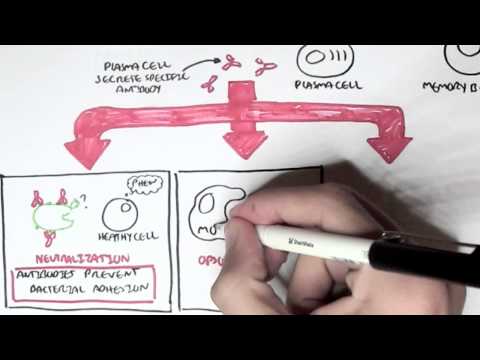
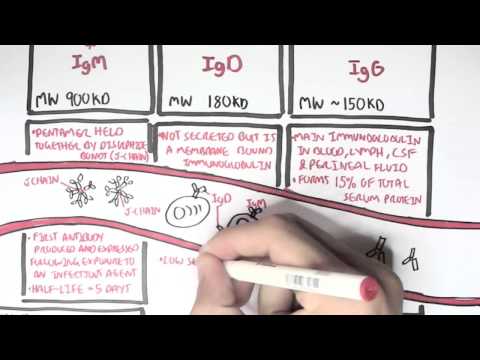
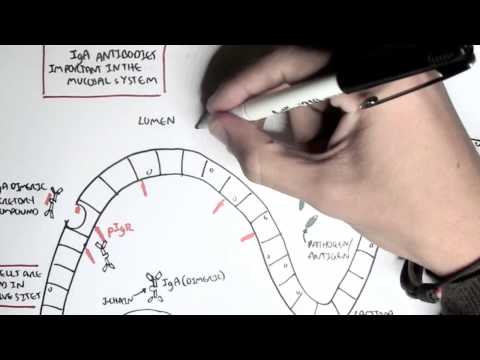
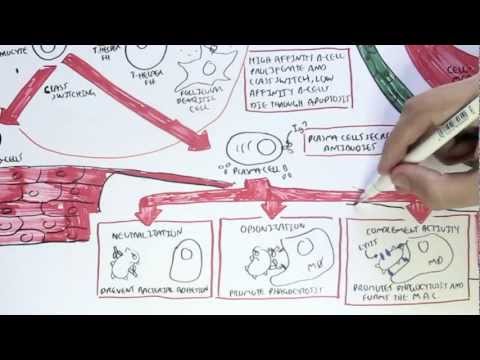
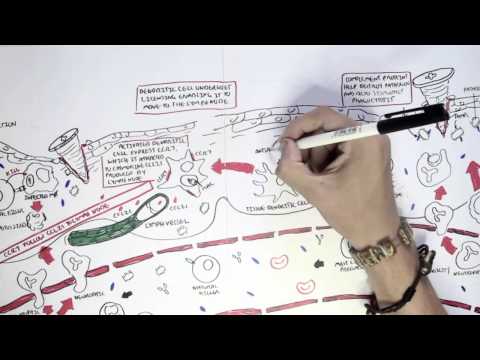
0:00 In this video we're going to talk about antibodies. 0:12 Antibodies also known as immunoglobulins are secreted by B cells, plasma cells 0:18 specifically 0:19 in the bloodstream and into the tissues. 0:24 Antibodies are to control and stop pathogens and to assist in an immune 0:32 response. 0:33 Antibodies, or immunoglobulins, are generally Y-shaped. 0:38 What's really important to know is that antibodies here, if we zoom in, contain 0:43 a variable region 0:45 or FAB region and a constant region, or the FC region, as the name suggests, 0:53 constant 0:53 region stays the same and the variable region can be different. 1:00 This antibody here is a single antibody, however, there are also antibodies 1:06 that actually 1:07 for function and for multiple antibodies, such as a pentamer shape, pentamer as 1:14 in five antibodies, 1:16 which is made up of IgM antibodies, and there's also a dimer form, meaning two 1:23 antibodies, 1:25 made up of IgA antibodies. 1:30 And we'll learn about the different types of antibodies, IgM and IgA, later on. 1:36 So going back to the bloodstream, we can have IgA secreting B cells or plasma 1:43 cells, and 1:44 they will essentially secrete IgA in a dimeric form here. 1:49 So this is a dimeric IgA. 1:54 Of course, there are other antibodies that are only a monomer, they're only a 1:58 single antibody. 2:05 So let's zoom again into this monomer and learn a bit more about the shape. 2:11 Let's have a closer look. 2:14 Because antibodies are protein, antibodies have a terminal with a termination 2:20 ending 2:21 in an amine group, and then a C-terminal termination with a carboxyl group at 2:25 the other end. 2:30 And also remember about antibodies, this region here is the variable region, 2:35 which will bind 2:36 onto antigens, which will bind onto molecules of a pathogen. 2:42 Now the variable region is also known as the fab portion of the antibody. 2:49 And then on the bottom bit, you have the constant region. 2:52 And the constant region will determine what isotope the antibody is, isotope 2:57 meaning what 2:58 class the antibody will be in. 3:01 And we'll learn about the different classes, the different isotopes later. 3:06 The constant region is also known as the FC portion of the antibody. 3:12 Try to remember these terminologies. 3:15 So again, we're going to zoom into the same antibody here. 3:19 It'll be exactly the same as the one on the left, but we'll look at different 3:23 components 3:24 of it. 3:25 So the immunoglobulins, which is the antibody, exists as four chains held 3:30 together by disulfide 3:32 bonds. 3:34 So this here, this is the disulfide bonds. 3:42 And because the immunoglobulin, the antibody, exists as four chains, it's made 3:47 up of two 3:48 heavy chains and two light chains. 3:51 The two heavy chains here has a mass of about 53 kilodaltons each. 3:58 And the two light chains here, they have a mass of about 22 kilodaltons each. 4:07 So as you can see from the diagram on the antibody, on the right and on the 4:11 left, you 4:12 can basically say that the heavy chain is the same as the constant region, 4:18 because the 4:19 bottom part is the same. 4:21 So the heavy chain can also determine the isotope of the immunoglobulin, the 4:30 class of 4:30 the immunoglobulin. 4:32 And remember, when I mean immunoglobulin, I basically mean antibody. 4:37 And now you might think there are million of classes, but there are actually 4:42 five immunoglobulin 4:43 classes. 4:44 These are IgM, IgD, IgG, IgE, and IgA, and they have distinct differences, 4:53 obviously. 4:55 They can also be designated a Greek symbol based on what class they are, which 5:01 is mu 5:02 for IgM, Delta for IgD, Gamma for IgG, Epsilon for IgE, and Alpha for IgA. 5:15 And again, because I mentioned earlier, the heavy chain is within the constant 5:19 region. 5:19 We can safely say that the heavy chain also determines what isotope or what 5:23 class the 5:24 immunoglobulin will be in. 5:27 So that was for the heavy chain and the constant region. 5:31 What about the light chain? 5:33 Well the light chains of the antibody can either be Kappa or Lambda, because 5:38 these are 5:39 the only genes involved in basically making the light chain. 5:45 So light chains, Kappa, and Lambda. 5:48 So just a quick taste test, sorry. 5:50 If this antibody were Kappa Gamma, what is it, like what class of antibody is 5:57 it? 5:57 Well Kappa will imply the light chain is Kappa, and the constant region where 6:02 heavy chain 6:03 is IgG, because IgG, if you remember, is designated the Greek symbol Gamma. 6:09 Similarly, if this antibody were Lambda Gamma, it is the Lambda that is a light 6:16 chain with 6:17 the constant region, the heavy chain being IgG. 6:21 Okay, to make this even just a bit more confusing, there are subclasses that 6:28 can exist within 6:30 certain isotopes. 6:31 For example, the isotope IgG has four subclasses, IgG1, IgG2, IgG3, and IgG4, 6:41 and the isotope 6:43 IgA has IgA1 and IgA2. 6:48 Not that you have to memorize this, but it's just interesting to note. 6:52 Now that we know a bit about antibodies, a bit about immunoglobulins, let's 6:57 look at 6:58 these different isotopes in a lot more detail.