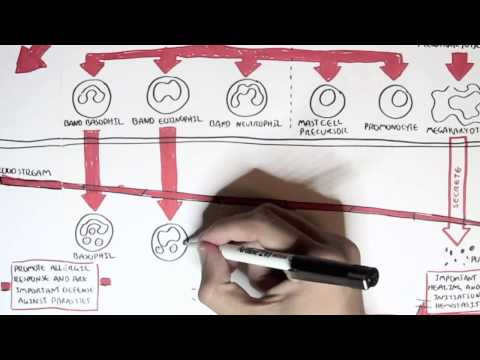
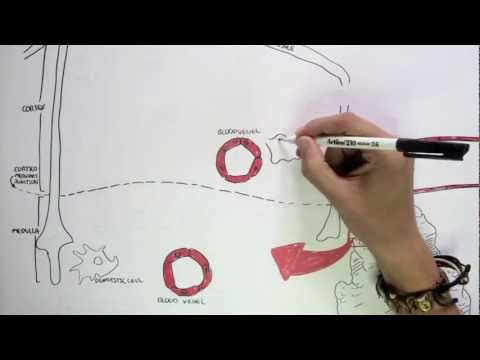
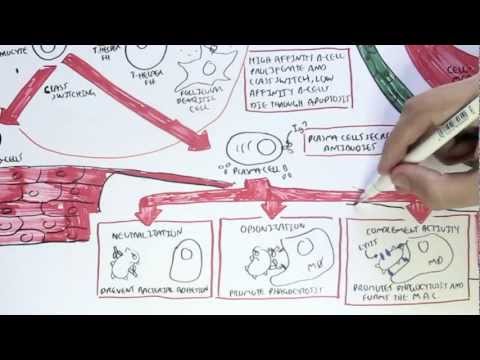
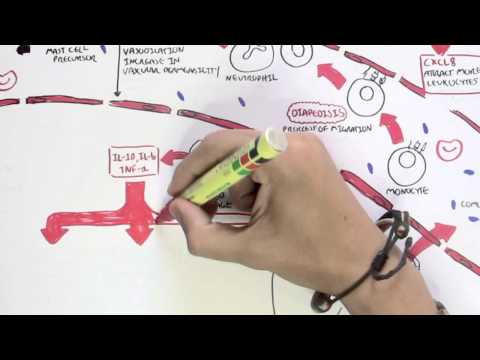
0:00 Armando Hasirunga, Biology and Medicine videos, please make sure to subscribe, 0:05 join the forming 0:06 group for the latest videos, please visit Facebook, Armando Surya, please like, 0:09 and here 0:09 you can also ask questions, answer questions, and post some interesting things, 0:14 including 0:15 artworks, and you can also change the quality settings, the highest one for 0:19 better graphics. 0:20 In the previous video, the part one we talked about the immune cells, and how 0:25 they arise 0:26 from the bone marrow, specifically from the cells in the bone marrow known as 0:30 the pluripotent 0:30 stem cells, and these pluripotent stem cells, they divide into different and 0:37 give rise to 0:38 different types of cells, different types of leukocytes, and then these leuk 0:43 ocytes, 0:44 they can be immature precursors, leukocytes, which when they leave the bone 0:49 marrow, they 0:50 will migrate to different destinations, different areas, different tissues, 0:55 such as a T cell 0:56 precursor will go to the thymus for maturation, the immature B cell will 1:01 migrate to the lymph 1:02 nodes to become activated later on, and also we have the granulocytes, such as 1:08 the basophils 1:09 and synophils, which will circulate around the bloodstream, and may migrate to 1:14 specific 1:15 tissues on different circumstances. Now, in this video, what we will look at is 1:20 we will 1:20 look at some other organs which are important in the immune system, and also 1:25 which are part 1:26 of the lymphatic system, such as the liver, which produces complement proteins 1:31 and other 1:32 substances which are important for the inflammatory process, and then we'll 1:37 look at a typical 1:38 tissue, such as a tissue beneath our skin, for example, and how some of these 1:42 cells will 1:43 migrate into this tissue, specifically the innate immune cells, because they're 1:48 the first line 1:51 of defense in the immune system you can say, and we'll see how they migrate 1:56 into the tissues, 1:57 and remember that this is not exactly what happens in our body, this is just an 2:02 overall 2:03 picture for you, hopefully to get a better understanding of how these immune 2:09 cells and 2:10 the immune system works together. Okay, now let's go back to the big immunology 2:17 map, and we learned, and we saw how the pluripotent stem cells gave rise to all 2:22 these different 2:22 cells, and now they're in the bloodstream. Some are immature, some are precurs 2:27 ors, and 2:27 some will just circulate, some of them, such as the granulocytes. We will 2:31 actually mainly 2:31 concentrate on this cell here, the lymphoid precursors cell, and follow it into 2:38 the thymus. 2:40 That's our main goal, but we will also learn about only associated organs, 2:44 which will pass. 2:47 So the bloodstream continues on bringing these cells to different areas. We see 2:52 the liver. 2:53 The liver is an important organ in the immune system. It secretes many 2:57 substances. A very 2:58 important substance it secretes in an inactive form is the complement proteins. 3:04 The complement 3:05 proteins, which we'll soon learn in the next video or whatnot, are important in 3:09 the innate 3:10 immune system to prevent invasion and to promote destruction of the pathogen. 3:16 Okay, they're 3:17 so circulating around, we have all those different leukocytes. Let's look at a 3:21 monocyte, which 3:22 is circulating around. Now, when it enters a tissue, it binds to receptors on 3:27 the surface 3:28 of epithelial cells, where it will successfully migrate, and when it migrates 3:32 into a tissue, 3:33 it will become a macrophage. I designated with an M with an O and a dash. That 3:38 's an easy 3:38 abbreviation for a macrophage. And the process of migration for all cells, 3:43 including the 3:43 monocyte, is a process known as diapadeces. So it's the process of migration. 3:50 And to learn 3:50 more about diapadeces, I have a video, and I'll provide a link here. So you can 3:54 click 3:54 on it if you want to learn more about diapadeces. The mast cell precursor will 3:59 also enter the 3:59 tissues in the process of diapadeces. The mast cell precursor, which originates 4:03 for the 4:04 bone marrow, when it migrates into a tissue, it will become a mast cell. And 4:09 mast cells typically 4:11 are situated within tissues, such as underneath, the tissues underneath our 4:15 skin, and they 4:16 will stay there as an innate immune cell. So in the tissues, we can find 4:23 different cells. 4:24 We can find tissue macrophages, which migrated. We can also find immature dend 4:30 ritic cells, 4:31 which migrated. And they're still immature because they have not been activated 4:36 , right? 4:37 They are not activated because there is no invasion from a pathogen. Now 4:41 continuing on, 4:42 if we follow the blood vessel and the tissues above it, we can see many other 4:47 types of things. 4:48 We see erythrocytes and carbonate proteins, circulating the bloodstream and all 4:53 other types 4:54 of leukocytes, such as this natural kill cell. And in the tissue above, we can 4:59 see tissue 5:00 dendritic cells and tissue macrophage, which are not activated yet, but are 5:04 situated there 5:05 as a defense mechanism, right? And also we have this green-looking thing. This 5:09 is the 5:09 lymphatic vessel, the lymph vessel, which is part of the lymphatic system. The 5:16 lymph 5:16 vessel has a critical role in the immune system in that it actually transports 5:22 activated 5:23 T-cells and B-cells around the body. But in an immature B-cell form, this 5:29 immature B-cell, 5:31 for example, it will circulate in the blood vessel and will go to the lymph 5:36 node first 5:36 for activation. Similarly, the lymphoid precursor will float through the blood 5:42 vessel and will 5:42 go into the thymus to become different types of leukocytes, particularly T- 5:48 cells. And 5:49 then circulating around the bloodstream, we also have basophils, neutrophils, 5:53 and icinophils, 5:54 which are the granulocytes, and they will just circulate around. So continuing 6:00 on these 6:01 red blood cells, the inactive complement proteins, and the different types of 6:06 leukocytes will 6:07 keep circulating around the bloodstream. And some leukocytes will migrate to 6:13 specific destinations. 6:16 Such as above here, we have a lymph node. This is a lymph node. And here is a 6:20 bloodstream. 6:21 And the immature B-cell will migrate into the lymph node through the lymph node 6:29 artery. 6:30 And I did mention that the immature B-cell will become activated once it migr 6:34 ates to 6:35 the lymph node. This is true, except it has to wait for a signal to become 6:40 activated within 6:41 the lymph node. So for now, it's still an immature B-cell in the lymph node. 6:46 And we'll 6:46 get back to it later on. But for now, let's continue on with the bloodstream 6:50 and proceed 6:51 to the thymus. And this is a thymus. And the cells that will migrate to the th 6:58 ymus are 6:59 cells such as monocytes, which will become a thymus macrophage. And also, most 7:04 importantly, 7:05 the lymphoid precursor cell will migrate into the thymus, as well as the 7:09 immature dendritic 7:10 cell. And cells entering the thymus through the bloodstream will enter the thym 7:16 us with 7:17 thymic artery. And remember, the granulocytes are still circling the 7:23 bloodstream, such as 7:24 the neutrophil and acetophil. And so we finished there. And that concludes this 7:29 video on the 7:31 overall immune system sort of thing. And in the next video, we'll look at the 7:35 lymphoid 7:35 precursor cell and how it matures to become two types of T-cell, CD4 and CD8.