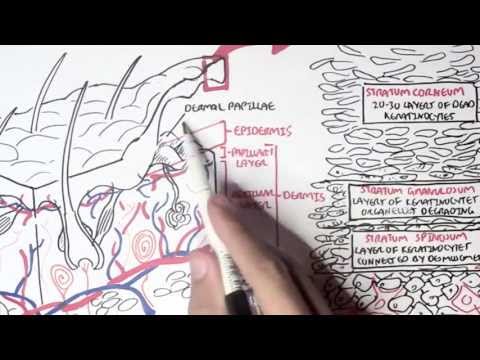
0:00 Hello, in this video, we're going to talk and focus on skin anatomy and 0:10 physiology. 0:12 The skin is made up of two main layers, the epidermis on the top and the dermis 0:18 below 0:18 it. 0:19 Below the dermis you have a subcutaneous tissue, and this layer is called a hyp 0:24 odermis. 0:24 It also makes up what's known as a superficial fascia. 0:29 Below the superficial fascia you have the deep fascia, which is like connective 0:34 tissue 0:34 that surrounds organs such as muscle drawn here. 0:42 So you have two skin layers, the epidermis and the dermis. 0:48 The skin itself contains many accessory things, skin appendages such as the 0:53 hair follicle, 0:54 sebaceous gland, sweat glands here, as well as erectile pellia muscle. 1:02 The hair follicle and the surrounding stuff make up an important part called 1:06 the pylosubaceous 1:07 unit, which we will talk about later. 1:10 You have sensory nerve fibers that come up and go all the way up to the base of 1:16 the epidermis, 1:17 and you have different types of sensory nerve fibers. 1:21 Then you have the archery and the vein of the skin, which actually originates 1:25 in the 1:26 dermis and the subcutaneous tissue area. 1:29 And they will project capillaries that will go all the way up to the base of 1:36 the epidermis. 1:38 Speaking of the epidermis, the epidermis can then also be further divided into 1:42 other layers. 1:44 So if we zoom into the epidermis, the basement membrane here separates the ep 1:49 idermis to the 1:50 dermis down below. 1:52 On top of the basement membrane, you have cuboidal epithelial cells, which make 1:57 up the 1:57 layer called the stratum bazale. 2:00 These cells essentially will divide, and as they divide they will migrate up, 2:05 but as they 2:05 migrate up they will lose their blood supply and flatten. 2:09 You also find other cells in this layer, such as merkel cells, which play an 2:13 important 2:13 role in sensation. 2:16 As the stratum bazale divides, it will form a new layer on top. 2:21 This new layer is called the stratum spinosum. 2:25 Within the stratum spinosum, you also find other types of cells, such as melan 2:30 ocytes. 2:31 Now melanocytes are the cells which produce melanin, and melanin is essentially 2:36 the pig 2:36 mentation we have. 2:40 You also find other cells such as langehan cells, which are a type of dendritic 2:44 cell. 2:44 These are antigen-presenting cells and play an important role in the immune 2:50 system. 2:50 As the stratum spinosum moves up, it forms another layer called the stratum 2:56 granulosum. 2:56 In this layer, they essentially die off even further, and they form granules 3:00 within the 3:01 cells. 3:03 Above the stratum granulosum is a layer called the stratum lucidum, which is 3:07 only found on 3:08 the thick parts of your skin, such as the palm and soles of your foot. 3:13 The very top layer of the epidermis is called the stratum corneum, and this is 3:19 also possibly 3:20 the thickest layer of the epidermis. 3:24 Above the stratum corneum, and on top of the epidermis, you find bacteria that 3:27 live 3:28 normally on top. 3:30 These are your commensal bacteria, and we will talk about that in another video 3:38 . 3:38 Because we talked about the epidermis, it's good to also talk about the dermis. 3:42 The dermis is essentially connective tissue, and so, if we look at it, it's 3:47 made up of 3:48 many cells called fibroblasts, which produce and secrete extracellular matrix. 3:54 An example is collagen. 4:02 Muscles are also found here, and muscles play an important role in allergy, 4:05 hypersensitivity, 4:07 and inflammation. 4:09 We also find sensory nerve fibers around this area as we talked about, and we 4:12 have many 4:13 different types. 4:14 Remember, the skin artery and vein basically originates in the dermis, as well 4:19 as a hypodermis, 4:21 and will project capillaries all the way up to the base of the epidermis. 4:26 And thus, the stratum basale will be able to receive blood supply and will 4:31 divide, but 4:31 as the cells divide and move up, it will lose this blood supply, and so will 4:35 die off. 4:39 Let's go back to the pyrosubaceous unit, which is essentially a hair follicle, 4:43 and the other 4:44 accessory appendages around it. 4:47 So let's zoom into this area. 4:50 The pyrosubaceous unit is made up of several things. 4:53 The first, and most important one, would be the hair follicle. 4:59 And then you have a muscle essentially connecting at its base. 5:02 This is the erectile pillow muscle, and this, when it contracts, it will shoot 5:07 the hair 5:07 up, and this is what you get when you get goosebumps or when you're in cold 5:10 weather, for example. 5:13 You have a gland called the sebaceous gland which produces sebum, and this 5:17 connects with 5:17 the hair follicle. 5:19 The sebaceous gland produces sebum, which essentially lubricates the hair. 5:24 You also have the hair root here, which has a blood supply. 5:29 Interestingly, there's actually a sweat gland which connects with the hair foll 5:33 icle, and 5:33 this is your apple-crying sweat gland. 5:36 Your apple-crying sweat gland are found only in areas really where there is a 5:41 lot of hair, 5:41 such as your axilla under your armpits, as well as your genitalia. 5:45 And these apple-crying sweat glands are hormone-driven. 5:52 The sweat glands, the sebaceous gland, are essentially skin appendages, and you 5:56 have 5:56 other skin appendages. 5:58 We talked about the apple-crying sweat gland, but you also have another sweat 6:01 gland called 6:02 the e-crying sweat gland. 6:03 These are the sweat glands that are found on your forearms and your legs, just 6:10 normally. 6:11 The sweat glands play an important role in thermal regulation, which brings us 6:14 to the 6:14 next topic of this video, which is physiology of the skin. 6:20 Now, the skin has many, many functions. 6:24 One of the most obvious functions is that it acts as a barrier. 6:28 It acts as a barrier, for example, because you have microorganisms living 6:31 normally on 6:32 top of your skin. 6:33 The skin is able to produce antimicrobials such as defenseins, for example. 6:38 Also, you have the sun, which essentially projects UV light, which can be 6:42 damaging. 6:43 Your skin helps protect against this, as well. 6:46 And finally, most obviously, is trauma. 6:48 When you have trauma, your skin essentially protects it from injuring other 6:53 vital organs. 6:54 The skin also, in this way, has an amazing ability to heal itself, so wound 6:58 healing is 6:59 another function. 7:02 The third function of this skin can be vitamin D synthesis. 7:06 On your, in your epidermis, you have a chemical called 7-dehydrocholesterol. 7:12 When UV light reacts with this, it actually, the 7-dehydrocholesterol undergoes 7:17 a chemical 7:18 reaction and becomes cholicaliferol, or vitamin D3. 7:24 This chemical will then go on to the liver and then to the kidneys to become 7:28 the active 7:29 form of vitamin D. 7:32 Which has an important role in calcium regulation in the body. 7:36 The fourth function of this skin is sensation. 7:38 As we've discussed, the skin has many different types of sensory nerve fibers. 7:43 For example, sensation for pressure, light and deep pressure, and also 7:47 sensation as in 7:48 pain and temperature. 7:57 Another function of the skin is thermal regulation, or temperature regulation. 8:03 This is done by two main things found in the skin. 8:06 The first are the sweat glands, and the second are the blood vessels within the 8:13 skin. 8:13 Let's just say, let's give a scenario, you are in the Sahara Desert and it's 8:17 very, very 8:17 hot. 8:19 This will cause your body temperature to increase. 8:22 When your body temperature increases, it will do two things. 8:25 One, it will cause basal dilation of the capillaries. 8:28 This will allow heat to radiate out of the skin. 8:30 And two, the increase in body temperature will stimulate the sweat glands to 8:35 release sweat. 8:36 And this obviously will actually cool the skin surface. 8:40 And so two things, cooling effect and also allows heat to radiate out from the 8:44 skin surface. 8:46 And obviously, if you have a decrease in body temperature, you have the 8:49 opposite. 8:50 The final function of the skin, we can say, is secretion or excretion. 8:54 We talked about how the skin is able to produce antimicrobials, which help 8:59 defend against 9:00 microorganisms. 9:01 There is also the sebaceous gland, which produces sebum, which helps lubricate 9:05 the skin and 9:06 also secretes fat. 9:09 Finally, the sweat glands have an important role in electrolyte and water home 9:14 ostasis, 9:14 because it secretes sodium chloride, for example, as well as H2O. 9:21 Thank you for watching. 9:22 The video on the skin anatomy and also physiology, I hope it helped.