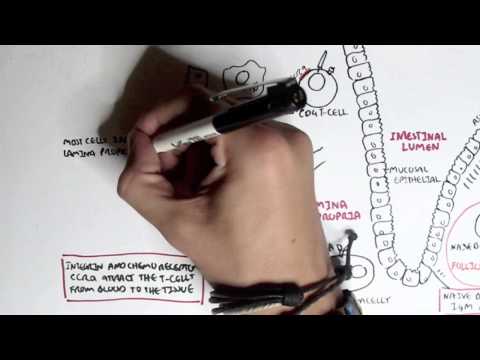
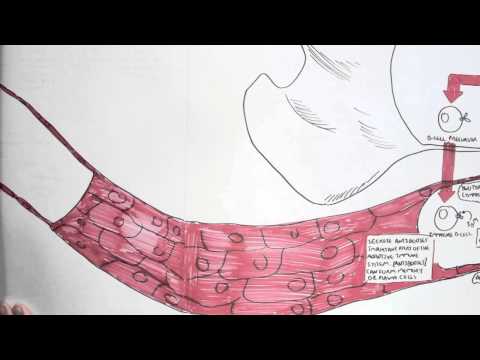
0:00 In this video, we'll look at the mucosal immune system. 0:18 The mucosal epithelial cells are continuously exposed to pathogens. 0:24 These are the cells lining the gut tract, our lung tract, our nasal cavity, for 0:30 example. 0:31 The mucosal surfaces constitute the largest and most important interaction 0:37 between the 0:38 body and the outside environment. 0:43 The mucosal surfaces include the respiratory tract, the gastrointestinal tract, 0:49 and the 0:50 urogenital tract. 0:57 Because these mucosal cells are critical in the protection against pathogens, 1:01 they contain 1:02 approximately 3/4 of all lymphocytes, so that T and B cells, they predominantly 1:09 reside 1:10 beneath the mucosal surfaces or within the mucosal surfaces, lining the 1:14 respiratory 1:15 tract, gastrointestinal tract, and urogenital tract. 1:19 And that is why we have what's called the mucosal immunity as well as the 1:22 systemic 1:23 immunity. 1:24 The mucosal immunity being the gastrointestinal tract and respiratory tract, 1:27 for example, 1:28 the systemic immunity being the spleen and the systemic lymph nodes where the 1:32 blood 1:33 circulates around the body. 1:34 Mucosal surfaces, as mentioned, are continuously exposed to pathogens and so 1:38 are prone to infections, 1:40 such as within the gastric tesal tract, you can have worm infection, and within 1:44 the respiratory 1:45 tract, you can have viruses, which causes flu. 1:53 But some pathogens does not need to be pathogenic. 1:58 Such as within the gastric tesal tract, we have our own pathogens reciting 2:03 within it, 2:04 which help in food digestion, for example. 2:09 So if we take a cross-section or a section within this one in test times, we 2:12 can see 2:12 what we mean by non-pathogenic pathogens. 2:16 So here we have the mucosal epithelial cells lining the intestinal tract and 2:22 the lumen 2:23 where food passes through. 2:26 Within the lumen, on mucosal surfaces, we have what's called commensal micro 2:32 organisms 2:32 or bacteria, which help in food digestion. 2:35 They're also referred to as microbiota, and they live in symbiosis with their 2:42 hosts. 2:43 But they can be pathogenic if they leave the area where they usually live in 2:50 symbiosis 2:51 with their hosts, such as if these commensal microorganisms move to the heart, 2:58 for example, 2:59 then they will create an immune response. 3:02 Therefore, they must usually always stay in the gut. 3:06 Now, I should have also said that the mucosal immune system have also lymph 3:12 nodes, because 3:12 lymph nodes are important in initiating the adaptive immune response. 3:17 These lymph nodes within the gut are known as mesenteric lymph nodes. 3:23 They are also lymph nodes near our lungs. 3:28 The mesenteric lymph nodes are all around the gastrointestinal tract, 3:33 particularly the 3:34 small intestines. 3:36 So they're everywhere, such as here. 3:41 So let's look at the gastrointestinal tract specifically and see how the muc 3:47 osal immune 3:48 tissues are organized. 3:51 There's an abbreviation known as malt, which stands for mucosal-associated 3:58 lymphoid tissue. 4:00 What this means is that it's just the tissue within the gastrointestinal tract 4:07 or the respiratory 4:09 tract where lymphocytes or immune cells reside in and are organized into. 4:17 So let's take a look at where these immune cells are, et cetera. 4:20 Let's look at this. 4:21 So here we have the stomach and the small intestines. 4:23 Let's take a section of the small intestines. 4:24 Here we have the loom of the small intestines, and let's take another section 4:29 within this 4:29 small epithelial layer of the small intestines. 4:34 So this is what we see in a very simplified form. 4:37 We see the villi. 4:38 We see epithelial cells containing villi and forming crypts within the small 4:44 intestines. 4:45 And therefore, here is the lumen where the food passes through and where 4:49 bacteria also 4:50 can pass through as well. 4:52 Now we have two important sites within the mucosal system. 4:58 We have what's called the effector site. 5:01 The effector site are where effector cells reside in. 5:05 Effector cells being activated CD8, activated CD4 as well as plasma cells, 5:09 because remember 5:10 plasma cells are already like the activated B cells. 5:15 We also have lymph vessels all going around this area because lymph vessels are 5:19 also important 5:20 in the fat absorption, remember, as well as bringing the immune cells in and 5:25 out of these 5:26 areas. 5:29 The lymph vessels connects to the mesenteric lymph nodes, remember this. 5:34 And then the other important site is the inductive site, which is also referred 5:38 to as the organized 5:40 lymphoid tissue. 5:42 Typically, the inductive sites do not contain the effector cells, the activated 5:48 lymphocytes, 5:49 for example, they usually contain the naive lymphocytes. 5:52 But they also contain many antigen-presenting cells, such as dendritic cells, 5:56 because the 5:57 inductive site is where they induce typically where the mucosal immune system 6:03 is induced 6:04 from the antigen-presenting cell, which can then activate the naive lymphocytes 6:09 . 6:09 The inductive sites are also connected via lymph vessel to the mesenteric lymph 6:14 nodes. 6:15 Within the mesenteric lymph nodes, we also have the naive lymphocytes, where if 6:21 the dendritic 6:22 cell captures an antigen, it can go into the mesenteric lymph nodes and 6:26 activate the 6:27 naive lymphocytes as well. 6:32 The organized lymphoid tissue within the gut, because we're looking at the gut 6:37 right now, 6:38 to make up what's called gout, which stands for gut-associated lymphoid tissue. 6:46 And this is essentially a branch of malt, the mucosal-associated lymphoid 6:51 tissue. 6:52 So malt is essentially a big abbreviated word denoting all the other, smaller, 6:59 specific 7:00 mucosal surfaces. 7:02 So malt can be gout, which is specifically the gout, can be nalt, which is 7:05 specifically 7:06 the nasal cavity, or can be the balt, which can be specifically the bronchus, 7:10 the lung. 7:11 In this series of video, we will be specifically looking at gout, the gut- 7:15 associated lymphoid 7:16 tissue, and as well as the gut immune system and immune response. 7:21 So this was just an overview of the mucosal immunity. 7:27 You can click on the mucosal immunity videos, which will look in more detail at 7:32 the mucosal 7:33 immunity, particularly of the gut. 7:35 - Thank you.