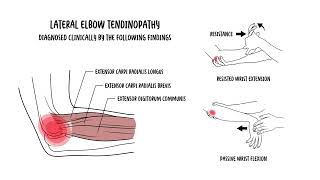
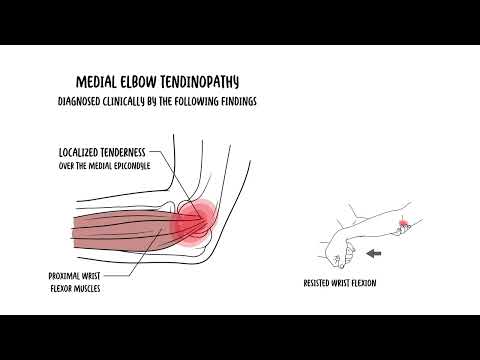
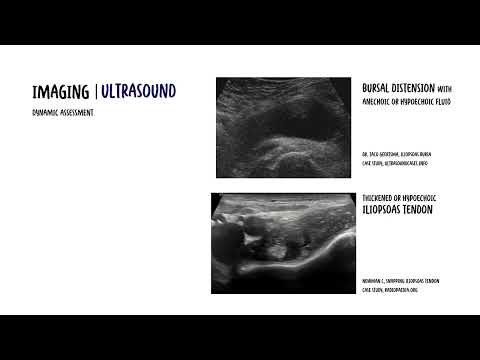
0:00 Hello, in this video, we're going to talk about lateral elbow tenonopathy, 0:14 commonly 0:16 known as tenus elbow. 0:17 It is a chronic non-inflammatory disorder that primarily affects the risk, ext 0:22 ents or 0:22 muscles, especially the extentsicapi radialis brevis, or ECRB. 0:28 This condition was formerly known as lateral epicondylitis. 0:33 Patients typically report a dull pain on the lateral side of the elbow, which 0:37 often worsens 0:37 with repetitive movements such as flexion extension or pronation supination of 0:42 the wrist. 0:44 This condition can cause discomfort during various activities, from sports like 0:48 tennis 0:49 to everyday tasks like turning a doorknob, opening a jar, or typing. 0:59 Let's revise some anatomy. 1:01 Well, the distal humerus has a medial and lateral epicondyl. 1:06 The epicondyls are bony prominences easily palpated on the medial and lateral 1:11 sides of 1:12 the distal humerus, just proximal to the elbow joint. 1:17 The lateral humeral epicondyl serves as the bony common origin of the wrist and 1:23 extrinsic 1:24 hand extensors. 1:26 The medial humeral epicondyl serves as the bony common origin of the wrist and 1:33 extrinsic 1:34 hand flexes. 1:42 Lateral elbow tenonopathy is diagnosed clinically through examination by the 1:47 following findings. 1:49 There is tenonus at the origin of the ECRB, the extensor copy radialis brevis 1:56 on the lateral 1:57 epicondyl, although the pain may also spread to the origins of the extensor dig 2:02 itorum, 2:02 commonus, and the extensor copy radialis longus. 2:07 There is pain with resisted wrist extension with the elbow in full extension or 2:14 60 degrees. 2:16 There is pain with passive terminal wrist flexion with the elbow in full 2:28 extension. 2:30 So what about medial elbow tenonopathy? 2:34 Well medial elbow tenonopathy, also known as golfer's elbow, causes pain on the 2:39 inner 2:39 side of the elbow, comparatively both medial and lateral elbow tenonopathy 2:44 share similarities 2:46 in that they are both overuse injuries affecting the elbow tendons, they are 2:50 associated with 2:51 repetitive motion and manifest as localized pain exacerbated by specific 2:55 movements. 2:56 However, the primary differences lies in the location of the pain and the 3:00 involved muscle 3:01 groups. 3:03 Medial epicondylitis, specifically medial elbow tenonopathy, impacts the inner 3:11 elbow and affects 3:12 the flexor pronation group, while lateral elbow tenonopathy affects the outer 3:18 elbow and involves 3:19 the extensor copy radialis brevis and associated with the extensor muscles. 3:26 So one flexion, one extension. 3:35 Investigations. 3:36 Imaging techniques such as x-rays, ultrasounds, or MRIs are not routinely used, 3:41 but can be 3:41 helpful in showing specific changes like spur formation, tendon, homodionity, 3:47 tendon structure, 3:49 or fluid collection near the lateral epicondyl. 3:52 Remember lateral elbow tenonopathy is a clinical diagnosis. 4:04 Treatment strategies focus on acknowledging the overuse nature of the syndrome 4:07 and managing 4:08 symptoms conservatively at first. 4:12 Recommended non-operative treatments, which include rest, ice application, 4:16 compression 4:17 and the use of topical anti-inflammatory medications such as vultaryngeal, 4:22 additionally wearing 4:24 compression straps or counterforce braces can alleviate symptoms by limiting 4:29 tendon 4:29 strain during activities. 4:31 If conservative measures are insufficient, a combination of lidocaine and cort 4:36 icosteric 4:36 rejections may be considered. 4:38 However, such treatment should be limited to prevent tendon damage. 4:43 For athletes, professional coaching may be necessary to correct biomechanical 4:55 faults. 4:56 Surgical intervention is considered a last resort and is only advised that the 5:00 patient's 5:00 symptoms remain severe despite trying all non-operative options for at least a 5:06 year. 5:06 Surgical treatments typically involve excision of the damaged tendon and 5:09 drilling of the 5:10 subcontral bone at the lateral epicondyl to stimulate healing and repair of the 5:14 extensor 5:15 origin. 5:21 So in summary, lateral elbow tenonopathy known as tennis elbow or previously 5:27 lateral epicondylitis 5:28 is an overuse injury that affects the tendons that originate in the lateral 5:35 epicondyl, specifically 5:37 the extensor copy radial is brevis. 5:40 Treatment is non-surgical mainly, but in severe cases, surgery is performed. 5:46 Thank you. 5:58 for watching. 5:59 Thank you.