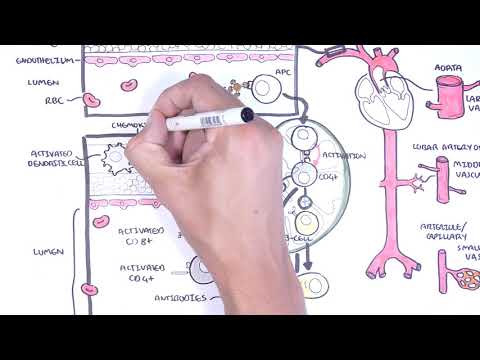
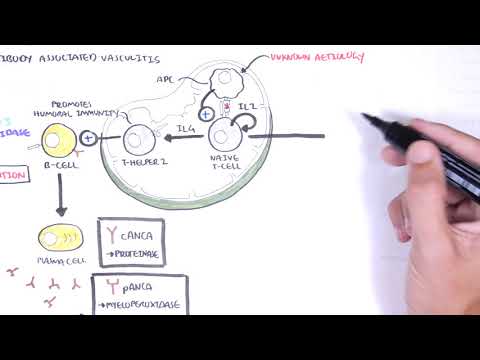
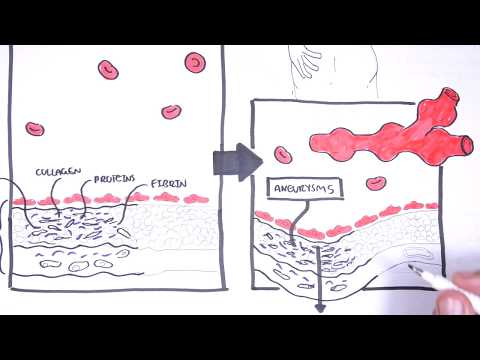
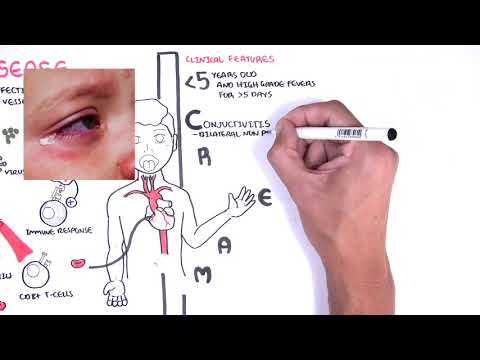
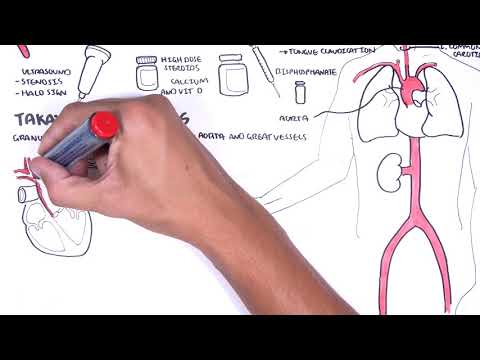
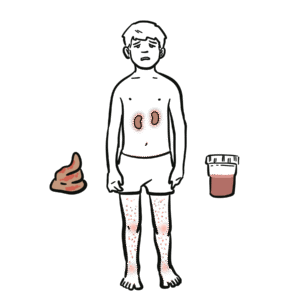
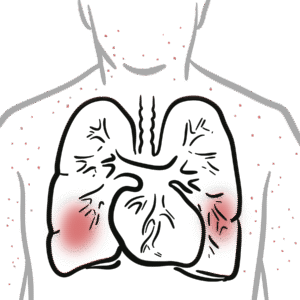
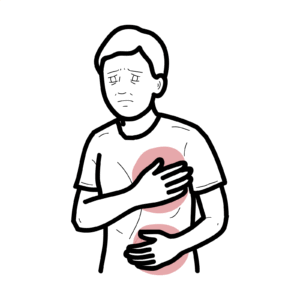
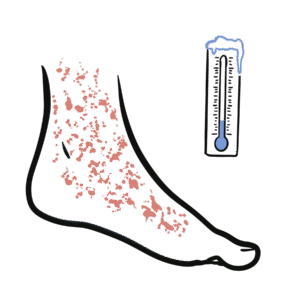
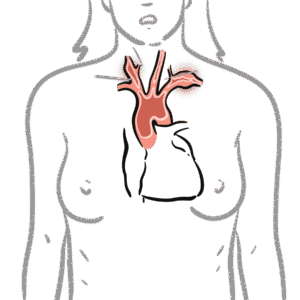
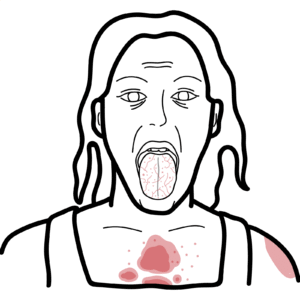
0:00 Vascularitis means inflammation of the blood vessel. It is an inflammatory 0:09 condition whereby 0:10 the immune cells attack certain types of blood vessels, typically arteries. 0:15 This can lead to a 0:15 number of complications, including blockage of the blood vessel, aneurysmal 0:19 formation, 0:20 which is dilatation of the blood vessel, and then also clot formation or thromb 0:24 osis. 0:26 Vascularitis can be divided broadly into primary vasculitis or secondary vascul 0:30 itis. 0:31 Primary vasculitis essentially is its own disease entity or condition, 0:36 whereas secondary vasculitis is secondary to something else, such as an 0:39 autoimmune disease, 0:41 medication, or infection. Let's focus on some causes of primary vasculitis. 0:48 We can categorize primary vasculitis based on the size and the type of blood 0:54 vessel that is 0:55 affected. Here is a drawing of different sizes of the arteries in red, which 1:02 become smaller 1:03 arterials and then capillaries and then veins in blue at the bottom. Primary 1:08 vasculitis include 1:09 those that affect large arteries. These are called large vasculitis, medium- 1:16 sized arteries, 1:18 your medium vasculitis, and then you have anca associated small vasculitis, 1:24 which 1:24 affects small blood vessels, including arterials, capillaries, and small veins. 1:28 The other type of small vasculitis is immune complex associated small vascul 1:35 itis, 1:36 as well as anti-GBM syndrome, which specifically targets the capillaries. 1:44 Let's take a look at each of these in a bit more detail. Now, the large vascul 1:52 itis, 1:53 typically affect large arteries, such as the aorta and its branches. 1:59 A type of large vasculitis is giant cell arthritis, also known as temporal 2:05 arthritis, 2:06 which typically affect the cranial blood vessels, including the temporal 2:10 arteries, 2:10 which can lead to blindness and also it can cause dual-chlorication in worst- 2:15 case scenario. 2:16 While giant cell arthritis typically affect older people, there is one that 2:22 affects 2:22 younger people, called Takayasu, the other type of large vasculitis. It causes 2:30 inflammation of large 2:31 arteries, typically branches of the aorta, causing absent or reduced peripheral 2:37 pulses, 2:38 such as the radial pulse, and interestingly, there are no antibodies that are 2:44 found in these 2:45 two types of large vasculitis. Then you have the medium vasculitis, and there 2:51 are two types here. 2:53 These are Kawasaki's disease, which affect children. Kawasaki disease is 2:58 characterized 2:59 by fever greater than five days, bilateral conjunctival congestion, lip and 3:04 oral changes, 3:04 such as strawberry tongue, polymer first rash, changes in the peripheral extrem 3:09 ities and 3:09 cervical lymphadenopathy. Coronary artery aneurysm and dilatation are 3:15 complications in Kawasaki 3:16 disease. The other medium vasculitis is polyarchritis in the dosa, which can be 3:22 extremely dangerous. 3:23 It is divided into systemic or only cutaneous affecting the skin. It causes 3:29 inflammation of the 3:30 medium arteries and never capillaries or the veins. It is associated with 3:35 hepatitis B. 3:36 Then you have the small vasculitis, including anca, which stands for anti-neut 3:43 rophilic 3:44 cytoplasmic antibody. It is a rare systemic disease, which comprises of 3:49 microscopic polyangitis, 3:51 MPA, ecinophilic granular mitosis with polyangitis, EGPA, and granular mitosis 3:57 with polyangitis, 3:58 GPA. They have few or no immune deposition and predominantly affect small 4:04 vessels, such as the 4:04 capillaries, venules, and arterials. They are characterized by presence of anca 4:10 antibodies, which 4:11 are MPO or PR3 antibodies. The other type of small vasculitis is immune complex 4:19 vasculitis, where you have immune complex is that deposit in the vessel wall, 4:25 and this includes 4:26 IgA vasculitis, also known as Hinocchonlin perpera, hypo complementemic urticar 4:32 ovascular 4:33 vasculitis, which is basically urticaria, and you also get vasculitis and low 4:38 complements. 4:41 Cryoglobulinemic vasculitis, which is associated with hepatitis C virus, and 4:46 finally anti-GBM, 4:48 which I have drawn separately here because this condition is unique. Firstly, 4:54 there are antibodies 4:55 called anti-GBM, which target glomerular basement membrane proteins, but it can 5:00 also target the lungs. 5:02 Without prompt diagnosis and treatment, the patients with anti-GBM syndrome or 5:08 disease can 5:09 develop lung hemorrhage, kidney failure, and even death. 5:12 There is another type of vasculitis called variable vessel vasculitis under 5:19 primary vasculitis, 5:20 and there are two types of variable vasculitis. These are Biscets disease and C 5:25 ogan syndrome, 5:26 which are variable vasculitis because they target or affect either small 5:31 vessels or medium-sized 5:32 vessels. Biscets disease is an auto-inflammatory condition with a clinical tri 5:36 ad of oral ulcers, 5:38 genital ulcers, and uveitis. Cogan syndrome is a rare auto-inflammatory 5:43 systemic disease, 5:44 which is characterized also by a triad of inflammatory eye disease, vestibular 5:49 auditory dysfunction, 5:50 and vasculitis. Now, finally, the other primary vasculitis that I should 5:56 mention and not as 5:58 exciting as what we just talked about include single organ-specific vasculitis. 6:03 And this includes 6:04 isolated arotitis, which is inflammation of the largest artery in the body of 6:07 the aorta, 6:08 primary central nervous system vasculitis, and cutaneous leucocytoclastic vas 6:18 culitis, 6:19 which is essentially inflammation of the small blood vessels in the skin. And 6:25 this condition 6:27 can be its own entity or associated also with other things, such as infections, 6:34 medications. 6:35 Now, vasculitis can lead to many different complications depending on the blood 6:42 vessel 6:42 affected and also the organ affected. But it's important to know that 6:47 inflammation of the blood 6:48 vessel causes damage to the blood vessel and can lead to thrombosis, which is 6:54 clot formation. 6:55 It can lead to stenosis, narrowing of the blood vessel, and even occlusion, so 7:00 blockage of the 7:01 blood vessel. And finally, when you get inflammation and damage to the blood 7:05 vessel, it can make it 7:06 slightly elastic and so dilate causing what's called an aneurysm. So, we talked 7:14 about briefly 7:15 the different types of primary vasculitis. Let's talk now about secondary vas 7:20 culitis, 7:21 which again is a type of vasculitis that occurs secondary to something else. 7:26 They are grouped 7:27 into two broad categories. First, the vasculitis associated with another 7:30 autoimmune disease. 7:31 This includes lupus, systemic lupus erythmatosis, rheumatoid arthritis, or sar 7:38 coidosis. 7:39 Then you have vasculitis associated with other conditions or even medications. 7:44 And this includes 7:45 hepatitis B and C infections, syphilis. Drug-induced vasculitis is very common, 7:52 including antibiotics. 7:54 There's also drug-induced or associated anchor vasculitis, whereby taking a 7:59 drug can actually cause 8:00 anchor antibodies to be formed, thus leading to a small vessel vasculitis that 8:06 is anchor. 8:07 Finally, there's also cancer-associated vasculitis. 8:12 So, in summary, in this video, we revise the different types of vasculitis. 8:16 Firstly, 8:16 we divided vasculitis into primary or secondary. Then we focused on primary vas 8:21 culitis and further 8:23 categorized it based on the size of the blood vessel affected. Again, typically 8:29 arteries. 8:29 These include large vasculitis, medium vasculitis, and small vasculitis. There 8:36 's also variable 8:36 vasculitis and single organ vasculitis. Thank you for watching. I hope you 8:42 enjoyed this video.