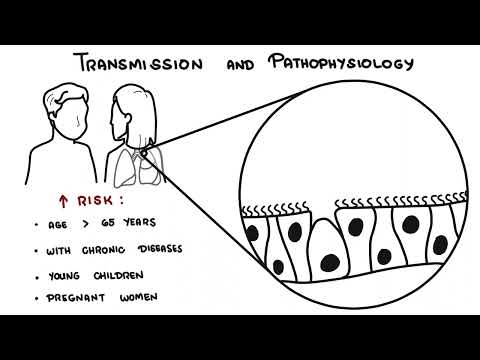
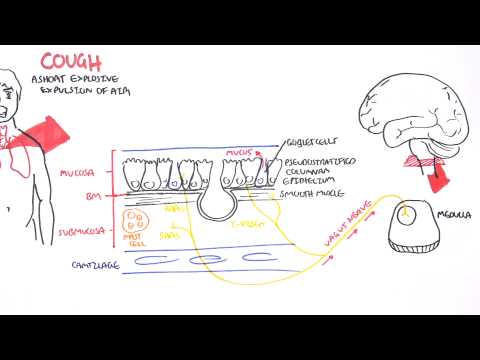
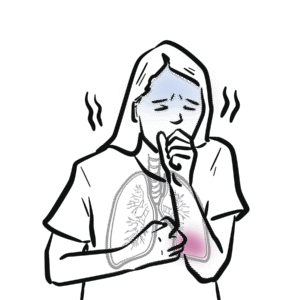
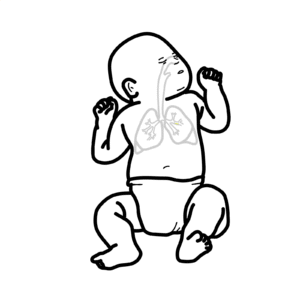
0:00 Pertussis, also known as whooping cough, is a highly contagious acute 0:09 respiratory infection 0:11 caused by the bacterium bordetella pertussis. 0:15 The disease usually transmitted through airborne droplets, and most commonly 0:19 occurs in children. 0:21 The classic clinical symptom of pertussis are coughing fits. 0:25 These inspiratory whoops, with coughing and maybe some vomiting after the cough 0:37 . 0:37 Let's look at the actual organism itself. 0:40 Bordetella pertussis is a gram negative coco-basilis, so they're a bit of a 0:46 circle but also a bit 0:47 of a rectangle, coco-basilis, which really, these guys only have been found in 0:54 humans. 0:55 They are no known animal or other environmental reservoirs. 1:00 It is important to note that other bordetella species can cause respiratory 1:06 illness as well, 1:07 with similar symptoms to pertussis. 1:10 These are bordetella para pertussis, bordetella bronchi septica and bordetella 1:21 whole messy. 1:23 Bordetella pertussis, the bacteria, is transmitted through airborne droplets, 1:29 like when someone 1:30 coughs and sneeze, someone could receive this organism. 1:36 Once bordetella pertussis is inhaled, it travels to the ciliated epithelial 1:42 cells in 1:43 the nasopharynx and the upper respiratory tract. 1:48 Here the bacteria can anchor itself into the epithelial cells, using its vir 1:53 ulent factors, 1:54 its structures, including the filamentous hemagglutinin per tactin and agglutin 2:04 in. 2:04 Once bordetella pertussis attaches, the bacteria multiply and release toxins, 2:11 which is important 2:12 in the pathophysiology of the disease. 2:15 There are many toxins, including pertussis toxin, which disrupts the ciliated 2:21 epithelial 2:21 cell function. 2:23 Pertussis toxin also makes the respiratory tract more sensitive to histamine, a 2:28 chemical 2:28 that causes swelling around the area, causing difficulty breathing, and this is 2:32 where the 2:32 classical whooping sound in a pertussis infection comes from. 2:39 Herkyl cytotoxin paralyzes and kills cilia, these cilia are responsible 2:45 normally for 2:46 clearing debris from the respiratory tract, so mucus and other materials can 2:50 become trapped 2:51 in the airways and cause a cough reflex. 2:55 Adenolate cyclase toxin interferes with phagocytosis, so it evades the human 3:01 immune system. 3:03 Dermal necrotic toxin causes local necrosis cell death. 3:10 Bordetella pertussis remain localized on the respiratory tract, and they 3:15 actually do not 3:16 invade deeper into the tissue, they don't invade into the bloodstream normally. 3:26 The symptoms that arises with bordetella pertussis infection, so first of all, 3:31 bordetella pertussis 3:33 once inhaled, it enters the respiratory tract and enters what's called the 3:38 incubation period, 3:40 which is for about one to three weeks. 3:42 In this period, the person who is infected is asymptomatic and not infectious. 3:50 Following the incubation period, there are three stages of the illness. 3:54 The first phase is the catarol stage, which lasts about one to two weeks. 4:00 In this stage, the infection is highly contagious and presents similarly to an 4:06 upper respiratory 4:08 tract infection or a flu. 4:11 The second phase of the illness is a paroxysmal stage, which lasts up to six 4:17 weeks. 4:18 This is where the whooping cough occurs due to the swollen glottis. 4:24 The whoop occurs during inspiration, which is like a high pitched intake of 4:28 breath that 4:29 sounds like a whoop and is characteristic of pertussis. 4:33 Here is an example. 4:45 Coughing fits may be followed by vomiting, also known as post-tussive emesis. 4:51 The person may be struggling for breath, have sinuses and apneic episodes. 4:57 The last stage is the convalescent stage, which can last up to two weeks or 5:03 longer. 5:04 This is where symptoms start to improve, but coughing attacks may persist. 5:09 However, these stages are often less obvious in adolescents and adults, 5:14 compared to children 5:15 and infants. 5:21 Risk factors for bordetalapertussis include anyone who is really unvaccinated 5:25 regardless 5:26 of age, immunocompromised people. 5:29 Infants are under the age of one, as well as teenagers, adults and the elderly, 5:35 especially 5:35 if they are also in close contact with people who have actually pertussis. 5:46 Complications of pertussis for infants and children include apnea, which is 5:49 where breathing 5:50 stops temporarily. 5:52 Apnea, also known as bordetalapertussis pneumonia, seizures and kephalopathy, 5:59 which is when the 6:01 disease actually alters the brain function. 6:04 Hernias, when you cough so much this increases pressure and a hernia can form, 6:09 weight loss, 6:10 atlectuses and rib fractures or strain chest wall muscles due to severe 6:20 coughing. 6:22 In adults who have pertussis, issues can include urinary incontinence, syncope 6:28 or fainting, 6:29 weight loss as well as rib fractures and the chest wall muscle strain from 6:37 severe coughing. 6:39 There are many differential diagnosis for a child, for example presenting with 6:43 a cough, 6:44 and this includes viral or bacterial respiratory infections, bronchitis or bron 6:50 chiolitis, cystic 6:52 fibrosis which is actually very specific inherited disorder, as well as asthma. 7:03 Now pertussis is a clinical diagnosis. 7:07 It's important to suspect it in any infant or child with a persistent cough, 7:12 regardless 7:12 of their vaccination status. 7:15 It's important to suspect pertussis due to the high risk of complications and 7:19 it should 7:19 trigger immediate treatment even before laboratory diagnosis confirms anything. 7:26 These laboratory investigations include a nasopharyngeal swab for bacterial 7:31 growth and 7:32 culture, which is considered gold standard. 7:38 The swab or sputum sample for example can be sent for PCR to identify pertussis 7:46 DNA. 7:47 Fluorescent antibody technique can also be used to recognize pertussis antigens 7:55 . 7:55 This serology in the blood is good to confirm the presence of IgG to pertussis 8:01 toxin, but 8:02 this is usually late stage in the condition. 8:07 Pertussis is a notifiable disease in many countries, which means doctors, 8:11 hospitals 8:12 and laboratories are required by law to inform the local public health unit 8:17 about each new 8:17 case that is diagnosed. 8:24 The treatment for pertussis is antibiotics, and it's recommended for all 8:28 patients of any 8:28 age if they're diagnosed within three weeks of starting symptoms. 8:34 Antibiotics are also recommended for those in close contact with people who are 8:38 living 8:38 with infected individuals because of the highly contagious nature of the 8:44 condition. 8:44 The antibiotics used include macrolides such as azithromycin or clarithromycin 8:49 for a 8:49 few days, or a combination of two antibiotics such as trimetoprimin and sulfam 8:59 ethoxazole. 9:01 Given that pertussis is a very contagious condition, it is reportable. 9:07 And infectious control, infection control may differ between each country, but 9:10 in general, 9:12 patients are advised to avoid contact with others, especially other infants, 9:16 young children 9:17 and pregnant women. 9:20 And this is so until the person who's infected receives adequate treatment with 9:25 antibiotics, 9:26 or coughing has occurred for over three weeks, then usually they're not 9:31 contagious anymore. 9:34 In terms of prevention, routine immunization with a vaccine called DTAP or diph 9:42 theria tetanus 9:43 and pertussis is important at scheduled ages. 9:48 Otherwise, pregnant women and people in contact with newborns should also be 9:53 vaccinated, if 9:54 not done so. 10:00 So in summary, pertussis is caused by a bacteria called bordetella pertussis, 10:07 and it's a highly 10:07 contagious acute respiratory infection, usually affecting children. 10:14 It's characterized by a whooping cough, and it can go on for weeks, and is 10:19 associated 10:19 with some complications, and so immediate treatment is important, and to avoid 10:24 further 10:25 spread of the bacteria. 10:37 You